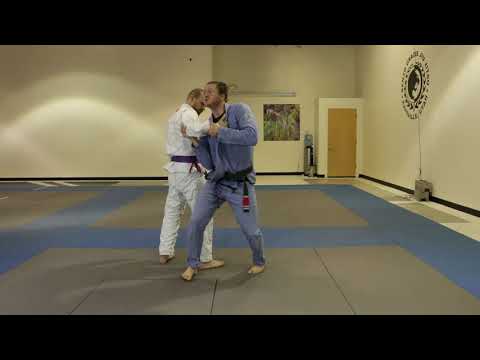
Blue Belt Mastery #13 Single Hand Collar Grab Defense (Bent Arm)
0
One Hand Collar Choke·Grayson Greener BJJ·Added by Admin
Translation: One-Hand Strangle
The one-hand collar choke from back control uses a single deep collar grip with wrist rotation to press the knuckles or forearm blade into the carotid artery while the collar fabric compresses the opposite side. [1],[2] The attacker inserts one hand deep into the collar, rotates the wrist so the bony edge of the forearm contacts the neck, and uses body weight or the free arm to prevent escape. [1],[3] This technique is effective as a surprise attack or when the opponent successfully defends against the second hand establishing a cross-collar grip. [1],[4]
Single-hand collar strangles have roots in judo's katate-jime (片手絞め) tradition, emphasizing efficiency with minimal gripping. [2],[3] In early Brazilian Jiu-Jitsu, practitioners like Rickson Gracie favored deep single-collar penetration from back mount as a high-percentage finishing method. [1] The technique remains relevant in modern competition when two-hand collar defenses are strong. [1],[4],[5]
The one-hand collar choke uses a single deep collar grip with the other arm framing to create a strangle. [1]
One-hand collar chokes were developed in BJJ as variations of the standard two-hand collar choke. [1]
One-hand collar chokes are used in gi BJJ competition from guard and mount positions. [1]
No images yet for this technique.
Sign in to suggest an image.
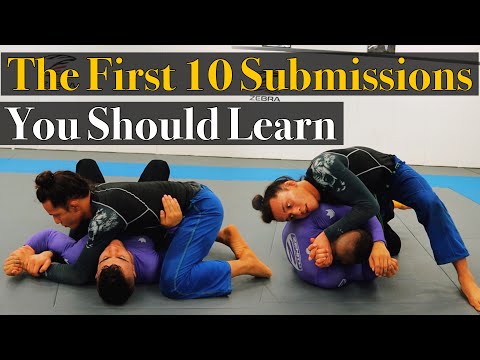
In today’s video I’ll be giving you the 10 first bjj submissions that every white belt should learn. These are the submi…
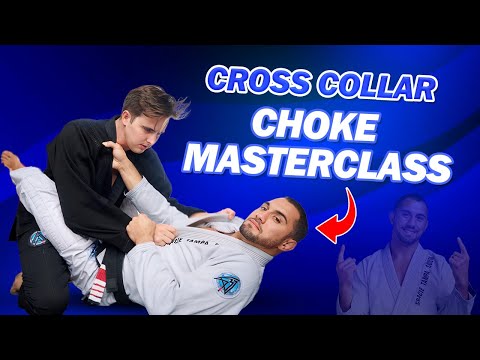
Join My Online Academy to Improve Your Jiu Jitsu FAST!!! http://academy.mattarroyo.com/home Welcome to your ultimate g…
The one-hand collar choke represents a fundamental submission technique in Brazilian jiu-jitsu, though the instructors' transcripts address different aspects of collar-based choking rather than a unified technique discussion. Matt Arroyo Jiu Jitsu provides the most detailed technical breakdown of the cross-collar choke, emphasizing that effective execution depends on wrist blade placement rather than gi pressure alone. Arroyo stresses obtaining a deep initial grip with the first hand across the opponent's body, then turning both wrist blades to align with the carotid arteries before applying pressure by driving the elbows downward while pulling the opponent's head into the chest. He identifies common mistakes including shallow grips and lifting elbows upward rather than driving them down. Arroyo demonstrates this technique from guard and mount positions, noting that proper blade orientation and depth separate beginner from advanced execution. Grayson Greener BJJ addresses a related but distinct self-defense scenario—collar grab defense against a bent-arm pull—which requires establishing a stable base and using hip pressure to open the opponent's arm before stepping through to a dominant position. While Greener's focus differs from choking mechanics, his emphasis on hip integration and keeping the head through last aligns with core jiu-jitsu movement principles. Jedi Does Jiujitsu mentions the rear naked choke and arm triangle as fundamental submissions suitable for beginners but provides minimal detail about collar-specific mechanics. The instructors agree on pressure application through body mechanics rather than arm strength alone.
Synthesized from 3 instructors
No instructional courses yet for this technique.
Sign in to suggest a course.
Risk of injury to the person this technique is applied to
Single-grip collar choke relies on precise hand placement deep in the collar
Skill level needed to execute this technique reliably
Whether this technique is allowed under major competition rule sets
Kodokan Judo — Official Shime-waza #7
Japanese terminology sourced from Kodokan Judo — Official Shime-waza #7
Official Kodokan ground technique classification system
Standard Japanese martial arts terminology (kanji/hiragana)
Established Japanese martial arts naming convention — native Japanese term (和語/漢語)
Japanese terminology sourced from Kodokan Judo — Official Shime-waza #7
grip or squeeze strength, positional control
strong upper body for sustained compression
forearms, biceps, pectorals, core stabilisers
According to Matt Arroyo Jiu Jitsu, the grip isn't deep enough—beginners often place their hand too high on the neck instead of getting it deep with their thumb positioned behind the opponent's ear. Additionally, many mistakenly try to choke with the gi itself rather than using it as a handle to apply pressure to the neck.
Matt Arroyo Jiu Jitsu emphasizes pulling the opponent's head into your chest by driving your elbows straight down to your hip bones rather than pulling them up, which generates maximum power from your whole body rather than just your arms.
Once you have a deep grip established, the only effective defense for your opponent is to expose one of their arms by coming over or under, which creates opportunities for you to transition to submissions like the S-mount or arm bar.
The one-hand collar choke from back control uses a single deep collar grip with wrist rotation to press the knuckles or forearm blade into the carotid artery while the collar fabric compresses the opposite side. The attacker inserts one hand deep into the collar, rotates the wrist so the bony edge of the forearm contacts the neck, and uses body weight or the free arm to prevent escape.
Single-hand collar strangles have roots in judo's katate-jime (片手絞め) tradition, emphasizing efficiency with minimal gripping. In early Brazilian Jiu-Jitsu, practitioners like Rickson Gracie favored deep single-collar penetration from back mount as a high-percentage finishing method.
IBJJF: legal — Legal at all belt levels, gi and no-gi — chokes are the safest submission cat…; IJF: legal — Legal (shime-waza) — strangulation techniques are one of three permitted subm…; ADCC: restricted — N/A (no-gi competition only — technique requires gi); Unified MMA: restricted — N/A (technique requires gi — not applicable in MMA); FIAS Sport Sambo: banned — All chokes prohibited in Sport Sambo; FIAS Combat Sambo: legal — Legal
Danger rating 8/10. Single-grip collar choke relies on precise hand placement deep in the collar
The standard setup chain: Achieve Controlling Position → Isolate the Neck → Set the Grip → Apply Pressure.
Standard counters include: Tuck Chin — protect the neck by lowering the chin to prevent the choke from sinking / Two-on-One Grip Fight — use both hands to strip the choking grip before it locks / Turn Into — rotate toward the choking arm to relieve carotid pressure / Posture Up — straighten the spine and create distance to break the choking angle.
Common variants: Standard grip variation (primary hand configuration for maximum choking pressure); Gi variation (uses the lapel or collar as an anchor for additional fric…); No-gi variation (adapted grip and positioning for submission grappling wit…); Transition finish (applied during a positional change to catch the opponent …).
One-hand collar chokes are used in gi BJJ competition from guard and mount positions.
Top errors to watch for: Insufficient grip depth — if the hand doesn't cross the centre line of the neck, the choke becomes a push rather than… / Relying on squeezing rather than structure — the choke works through bone-on-artery pressure and collar tension, not … / Not using the free hand — the second hand must contribute by controlling the head, blocking escape, or bracing / Attempting from an unstable position — without positional control (mount, back), the opponent simply turns away.
The One Hand Collar Choke is also known as Katate-jime, Single-Hand Lapel Choke.