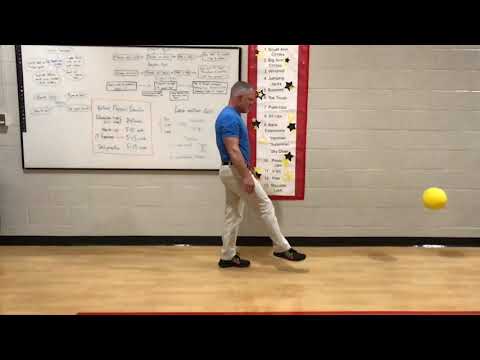
Basic punt
0
Punt Kick to Face·Ken Meinhardt
Elementary physical education basic punt. A lead up to getting the mechanics of the punt then the punt.
Translation: Punt kick to face — a soccer-style kicking motion directed at a grounded or downed opponent's head, using the instep in a swinging arc identical to kicking a football
The Punt Kick to Face is a soccer-style kicking motion directed at a grounded opponent's head, delivering the instep in a wide swinging arc identical to a football punt — one of the most devastating and controversial techniques in MMA's history. [1] The technique is executed while the opponent is on the ground (on their back, on all fours, or sitting up) and the attacker is standing: the attacker takes a running or stepping approach and swings the foot in a full arc into the opponent's face, using the same mechanics a footballer uses to punt a ball. [1] The Punt Kick was a legal and commonly used technique in early MMA (PRIDE Fighting Championships in Japan, Vale Tudo in Brazil, early UFC events before the Unified Rules) and remains legal in some current rulesets (ONE Championship allows soccer kicks to grounded opponents). [1],[2] Under the Unified Rules of MMA (used by the UFC, Bellator, and most American MMA organizations), the Punt Kick is ILLEGAL when the opponent has anything other than the soles of their feet on the ground — a fighter cannot kick a 'grounded' opponent's head. [2] BJ Penn documented the technique in The Book of Knowledge (2007) for its MMA application, noting that understanding the Punt Kick is important even where it is illegal, because fighters competing under rulesets that permit it (PRIDE, ONE Championship) must know both how to deliver and how to defend it. [1] The Punt Kick is one of the most fight-ending techniques in combat sports when permitted: PRIDE FC saw numerous fights ended by devastating soccer kicks to downed opponents, most notably Wanderlei Silva's brutal finishes that became synonymous with the PRIDE era. [2],[3] The technique's prohibition under the Unified Rules was one of the most significant regulatory decisions in MMA history, fundamentally changing how fighters approach ground-and-pound and significantly reducing the danger of being knocked down. [2]
The Punt Kick (soccer kick to the head of a downed opponent) was a standard weapon in the earliest era of professional MMA: Brazilian Vale Tudo competitions featured the technique regularly, and when the PRIDE Fighting Championships were established in Japan in 1997, soccer kicks were legal and commonly used. [2],[3] PRIDE FC became the spiritual home of the soccer kick to downed opponents: fighters like Wanderlei Silva, Mirko 'Cro Cop' Filipovic, and Fedor Emelianenko used the technique as a primary finishing weapon, with Wanderlei Silva's brutal punt kick knockouts of Rampage Jackson, Kazushi Sakuraba, and others becoming iconic (and horrifying) moments in MMA history. [3] When the Unified Rules of MMA were adopted in the United States (initially by the New Jersey State Athletic Control Board in 2000, later by most US commissions), soccer kicks to grounded opponents were prohibited — one of the most significant regulatory changes in MMA history, fundamentally altering ground fighting strategy. [2] BJ Penn documented the technique in 2007 for its continuing relevance in organizations that permit it (ONE Championship currently allows soccer kicks). [1] The debate over whether soccer kicks should be legal remains one of MMA's most contested regulatory discussions. [2]
In rulesets where it is legal, the Punt Kick is the single most effective finishing technique from a standing position over a downed opponent — the full-arc soccer kick to an unsupported head produces knockout or TKO finishes at a near-100% rate when landing cleanly. [1],[2] In PRIDE FC, soccer kicks to downed opponents produced dozens of fight stoppages, many of which became the promotion's most memorable (and most brutal) finishes. [3] Wanderlei Silva's PRIDE career demonstrated the technique's strategic importance: his aggressive follow-up after knockdowns (including soccer kicks) was so devastating that opponents were reluctant to engage in firefights with him, giving him a psychological advantage before a single strike was thrown. [3] The technique's effectiveness is the REASON it was banned under the Unified Rules: the force differential between a full soccer kick and a prone human head is so extreme that the regulatory community determined the risk of catastrophic injury was unacceptable for routine competition. [2]
Wanderlei Silva vs Rampage Jackson I (PRIDE 28, 2003) — soccer kicks to the downed head, TKO || Wanderlei Silva vs Kazushi Sakuraba II (PRIDE Total Elimination 2003) — soccer kicks, TKO || Numerous PRIDE FC finishes via soccer kicks to downed opponents during 1997-2007 era || Technique banned under Unified Rules (2000) — the ban fundamentally changed MMA ground fighting strategy || Currently legal in ONE Championship, where soccer kicks to grounded opponents still occur in competition.
No images yet for this technique.
Sign in to suggest an image.
Elementary physical education basic punt. A lead up to getting the mechanics of the punt then the punt.
No instructional courses yet for this technique.
Sign in to suggest a course.
Risk of injury to the person this technique is applied to
The Punt Kick to Face is arguably the single most dangerous legal technique in any ruleset that permits it. The full-arc instep swing to an unsupported head on the ground produces forces sufficient for: immediate loss of consciousness, skull fracture, facial bone fractures (orbital, nasal, zygomatic, maxillary), severe concussion, traumatic brain injury, and in extreme cases, potentially fatal outcomes. The 'anvil effect' (the ground preventing the head from moving away) dramatically increases the brain's exposure to acceleration forces. This extreme danger is the primary reason the technique was banned under the Unified Rules of MMA. [1,2,3]
Skill level needed to execute this technique reliably
Whether this technique is allowed under major competition rule sets
Mixed Martial Arts: The Book of Knowledge (Penn, Cordoza & Krauss, 2007)
description: [1] Penn 2007, [2] Unified Rules history, [3] PRIDE FC records
Standard katakana transliteration of Western martial arts terminology (外来語) — used in Japanese MMA, boxing, and BJJ communities
description: [1] Penn 2007, [2] Unified Rules history, [3] PRIDE FC records
The Punt Kick requires no special physical attributes — it is a soccer kick, a motion that most humans can perform instinctively
Football/soccer players have a natural advantage due to pre-existing punt mechanics
Basic balance and leg strength
The technique's simplicity (a natural swinging motion) is part of what makes it so dangerous — almost anyone can deliver a devastating Punt Kick without martial arts training
The punt kick (soccer kick) to the head of a grounded opponent is banned in UFC/most MMA under Unified Rules but legal in some organizations (ONE Championship, early PRIDE). One of the most controversial techniques in MMA history. (Unified Rules of MMA; ONE Championship rules; PRIDE records)
The fundamental technique is a step-drop-kick motion: step next to the ball, drop it, then kick it. Ken Meinhardt emphasizes practicing this sequence until you can execute it consistently before moving on to variations.
The contact point on the ball determines the direction—kicking lower on the ball sends it further forward in a straighter trajectory, while kicking higher on the ball causes it to go higher and potentially behind you. Adjust your contact point based on your desired result.
Many beginners toss the ball up before kicking it, which often results in missing the ball or dropping it. Ken Meinhardt recommends using the step-drop approach instead, where you drop the ball and kick it before it hits the ground.
The Punt Kick to Face is a soccer-style kicking motion directed at a grounded opponent's head, delivering the instep in a wide swinging arc identical to a football punt — one of the most devastating and controversial techniques in MMA's history. The technique is executed while the opponent is on the ground (on their back, on all fours, or sitting up) and the attacker is standing: the attacker takes a running or stepping approach and swings the foot in a full arc into the opponent's face, using the same mechanics a footballer uses to punt a ball.
The Punt Kick (soccer kick to the head of a downed opponent) was a standard weapon in the earliest era of professional MMA: Brazilian Vale Tudo competitions featured the technique regularly, and when the PRIDE Fighting Championships were established in Japan in 1997, soccer kicks were legal and commonly used. PRIDE FC became the spiritual home of the soccer kick to downed opponents: fighters like Wanderlei Silva, Mirko 'Cro Cop' Filipovic, and Fedor Emelianenko used the technique as a primary finishing weapon, with Wanderlei Silva's brutal punt kick knockouts of Rampage Jackson, Kazushi Sakuraba, and others becoming iconic (and horrifying) moments in MMA history.
Unified MMA: legal — Legal striking technique; WBC/Boxing: banned — All kicks prohibited in boxing; WKF: legal — Legal, chudan (body) kick scores 2 points, jodan (head) kick scores 3 points; Kyokushin: legal — Legal at full power to body and head; WT: legal — Legal, body kick 2 points, head kick 3 points, spinning body 4 points, spinni…; WAKO: legal — Legal in Full Contact and Low Kick formats; K: legal — 1/GLORY — Legal; IFMA: legal — Legal — kicks are a core Muay Thai technique
Danger rating 10/10. The Punt Kick to Face is arguably the single most dangerous legal technique in any ruleset that permits it. The full-arc instep swing to an unsupported head on the ground produces forces sufficient for: immediate loss of consciousness, skull fracture, facial bone fractures (orbital, nasal, zygomatic, maxillary), severe concussion, traumatic brain injury, and in extreme cases, potentially fatal outcomes. The 'anvil effect' (the ground preventing the head from moving away) dramatically increases the brain's exposure to acceleration forces. This extreme danger is the primary reason the technique was banned under the Unified Rules of MMA.
The standard setup chain: Knockdown (the opponent falls to the ground from a punch, kick, or takedown) → Attacker remains standing → Identify the opponent's position (face-up, turtled, sitting, etc.) → Approach the downed opponent with the standing foot planting beside their head → Full swinging arc: hip rotates, leg swings through, instep contacts the face → The ground acts as an anvil, preventing the head from moving away → Full force transfers into the skull → Knockout/TKO → In rulesets where the Punt Kick is illegal → follow to the ground for conventional ground-and-pound instead.
Standard counters include: Don't stay on the ground — the PRIMARY defence is immediate recovery to standing or guard after a knockdown; the Punt… / Turtle with arms protecting the head — tucking into a ball with forearms covering the head reduces the Punt Kick's ac… / Roll away — rolling laterally away from the standing opponent creates distance and takes the head out of the kick's arc / Grab the kicking leg — if the Punt Kick is anticipated, grabbing the incoming foot or ankle can prevent the kick from….
Common variants: Standing punt kick to face-up opponent (the opponent is on their back, kick approaches from the side); Running punt kick (taking several running steps before the punt for addition…); Standing punt to turtled opponent (kicking the face of an opponent on all fours); Stomping punt (a variation between a stomp and a punt, driving the foot …); Light punt (range-finder) (a controlled version used to measure distance before comm…); Double punt (two successive kicks from alternating legs to both sides …).
Wanderlei Silva vs Rampage Jackson I (PRIDE 28, 2003) — soccer kicks to the downed head, TKO || Wanderlei Silva vs Kazushi Sakuraba II (PRIDE Total Elimination 2003) — soccer kicks, TKO || Numerous PRIDE FC finishes via soccer kicks to downed opponents during 1997-2007 era || Technique banned under Unified Rules (2000) — the ban fundamentally changed MMA ground fighting strategy || Currently legal in ONE Championship, where soccer kicks to grounded opponents still occur in competition.
Top errors to watch for: Attempting under rulesets where it is illegal — the most critical error: using the Punt Kick in UFC or other Unified … / Kicking the body instead of the head — the devastating effectiveness of the Punt Kick comes from targeting the unsupp… / Poor foot placement — the standing foot must be planted beside (not behind) the opponent's head to allow the full swi… / Telegraphing the approach — a visible wind-up or running approach gives the downed opponent time to turtle, cover, or….
The Punt Kick to Face is also known as Panto Kikku tu Feisu, Soccer Kick, Ground Punt Kick, Head Kick to Downed Opponent, Grounded Head Kick.