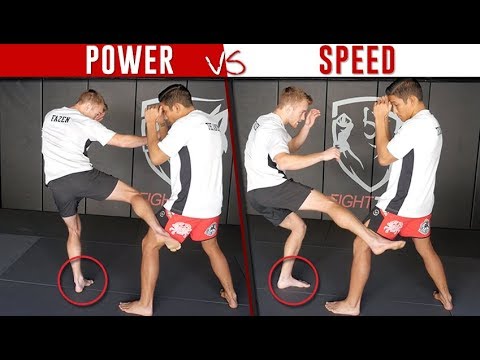
5 Variations of (Round) Low Kicks
0
Low Back Kick·fightTIPS
When we think of Muay Thai, we picture that low roundhouse kick to the legs, but there are many different variations and…
Translation: Low back kick
The Low Back Kick targets the opponent's knee, shin, or lower thigh from behind, aiming to damage the structural support of the lead leg. [1] By directing the back kick downward at the opponent's lower body, the practitioner attacks a target that is difficult to defend when struck from behind. [1] This technique is particularly effective as a counter when the opponent is advancing. [1]
Offers specific tactical advantages over the standard back kick in appropriate situations. [1]
Cross-style martial arts kicking tradition; documented in kick compendiums. [1]
Primarily a training, demonstration, and point-fighting technique. Rarely seen in full-contact MMA or kickboxing due to acrobatic risk and telegraphing. Appears occasionally in TKD and point-fighting karate tournaments. [1]
No images yet for this technique.
Sign in to suggest an image.
When we think of Muay Thai, we picture that low roundhouse kick to the legs, but there are many different variations and…
Patreon for Exclusive Coaching Content: https://www.patreon.com/JNMartialArtsExclusiveClub?utm_campaign=creatorshare_cre…
The low back kick represents a foundational striking technique with multiple pedagogical approaches across martial arts disciplines. Nat Hearn's taekwondo-focused instruction emphasizes the technique as part of a progression of rotational kicks, building from basic mechanics toward advanced variations like the 360 spinning hook kick and 540 spinning kick. Hearn stresses proper hip rotation, knee chamber positioning, and the coordinated use of non-kicking leg mechanics to generate height and power. The instruction prioritizes body mechanics: externally rotating the hip to allow the non-kicking knee to point toward the target direction, lifting the foot high during chamber to create backward lean for additional altitude, and maintaining continuous practice to refine execution. In contrast, fightTIPS's Shane presents low roundhouse kicks through a Muay Thai and Dutch kickboxing lens, focusing on tactical application and damage mechanics. Shane distinguishes between trajectories—downward axe-chop style targeting the quadriceps tendon versus upward variations used by Dutch fighters for speed and boxing integration. fightTIPS also covers inside leg kicks, calf scoops for balance disruption, and outside calf kicks for leg shutdown or sweeping, emphasizing functional purpose over a single mechanical ideal. Where Hearn prioritizes aesthetic form and progressive difficulty, fightTIPS prioritizes situational effectiveness, target selection, and setup combinations. Both instructors agree on the importance of footwork fundamentals and sequential practice, though their pedagogical frameworks reflect their respective combat sport traditions.
Synthesized from 2 instructors
No instructional courses yet for this technique.
Sign in to suggest a course.
Risk of injury to the person this technique is applied to
Back Kick variant with standard striking power
Skill level needed to execute this technique reliably
Whether this technique is allowed under major competition rule sets
Essential Book of Martial Arts Kicks (De Bremaeker & Faige, 2010)
[1] De Bremaeker & Faige, Essential Book of Martial Arts Kicks (2010)
Requires solid back kick foundation
Good balance and coordination
Documented in De Bremaeker & Faige, Section 4.2. A back kick aimed at low targets — the thigh, knee, or shin. Faster and harder to see than the standard mid-level back kick. Used as a range-management tool in kickboxing. (De Bremaeker & Faige, Essential Book of Martial Arts Kicks, 2010)
Consider your purpose first—are you trying to do damage, knock them off balance, or prioritize speed? This clarifies which variation of the technique you should use.
According to Nat Hearn, the key is to externally rotate your hip as your non-kicking leg comes around. Avoid bringing your knee inward; proper hip rotation is essential for correct technique.
Throw a cross, fake the jab, and get to the outside angle—this positioning lets you cleanly smash the calf without telegraphing your intention.
The Low Back Kick targets the opponent's knee, shin, or lower thigh from behind, aiming to damage the structural support of the lead leg. By directing the back kick downward at the opponent's lower body, the practitioner attacks a target that is difficult to defend when struck from behind.
The Low Back Kick is a specialised variant documented in cross-style kicking methodology. It represents an advanced development of the standard back kick.
Unified MMA: legal — Legal striking technique; WBC/Boxing: banned — All kicks prohibited in boxing; WKF: legal — Legal, chudan (body) kick scores 2 points, jodan (head) kick scores 3 points; Kyokushin: legal — Legal at full power to body and head; WT: legal — Legal, body kick 2 points, head kick 3 points, spinning body 4 points, spinni…; WAKO: legal — Legal in Full Contact and Low Kick formats; K: legal — 1/GLORY — Legal; IFMA: legal — Legal — kicks are a core Muay Thai technique
Danger rating 6/10. Back Kick variant with standard striking power
The standard setup chain: Feint → Low Back Kick → Follow-up combination.
Standard counters include: Step inside range / Block and counter / Low kick to support leg.
Common variants: High variant; Mid variant; Low variant.
Primarily a training, demonstration, and point-fighting technique. Rarely seen in full-contact MMA or kickboxing due to acrobatic risk and telegraphing.
Top errors to watch for: Attempting without solid back kick foundation / Poor balance / Insufficient power generation.
The Low Back Kick is also known as Gedan Ushiro Geri, Low Ushiro Geri.