What Is A Back Kick For?
0
Drop Hooking Back Kick·THE PIT Online Dojo
The Pit Online Dojo... Thank you for being a part of The Pit Online Dojo. I hope we can help you reach all of your mar…
Translation: Drop hooking back kick
The Drop Hooking Back Kick combines a body drop with a back kick that hooks at the end, creating a sweeping attack from ground level. [1] The combination of the drop and the hook creates a wide, unpredictable arc that is extremely difficult to anticipate. [1]
Offers specific tactical advantages over the standard back kick in appropriate situations. [1]
Cross-style martial arts kicking tradition; documented in kick compendiums. [1]
An acrobatic kick variation primarily seen in demonstrations and point-fighting tournaments. Not practical in full-contact competition due to the ground recovery time required. [1]
No images yet for this technique.
Sign in to suggest an image.
The Pit Online Dojo... Thank you for being a part of The Pit Online Dojo. I hope we can help you reach all of your mar…
Been asked frequently to do a tutorial on attacking the rear leg, which many people find difficult. So here you go. Drop…
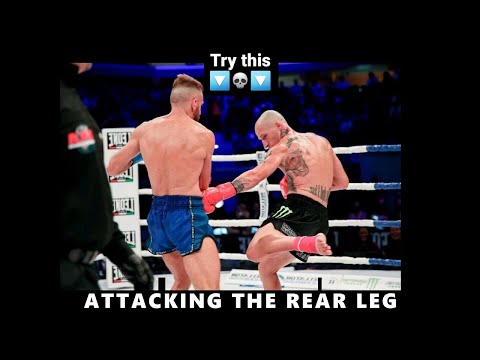
The drop hooking back kick is a devastating close-range strike targeting the opponent's rear leg, executed by shifting the hips forward and driving downward with commitment. Kevin Ross Official emphasizes that the primary technical challenge is hip shifting without switching stances—a righty fighter must rotate their hips into a southpaw-like position to access the rear leg effectively. He outlines three progression variations: a direct one-two setup with forward drive and drop, a lateral step-and-switch entry, and a pure hip-shift method that preserves base position. Critical to power generation is deep penetration—the striker must step in aggressively, drop low, and extend the shin as far as possible into the target, avoiding the common error of throwing the kick too upright from distance. Ross stresses full commitment, with the head driving forward over the front foot, combined with hand control to occupy the opponent's space and prevent counters. THE PIT Online Dojo contextualizes the back kick more broadly, explaining that while back kicks are conventionally practiced from rear-shoulder awareness, their primary application is against front-facing opponents—either as a follow-up after a missed initial kick or as a spinning entry. Both instructors agree on the fundamental principle of torque and hip rotation generating power, though their emphases differ: Ross focuses on the drop-and-drive mechanics for static rear-leg attacks, while THE PIT frames the back kick within broader spinning combinations and distance management.
Synthesized from 2 instructors
No instructional courses yet for this technique.
Sign in to suggest a course.
Risk of injury to the person this technique is applied to
Back Kick variant with standard striking power
Skill level needed to execute this technique reliably
Whether this technique is allowed under major competition rule sets
Essential Book of Martial Arts Kicks (De Bremaeker & Faige, 2010)
[1] De Bremaeker & Faige, Essential Book of Martial Arts Kicks (2010)
Requires solid back kick foundation
Good balance and coordination
Documented in De Bremaeker & Faige, Section 4.13. A hooking back kick delivered while dropping to the ground — the hooking arc comes from an unexpected low angle. (De Bremaeker & Faige, Essential Book of Martial Arts Kicks, 2010)
Kevin Ross emphasizes committing fully to the technique by driving forward with your weight, dropping down, and ensuring your hips shift correctly—don't stay back or you'll lose power. Think about driving through your opponent similar to a headbutt motion, which helps you jam them up and commit fully to the kick.
Kevin Ross notes that when you step out to the side, many people throw the kick from too far back, which takes all the power away. Instead, make sure to drive back in after stepping so you maintain distance and force behind the technique.
THE PIT Online Dojo recommends that if someone is behind you, you should turn around and face them rather than throw a back kick—turning is faster and safer. Back kicks are more useful if you miss a front kick and end up turned around, or as practice to develop your spinning mechanics for a spinning back kick.
The Drop Hooking Back Kick combines a body drop with a back kick that hooks at the end, creating a sweeping attack from ground level. The combination of the drop and the hook creates a wide, unpredictable arc that is extremely difficult to anticipate.
The Drop Hooking Back Kick is a specialised variant documented in cross-style kicking methodology. It represents an advanced development of the standard back kick.
Unified MMA: legal — Legal striking technique; WBC/Boxing: banned — All kicks prohibited in boxing; WKF: legal — Legal, chudan (body) kick scores 2 points, jodan (head) kick scores 3 points; Kyokushin: legal — Legal at full power to body and head; WT: legal — Legal, body kick 2 points, head kick 3 points, spinning body 4 points, spinni…; WAKO: legal — Legal in Full Contact and Low Kick formats; K: legal — 1/GLORY — Legal; IFMA: legal — Legal — kicks are a core Muay Thai technique
Danger rating 6/10. Back Kick variant with standard striking power
The standard setup chain: Feint → Drop Hooking Back Kick → Follow-up combination.
Standard counters include: Step inside range / Block and counter / Low kick to support leg.
Common variants: High variant; Mid variant; Low variant.
An acrobatic kick variation primarily seen in demonstrations and point-fighting tournaments. Not practical in full-contact competition due to the ground recovery time required.
Top errors to watch for: Attempting without solid back kick foundation / Poor balance / Insufficient power generation.
The Drop Hooking Back Kick is also known as Doroppu Fukkingu Bakku Kikku, Dropping Hook Back Kick.