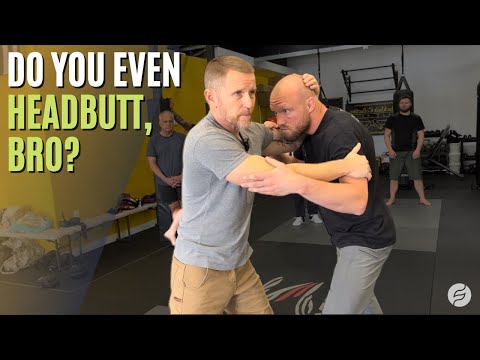
How to Headbutt for Self-Defense
0
Standard Side Headbutt·Fit To Fight Republic
We are big proponents of headbutts. They can be a huge asset physically and mentally in a fight. But if you're drilli…
Translation: standard side headbutt
The Standard Side Headbutt subfamily describes the basic lateral headbutt, executed by driving the side of the skull into the temple or face of an opponent positioned to the striker's side. [1] The technique involves a sharp lateral snap of the neck combined with a lateral shift of bodyweight, using the hard parietal bone above the ear as the striking surface. [1],[2] It is a situational self-defence technique for scenarios where conventional forward-facing strikes are not possible. [2],[3]
Standard side headbutt. [1]
Traditional. [1]
Illegal. [1]
No images yet for this technique.
Sign in to suggest an image.
We are big proponents of headbutts. They can be a huge asset physically and mentally in a fight. But if you're drilli…
No instructional courses yet for this technique.
Sign in to suggest a course.
Risk of injury to the person this technique is applied to
Lateral temporal bone strike; close-range weapon
Skill level needed to execute this technique reliably
Whether this technique is allowed under major competition rule sets
Dirty Boxing for Mixed Martial Arts (Anderson Silva, 2012)
Alias sources — [1] Dirty Boxing (Hatmaker, 2006) [2] Complete Krav Maga (Levine & Whitman, 2007) [3] The Noble Art of Self-Defence (Downey, 1967)
Effectiveness sources — [1] Comprehensive Asian Fighting Arts (Draeger & Smith, 1969)
Mixed Japanese-Western terminology — combines traditional Japanese terms with katakana loanwords
Alias sources — [1] Dirty Boxing (Hatmaker, 2006) [2] Complete Krav Maga (Levine & Whitman, 2007) [3] The Noble Art of Self-Defence (Downey, 1967)
Effectiveness sources — [1] Comprehensive Asian Fighting Arts (Draeger & Smith, 1969)
strong neck stabilisation, explosive forward drive, short range comfort
thick frontal bone, strong neck muscles
neck flexors, trapezius, core, legs (for drive)
Every move, in any martial art, shares a few universal traits. Mix and match below to pinpoint the right tool — or compare equivalents across styles.
You want to headbutt with the area from your eyebrows up, targeting anything from the opponent's eyebrows down, which is relatively fragile. This allows you to use the hardest part of your skull while striking vulnerable areas.
Fit To Fight Republic emphasizes this is rare advice, but it's hard to find a practical context where grabbing the opponent's head to headbutt them is the right choice. Grabbing changes your positioning and can give up opportunities to your opponent.
You want to make the opponent's skull move really fast and stop suddenly, which causes their brain to move at the same pace and creates the impact effect. This is biomechanically different from techniques taught by people who haven't actually executed headbutts in practice.
Drill headbutts in space rather than against a pad or mitt to maintain proper range awareness and prevent getting headbutted in practice. You need to be close enough to give a realistic target without being so close that you're inviting flying or uncontrolled headbutts.
The Standard Side Headbutt subfamily describes the basic lateral headbutt, executed by driving the side of the skull into the temple or face of an opponent positioned to the striker's side. The technique involves a sharp lateral snap of the neck combined with a lateral shift of bodyweight, using the hard parietal bone above the ear as the striking surface.
The standard side headbutt has been documented in military combatives and self-defence manuals as a response to lateral attacks or situations where the defender is grabbed from the side. It is a less common but recognised variant in the broader headbutt family.
Unified MMA: banned — Headbutts prohibited; WBC/Boxing: banned — Prohibited; WKF: banned — Prohibited; Kyokushin: banned — Prohibited; WT: banned — Prohibited; ITF: banned — Prohibited; WAKO: banned — Prohibited; K: banned — 1/GLORY — Prohibited; IFMA: banned — Prohibited; FIAS Combat Sambo: legal — Legal — headbutts permitted in combat sambo
Danger rating 7/10. Very High — lateral temporal bone strike; close-range weapon
The standard setup chain: Assume Fighting Stance → Generate Power → Execute Strike → Recover to Guard.
Standard counters include: Block — absorb the strike with a protective guard position / Evasion — move the target out of the strike's path / Counter-Attack — time an offensive response during the recovery phase of the strike.
Common variants: Standard variation (primary execution of the strike from the most common stance); Power variation (modified mechanics for maximum force generation); Speed variation (minimised telegraph for a faster, harder-to-read attack); Counter variation (timed to exploit the opponent's offensive commitment).
Illegal.
Top errors to watch for: Hitting with the top of the head sideways, which risks neck injury — use the temporal bone area / Driving with the neck instead of the legs and hips / Not having a clear target — the side headbutt requires knowing exactly where the opponent's face is / Losing balance from the lateral drive.
The Standard Side Headbutt is also known as Sutandādo Yoko Zutsuki, Lateral Headbutt, Side Butt, Diagonal Headbutt.