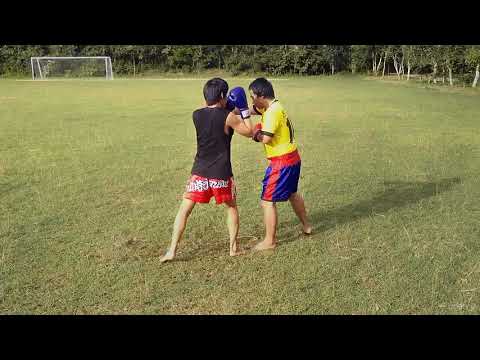
Muay Thai Ultimate Fights : Tad Mala Elbow Strike
0
Sok Tad·JOLLY MADLY VIDS
http://ytwizard.com/r/WxKcCK http://ytwizard.com/r/WxKcCK Muay Thai Ultimate Fights This course is to learn Muay Thai a…
Translation: Sok (ศอก) = elbow, Tad (ตัด) = to cut/to sever — the cutting horizontal elbow, named for its slicing trajectory parallel to the ground
Sok Tad (the Horizontal Elbow) is the second foundational elbow strike in Muay Thai's classical 24-elbow system (Cherng Sok 24 Cherng), delivered in a sweeping horizontal arc parallel to the ground, targeting the opponent's jaw, temple, or cheekbone from the side. [1] While the Sok Fan Nah (Elbow Chop) travels diagonally downward, the Sok Tad travels straight across on a horizontal plane — the body mechanics mirror those of a hook punch, with the critical difference that the striking surface is the razor-sharp point of the olecranon bone rather than the fist. [1],[2] The horizontal trajectory makes the Sok Tad particularly effective against the temporal region of the skull, where the bone is thinnest and a concussive blow can cause immediate unconsciousness. [2] In Muay Thai competition, the Sok Tad is the elbow most commonly responsible for knockouts (as opposed to cuts, which are more often caused by the diagonal Sok Fan Nah), because its horizontal arc generates rotational force on the head — the same rotation that causes knockout in hook punches, but delivered with a bone-hard, point-concentrated weapon. [2],[3] The strike requires the same full-body rotation as a hook punch: the hips, shoulders, and rear foot pivot simultaneously, with the lead foot grounded as the base. [1] The attacker must lean the body slightly away from the elbow to ensure the sharp olecranon point — not the flat of the forearm — makes contact. [1] Yod Ruerngsa documents the Sok Tad as a technique used for attack, defence, and escape, emphasising that it is effective both as a lead and a finishing strike in combinations. [1]
The Sok Tad is the second technique in the Cherng Sok 24 Cherng (24 traditional Muay Thai elbow techniques), a system that has been preserved and transmitted through Thai boxing camps for centuries as part of the complete Muay Thai arsenal. [1] Muay Thai is unique among global kickboxing styles in preserving the elbow as a primary weapon — when Western boxing influences led most martial arts to abandon elbow strikes in favour of gloved-fist techniques, Thailand maintained the elbow as integral to the art's identity. [2] The 24 elbow system represents one of the most comprehensive elbow arsenals in any martial art, and the Sok Tad's horizontal trajectory is the foundation for understanding the more complex angular and spinning elbow variants that follow it in the system. [1] The technique's effectiveness in the ring is well-documented: Muay Thai's golden era (1980s-1990s) produced fighters like Samart Payakaroon, Dieselnoi, and Sagat Petchyindee who used elbow techniques as fight-ending weapons at the highest levels. [3]
The horizontal elbow has the highest knockout rate per strike landed of any single technique in Muay Thai competition, because it combines the rotational knockout mechanism of a hook punch with the bone-concentrated impact of the elbow point. [2],[3] In MMA, the horizontal elbow has produced numerous highlight-reel knockouts, with fighters like Tony Ferguson, Jon Jones, and Matt Brown demonstrating its effectiveness in the Octagon. [3] The technique is particularly effective in the clinch and at close range, where punches cannot develop full power but the elbow operates at its optimal distance. [1],[2]
The horizontal elbow is the most common elbow knockout in both Muay Thai and MMA. Tony Ferguson produced multiple UFC TKO victories using horizontal elbows from the clinch and on the ground. Matt Brown knocked out Diego Sanchez with a horizontal elbow at UFC on Fox 12. In Muay Thai, Samart Payakaroon (considered the greatest Thai boxer) used the Sok Tad as a signature weapon during his legendary career.
No images yet for this technique.
Sign in to suggest an image.
http://ytwizard.com/r/WxKcCK http://ytwizard.com/r/WxKcCK Muay Thai Ultimate Fights This course is to learn Muay Thai a…
No instructional courses yet for this technique.
Sign in to suggest a course.
Risk of injury to the person this technique is applied to
The horizontal elbow to the temple or jaw is one of the most devastating legal strikes in combat sports. The temporal bone is the thinnest area of the skull, and a clean Sok Tad to this area can cause immediate loss of consciousness, concussion, temporal bone fracture, or epidural haematoma (bleeding between the skull and brain membrane). To the jaw, it produces the same rotational knockout mechanism as a hook punch but with concentrated bone-on-bone impact. [1,2]
Skill level needed to execute this technique reliably
Whether this technique is allowed under major competition rule sets
Muay Thai: The Art of Fighting (Ruerngsa, Charuad & Cartmell)
description: [1] Ruerngsa technique #2, [2] Krauss 2006
Official karate technique names (和語/漢語)
Established Japanese martial arts naming convention — native Japanese term (和語/漢語)
description: [1] Ruerngsa technique #2, [2] Krauss 2006
Same physical requirements as a hook punch — good hip rotation, balance on the lead leg, shoulder mobility
The elbow is the hardest striking surface on the body and requires no conditioning (unlike fists or shins)
Good proprioception needed to consistently land the olecranon point
Lean body slight away from the strike is a coordination detail that must be drilled
Accessible to all body types — shorter fighters have an advantage at elbow range
Sok tad (horizontal elbow) is the most commonly thrown elbow in Muay Thai — a tight horizontal arc from clinch range. The primary cause of cuts in professional Muay Thai due to the sharp elbow bone contacting facial tissue. (Kraitus, Muay Thai: The Art of Fighting; Delp, Muay Thai Unleashed)
Sok Tad (the Horizontal Elbow) is the second foundational elbow strike in Muay Thai's classical 24-elbow system (Cherng Sok 24 Cherng), delivered in a sweeping horizontal arc parallel to the ground, targeting the opponent's jaw, temple, or cheekbone from the side. While the Sok Fan Nah (Elbow Chop) travels diagonally downward, the Sok Tad travels straight across on a horizontal plane — the body mechanics mirror those of a hook punch, with the critical difference that the striking surface is the razor-sharp point of the olecranon bone rather than the fist.
The Sok Tad is the second technique in the Cherng Sok 24 Cherng (24 traditional Muay Thai elbow techniques), a system that has been preserved and transmitted through Thai boxing camps for centuries as part of the complete Muay Thai arsenal. Muay Thai is unique among global kickboxing styles in preserving the elbow as a primary weapon — when Western boxing influences led most martial arts to abandon elbow strikes in favour of gloved-fist techniques, Thailand maintained the elbow as integral to the art's identity.
Unified MMA: legal — Legal — all elbow strikes permitted; WBC/Boxing: banned — All elbow strikes prohibited in boxing; WKF: banned — Elbow strikes not a legal technique in sport karate; Kyokushin: banned — Elbow strikes prohibited; WT: banned — Prohibited; ITF: banned — Prohibited; WAKO: banned — Prohibited in all kickboxing formats; K: banned — 1/GLORY — Prohibited — key difference from Muay Thai; IFMA: legal — Legal — elbows are a core Muay Thai weapon (art of eight limbs)
Danger rating 9/10. The horizontal elbow to the temple or jaw is one of the most devastating legal strikes in combat sports. The temporal bone is the thinnest area of the skull, and a clean Sok Tad to this area can cause immediate loss of consciousness, concussion, temporal bone fracture, or epidural haematoma (bleeding between the skull and brain membrane). To the jaw, it produces the same rotational knockout mechanism as a hook punch but with concentrated bone-on-bone impact.
The standard setup chain: Establish the jab rhythm at punching range → Step inside to elbow range (using a feint, clinch entry, or off a caught kick) → Rotate hips and shoulders → Deliver Sok Tad horizontally to the jaw/temple → Drive through with the olecranon point → Retract immediately to guard → Follow up with a knee, additional elbow, or exit to punching range.
Standard counters include: Lean back — pulling the head back takes the jaw out of the elbow's horizontal path / Step back — the elbow's effective range is very short (12-14 inches); one step backward negates it entirely / Duck under — if the horizontal elbow is telegraphed, ducking below the arc avoids the strike and creates takedown opp… / Block with the forearm — a tight forearm guard absorbs the elbow (though this can cause cuts to the blocking arm).
Common variants: Lead Sok Tad (faster delivery from the lead arm, less power, used as a …); Rear Sok Tad (full power version from the rear arm with complete hip ro…); Spinning Sok Tad (a 180° or 360° spin adding centrifugal force to the horiz…); Jumping Sok Tad (leaping horizontally and delivering the elbow at the apex…); Sok Tad from clinch (delivered at the moment of clinch break or during clinch …); Double Sok Tad (two successive horizontal elbows from alternating sides i…).
The horizontal elbow is the most common elbow knockout in both Muay Thai and MMA. Tony Ferguson produced multiple UFC TKO victories using horizontal elbows from the clinch and on the ground.
Top errors to watch for: Hitting with the forearm flat instead of the elbow point — the single most critical error; the forearm flat has 8-10x… / Not rotating the hips — using only arm swing produces a weak elbow; the hips MUST rotate fully, exactly as for a hook… / Elbow too tight (less than 70°) — if the elbow angle is too acute, the forearm blocks the olecranon from reaching the… / Elbow too open (more than 110°) — if the angle is too wide, the strike becomes a forearm smash rather than a point-co….
The Sok Tad is also known as Sok Tad (Thai: ศอกตัด), Horizontal Elbow, Swinging Elbow, Cutting Elbow, Sok Tat.