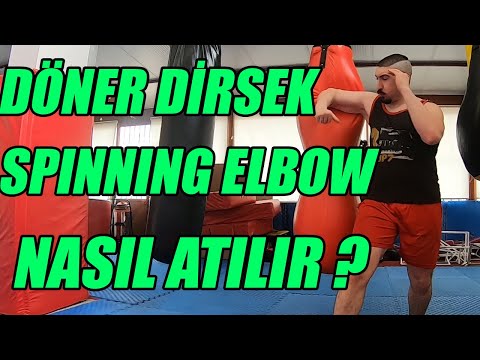
Döner Dirsek nasıl atılır? ( Spinning Elbow, Sok Klab)
0
Sok Klab·DR. Fightolog Sezer Çallı
"Döner Dirsek nasıl atılır?, Muay thai döner dirsek, Spinning elbow tutorial, Sok Klab muay thai" Herkese merhaba Muay t…
Translation: Sok (ศอก) = elbow, Klab (กลับ) = reverse/return — the reverse elbow, delivered by spinning 180° and swinging the elbow backward into the opponent's face or jaw
Sok Klab (the Reverse Spinning Elbow) is one of the most spectacular and devastating techniques in Muay Thai, delivered by turning the body 180 degrees and swinging the elbow backward into the opponent's face or jaw, combining full rotational momentum with the hardest striking surface on the human body. [1] The technique is used when the fighter's side or back is turned to the opponent — either deliberately (as a surprise attack from a feinted position) or as a recovery weapon when a previous technique has missed and the body has rotated past the target. [1] Yod Ruerngsa documents the Sok Klab as one of the 24 traditional Muay Thai elbow techniques (Cherng Sok 24 Cherng), noting that it converts the body's rotational momentum from a missed or feinted attack into a devastating counter that arrives from the opponent's blind side. [1] The spinning elbow generates significantly more force than a standing elbow because the entire body's mass rotates through 180 degrees, accumulating angular momentum that is released through the point of the olecranon at the moment of impact — biomechanical studies have measured spinning elbow forces at 2-3 times those of standing elbows. [1],[2] The technique achieved international fame through multiple spectacular UFC knockouts: Tony Ferguson's spinning elbow KO of Anthony Pettis (UFC 229, 2018), Jon Jones's spinning elbow against numerous opponents, and most dramatically, Matt Brown's spinning elbow KO of Diego Sanchez (UFC on Fox 12, 2014). [3] In Muay Thai stadium competition (Lumpinee and Rajadamnern), the spinning elbow is relatively rare but when it connects, it almost always produces a fight-ending knockout or severe laceration due to the enormous force concentrated on the sharp olecranon point. [1],[2]
The Sok Klab is one of the 24 traditional elbow techniques (Cherng Sok 24 Cherng) preserved in the classical Muay Thai curriculum, with roots in Muay Boran (ancient boxing). [1] Spinning elbows were used in the traditional Muay Boran era when fighters used hemp hand wraps (Kad Chuek) rather than gloves, and the elbow was one of the primary weapons for producing cuts and knockouts. [1] In modern Muay Thai stadium competition, the spinning elbow is relatively rare (perhaps 1-2 attempts per fight card) but carries legendary status due to its spectacular nature when it connects — a clean spinning elbow knockout is considered one of the ultimate displays of Muay Thai skill and timing. [1],[2] The technique achieved global recognition through MMA: Tony Ferguson's spinning elbow KO of Anthony Pettis (UFC 229, October 2018) was named Knockout of the Year and showcased the spinning elbow's fight-ending potential at the highest level of professional MMA. [3]
The Sok Klab is a high-risk, high-reward technique — when it connects, it is arguably the most destructive single strike in martial arts (2-3x standing elbow force concentrated on 1 cm² of olecranon bone against facial bones), but when it misses, it leaves the fighter's back exposed for 0.1-0.2 seconds. [1],[2] The technique is most effective when DISGUISED: used as a recovery from a missed technique, as a counter to the opponent's forward movement, or as the surprise final beat of a combination. [1] Statistical analysis of UFC fights shows that the spinning elbow has a knockout rate per landing of approximately 30-40% — one of the highest finish rates of any single technique when it lands clean. [3] In Muay Thai, the spinning elbow knockout is considered the pinnacle of elbow mastery. [1]
Tony Ferguson vs Anthony Pettis, UFC 229 (Oct 6, 2018) — spinning elbow TKO, named 2018 Knockout of the Year || Matt Brown vs Diego Sanchez, UFC on Fox 12 (Jul 26, 2014) — spinning elbow KO || Jon Jones — multiple spinning elbow attempts throughout his UFC title reign || In Muay Thai, the spinning elbow knockout at Lumpinee or Rajadamnern stadium is considered the pinnacle of elbow mastery || The technique has one of the highest knockout rates per clean landing (~30-40%) of any single technique in MMA.
No images yet for this technique.
Sign in to suggest an image.
"Döner Dirsek nasıl atılır?, Muay thai döner dirsek, Spinning elbow tutorial, Sok Klab muay thai" Herkese merhaba Muay t…
No instructional courses yet for this technique.
Sign in to suggest a course.
Risk of injury to the person this technique is applied to
The Sok Klab is the single most devastating elbow technique in martial arts. The spinning momentum produces 2-3x the force of a standing elbow, and this enormous force is concentrated on the sharp point of the olecranon (approximately 1 cm²). A clean spinning elbow to the face can produce: immediate unconsciousness (knockout), orbital fractures, jaw fractures, zygomatic (cheekbone) fractures, severe lacerations requiring 15-30 stitches, and catastrophic concussive injury. Multiple UFC fighters have been rendered unconscious for extended periods (30+ seconds) from spinning elbow impacts. [1,2,3]
Skill level needed to execute this technique reliably
Whether this technique is allowed under major competition rule sets
Muay Thai: The Art of Fighting (Ruerngsa, Charuad & Cartmell)
description: [1] Ruerngsa Sok Klab, [2] Krauss 2006, [3] UFC records
Official karate technique names (和語/漢語)
Established Japanese martial arts naming convention — native Japanese term (和語/漢語)
description: [1] Ruerngsa Sok Klab, [2] Krauss 2006, [3] UFC records
Requires excellent balance during the 180° rotation
Strong core (obliques) for fast rotational acceleration
Good proprioception for maintaining elbow height during the spin
Cervical mobility for the head turn to track the target
Cardiovascular fitness (the spinning elbow is physically demanding)
Elbow conditioning from heavy bag and pad work
Sok klab (reverse/spinning back elbow) drives the elbow backward — used when the opponent is behind or to the side. An alternative finishing trajectory from the spinning elbow rotation. (Kraitus, Muay Thai: The Art of Fighting)
Sok Klab (the Reverse Spinning Elbow) is one of the most spectacular and devastating techniques in Muay Thai, delivered by turning the body 180 degrees and swinging the elbow backward into the opponent's face or jaw, combining full rotational momentum with the hardest striking surface on the human body. The technique is used when the fighter's side or back is turned to the opponent — either deliberately (as a surprise attack from a feinted position) or as a recovery weapon when a previous technique has missed and the body has rotated past the target.
The Sok Klab is one of the 24 traditional elbow techniques (Cherng Sok 24 Cherng) preserved in the classical Muay Thai curriculum, with roots in Muay Boran (ancient boxing). Spinning elbows were used in the traditional Muay Boran era when fighters used hemp hand wraps (Kad Chuek) rather than gloves, and the elbow was one of the primary weapons for producing cuts and knockouts.
Unified MMA: legal — Legal — all elbow strikes permitted; WBC/Boxing: banned — All elbow strikes prohibited in boxing; WKF: banned — Elbow strikes not a legal technique in sport karate; Kyokushin: banned — Elbow strikes prohibited; WT: banned — Prohibited; ITF: banned — Prohibited; WAKO: banned — Prohibited in all kickboxing formats; K: banned — 1/GLORY — Prohibited — key difference from Muay Thai; IFMA: legal — Legal — elbows are a core Muay Thai weapon (art of eight limbs)
Danger rating 10/10. The Sok Klab is the single most devastating elbow technique in martial arts. The spinning momentum produces 2-3x the force of a standing elbow, and this enormous force is concentrated on the sharp point of the olecranon (approximately 1 cm²). A clean spinning elbow to the face can produce: immediate unconsciousness (knockout), orbital fractures, jaw fractures, zygomatic (cheekbone) fractures, severe lacerations requiring 15-30 stitches, and catastrophic concussive injury. Multiple UFC fighters have been rendered unconscious for extended periods (30+ seconds) from spinning elbow impacts.
The standard setup chain: Establish a jab-cross rhythm → Opponent calibrates defence to frontal attacks → After a jab-cross: continue the body's rotation past the cross → Head turns to locate the target over the shoulder → Spinning elbow fires at the moment the target is visually acquired → Olecranon impacts the opponent's jaw/temple from the blind side → The rotational momentum + the concentrated elbow point produces devastating impact → If missed: immediately recover to fighting stance or flow into a follow-up technique → Alternative: missed spinning kick → body has already rotated → Sok Klab fires as a recovery weapon using the existing rotational momentum.
Standard counters include: Timing the spin — the 0.1-0.2 second window when the spinner's back is fully exposed is the primary counter-window; a… / Step back — retreating as the spin initiates takes the target out of the elbow's range / Duck — the spinning elbow at head height can be ducked under / Low kick to the pivot leg — attacking the planted foot/leg during the spin destabilises the rotation.
Common variants: Standard Sok Klab (180° spin from fighting stance, rear elbow strikes the op…); Quick Sok Klab (abbreviated spin (90-120°) for faster delivery at closer …); Full 360° spinning elbow (a complete rotation before the elbow lands (maximum power…); Jumping spinning elbow (adding a jump during the spin for additional height and d…); Sok Klab from the clinch (spinning out of the Muay Thai clinch and firing the elbow…); Descending Sok Klab (the spinning elbow angled downward from above (combinatio…).
Tony Ferguson vs Anthony Pettis, UFC 229 (Oct 6, 2018) — spinning elbow TKO, named 2018 Knockout of the Year || Matt Brown vs Diego Sanchez, UFC on Fox 12 (Jul 26, 2014) — spinning elbow KO || Jon Jones — multiple spinning elbow attempts throughout his UFC title reign || In Muay Thai, the spinning elbow knockout at Lumpinee or Rajadamnern stadium is considered the pinnacle of elbow mastery || The technique has one of the highest knockout rates per clean landing (~30-40%) of any single technique in MMA.
Top errors to watch for: Not turning the head to locate the target — the most critical error: a blind spinning elbow misses approximately 80% … / Wide, looping spin — a spin that travels a wide arc is slow, visible, and covers distance laterally rather than rotat… / Elbow drops during the spin — if the elbow falls below head height during the rotation, it misses the face and hits t… / Telegraphing by looking backward — any pre-spin preparation (looking over the shoulder, shifting weight, dropping han….
The Sok Klab is also known as Sok Klab (Thai: ศอกกลับ), Reverse Spinning Elbow, Spinning Back Elbow, Sok Klab Lan, Turning Elbow.