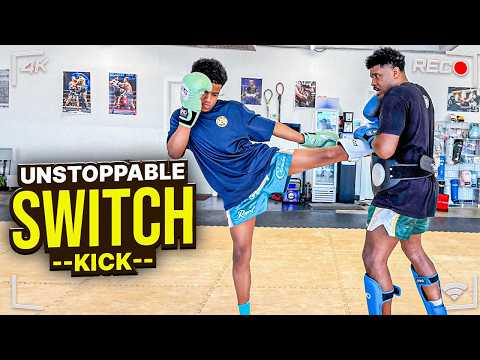
Mastering the Muay Thai Switch Kick: A Step-by-Step Guide
0
Standard Switch·Kingdom Martial Arts Academy·Added by Admin
Learn the art of Muay Thai with our step-by-step guide to mastering the switch kick, a fundamental technique in Muay Tha…
Translation: standard switch
The Standard Switch executes the wrestling escape from turtle by sitting the hips to one side while simultaneously switching the direction of the body, using the hip motion and direction change to break the opponent's control and transition to a standing or dominant position. [1] The turtled fighter plants one hand, kicks the hips to the opposite side (similar to a sit-out), and then pivots to reverse the facing direction, ending up behind or beside the opponent. [1],[2] The switch combines the sit-out's hip motion with a directional change that creates superior positioning. [2],[3]
The switch is a standard reversal in folkstyle wrestling competition. [1]
No images yet for this technique.
Sign in to suggest an image.
Learn the art of Muay Thai with our step-by-step guide to mastering the switch kick, a fundamental technique in Muay Tha…
No instructional courses yet for this technique.
Sign in to suggest a course.
Risk of injury to the person this technique is applied to
Turtle escapes involve rolling and granby movements; neck strain risk
Skill level needed to execute this technique reliably
Whether this technique is allowed under major competition rule sets
Jiu-Jitsu University (Saulo Ribeiro, 2008)
Alias sources — [1] Wrestling Physical Conditioning Encyclopedia (John Jesse, 1974) [2] NCAA wrestling terminology
Effectiveness sources — [1] Wrestling for Fighting (Randy Couture, 2007) [2] Coaching Wrestling Successfully (Dan Gable, 1999)
Standard katakana transliteration of Western martial arts terminology (外来語) — used in Japanese MMA, boxing, and BJJ communities
Alias sources — [1] Wrestling Physical Conditioning Encyclopedia (John Jesse, 1974) [2] NCAA wrestling terminology
Effectiveness sources — [1] Wrestling for Fighting (Randy Couture, 2007) [2] Coaching Wrestling Successfully (Dan Gable, 1999)
hip escape (shrimping) speed, framing strength, timing
flexible hips and quick lateral movement
hip flexors, obliques, triceps (framing), core
Keep your lead hand up protecting your face, chin down, and maintain that guard as you throw the kick. Kingdom Martial Arts Academy emphasizes that proper head protection is essential during the technique execution.
Yes, practice from the square position where your belly button faces your opponent—this allows you to block if needed and helps you execute the kick with proper speed and precision. Make sure you're squared up and can get the kick up and down as fast as possible.
Focus on precision first. Kingdom Martial Arts Academy teaches that practicing perfect precision will protect you and is more important than speed when starting out, since precise technique takes practice to develop.
Make two precise switch kicks back to back, keeping your hip open and ensuring the second kick comes behind you rather than in front or parallel to your body. Each kick should be clean and deliberate rather than rushed.
The Standard Switch executes the wrestling escape from turtle by sitting the hips to one side while simultaneously switching the direction of the body, using the hip motion and direction change to break the opponent's control and transition to a standing or dominant position. The turtled fighter plants one hand, kicks the hips to the opposite side (similar to a sit-out), and then pivots to reverse the facing direction, ending up behind or beside the opponent.
The standard switch is a foundational wrestling technique taught at all levels, from youth wrestling to international competition. Its effectiveness in escaping bottom position has made it a universal grappling technique.
Unified MMA: legal — Legal defensive/transitional technique; IBJJF: legal — Legal; IJF: legal — Legal; ADCC: legal — Legal; UWW: legal — Legal, escape scores 1 point (freestyle), reversal scores 1 point; FIAS Sport Sambo: legal — Legal; NCAA Folkstyle: legal — Legal, escape scores 1 point, reversal scores 2 points
Danger rating 3/10. Moderate — turtle escapes involve rolling and granby movements; neck strain risk
The standard setup chain: Create Space → Disrupt Control → Execute Escape → Recover Position.
Standard counters include: Maintain Pressure — keep consistent weight distribution to limit escape space / Anticipate Direction — read escape attempt direction and block early / Transition — flow to a new position when the current one is threatened.
Common variants: Shrimp to guard (framing and hip-escaping to recover full guard or half guard); Underhook escape (winning the underhook and coming to knees or reversing); Bridge to knees (bridging into the opponent and transitioning to turtle or…); Ghost escape (inverting under the opponent to re-guard from the opposit…).
The switch is a standard reversal in folkstyle wrestling competition.
Top errors to watch for: Hooking the thigh too shallow — the hook must be deep enough to create a solid pivot point / Switching the hips without the thigh hook — the hook anchors the switch; without it, the rotation has no pivot / Rotating too far (more than 180 degrees) — stop the rotation when you're facing the opponent / Not using the non-hooking arm for base — post it on the mat for stability during the switch.
The Standard Switch is also known as Sutandādo Suitchi, Basic Switch, Standard Hip Switch.