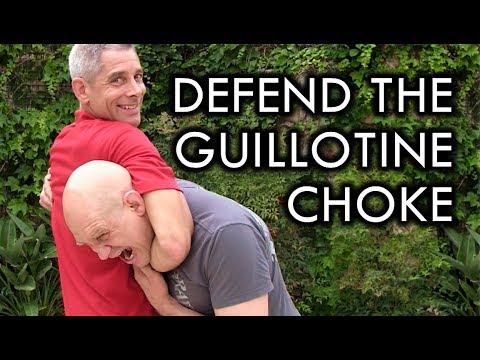
How to Defend a Standing Guillotine Choke with Stephan Kesting
0
Standard Guillotine Counter·Ando Mierzwa·Added by Admin
Learning how to defend against the standing guillotine choke is a MUST for every martial artist, whether you're into MMA…
Translation: standard guillotine counter
The Standard Guillotine Counter wraps the arm around the shooting opponent's neck as they level-change for a takedown, secures the choking grip (arm-in or no-arm), and applies the choke either standing or by pulling guard. [1] The counter is executed by sprawling slightly to create the angle needed to secure the neck, then wrapping the choking arm deep under the chin and connecting the hands. [1],[2] The defender can finish standing by squeezing the choke while sprawling, or by pulling guard and applying the choke from the bottom position. [2],[3]
The guillotine choke as a takedown counter is one of the highest-percentage submissions in MMA, as the head position required for many takedowns (head on the inside) naturally exposes the neck to the guillotine grip. [1] Statistics from UFC bouts show the guillotine is among the most frequently attempted submissions in the sport, with a significant percentage coming as counters to takedown attempts. [2]
The guillotine choke has been used as a takedown counter since the earliest days of MMA, with Royce Gracie demonstrating its effectiveness in the early UFC events. [1] John Danaher's systematisation of the front headlock position further refined the guillotine as a primary takedown defence option. [2]
The guillotine counter has produced numerous finishes in UFC competition. Notably, Nate Diaz submitted Marcus Davis via guillotine after a takedown attempt at UFC Fight Night 19 (2009), and Dustin Poirier has secured multiple guillotine finishes off of scrambles from takedown defence. [1]
No images yet for this technique.
Sign in to suggest an image.
Learning how to defend against the standing guillotine choke is a MUST for every martial artist, whether you're into MMA…
No instructional courses yet for this technique.
Sign in to suggest a course.
Risk of injury to the person this technique is applied to
Sprawls and stuffs involve sudden body weight displacement; knee/hip strain risk
Skill level needed to execute this technique reliably
Whether this technique is allowed under major competition rule sets
Freestyle Wrestling: A Complete Guide for Coaches and Wrestlers (Petrov, 1977)
Alias sources — [1] Jiu-Jitsu University (Ribeiro, 2008) [2] Fundamentals of Brazilian Jiu-Jitsu (Danaher, 2012) [3] MMA Instruction Manual (Ryan & Snowden, 2010)
Effectiveness sources — [1] Jiu-Jitsu University (Ribeiro, 2008) [2] UFC FightMetric submission statistics
Standard katakana transliteration of Western martial arts terminology (外来語) — used in Japanese MMA, boxing, and BJJ communities
Alias sources — [1] Jiu-Jitsu University (Ribeiro, 2008) [2] Fundamentals of Brazilian Jiu-Jitsu (Danaher, 2012) [3] MMA Instruction Manual (Ryan & Snowden, 2010)
Effectiveness sources — [1] Jiu-Jitsu University (Ribeiro, 2008) [2] UFC FightMetric submission statistics
reaction speed, explosive hip extension, downward driving force
long legs for quick sprawl, heavy upper body
hip extensors, glutes, core, shoulders (dead weight)
Keep your head up and avoid looking down at the floor. Ando Mierzwa emphasizes that maintaining head position makes it difficult for your opponent to apply the choke effectively.
Both attacker and defender need to arch to succeed—the attacker must arch to secure the choke, and the defender must arch to create space and potentially counter by looping the opponent's head. According to Ando Mierzwa, it comes down to who executes the arch correctly first.
Yes. Ando Mierzwa notes that looping the head works both ways—if your opponent loops your head to attack, you can loop their head to defend, making it a timing game where whoever executes the technique correctly first wins.
The Standard Guillotine Counter wraps the arm around the shooting opponent's neck as they level-change for a takedown, secures the choking grip (arm-in or no-arm), and applies the choke either standing or by pulling guard. The counter is executed by sprawling slightly to create the angle needed to secure the neck, then wrapping the choking arm deep under the chin and connecting the hands.
The standard guillotine counter is one of the most practised defensive techniques in MMA, recognised as the primary submission risk associated with shooting takedowns. Its high finish rate has made it a fundamental part of MMA defensive training.
Unified MMA: legal — Legal defensive technique; IBJJF: legal — Legal — defensive techniques are fundamental to grappling; IJF: legal — Legal defensive action; ADCC: legal — Legal; UWW: legal — Legal defensive technique; FIAS Sport Sambo: legal — Legal
Danger rating 3/10. Moderate — sprawls and stuffs involve sudden body weight displacement; knee/hip strain risk
The standard setup chain: Anticipate the Attack → Execute Defence → Recover Stance → Counter or Disengage.
Standard counters include: Timing — attack when the defence is recovering or between movements / Feint — use deception to create openings in the defensive structure / Angle Change — attack from an unexpected angle that the defence does not cover.
Common variants: Full sprawl (both legs kicked back, hips dropped to the mat); Half sprawl (one leg back while the other posts for balance); Sprawl to front headlock (sprawling and immediately securing head control).
The guillotine counter has produced numerous finishes in UFC competition. Notably, Nate Diaz submitted Marcus Davis via guillotine after a takedown attempt at UFC Fight Night 19 (2009), and Dustin Poirier has secured multiple guillotine finishes off of scrambles from takedown defence.
Top errors to watch for: Wrapping the neck loosely — the forearm must be tight against the neck before the opponent can posture up / Keeping the choking-arm elbow low — a low elbow makes it a neck crank, not a choke; point the elbow up / Pulling guard without a secure grip — the opponent will posture up and pass; secure the grip first / Not closing the guard (leaving it open or half guard) — closed guard prevents the opponent from posturing and passing.
The Standard Guillotine Counter is also known as Sutandādo Girochin Kauntā, Basic Guillotine Counter, Standing Guillotine, Front Choke Counter.