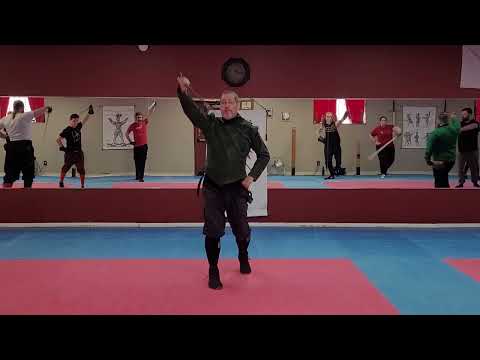
Bolognese Form for Beginners: Walking in the Guards (2023)
Our most recent version of Giovanni dall' Agocchie's "Walking in the Guards" (1572). This form contains the essential f…
スタンダードフェンスウォーク(Sutandādo Fensu Wōku)
TransliterationTranslation: standard fence walk
The Standard Fence Walk positions the upper back against the cage fence, plants both feet underneath the body, and uses a combination of leg drive and fence friction to push up to standing while maintaining a defensive frame against the opponent. [1] The defender typically posts one hand on the mat and uses the other to control the opponent's head or arm, then walks the feet close to the body and drives upward along the fence. [1],[2] The standard fence walk must be performed with defensive awareness, as the opponent will typically attempt to re-shoot or pull the defender back down during the stand-up attempt. [2],[3]
The fence walk stand-up is one of the most important defensive skills in MMA, allowing a fighter taken down against the cage to use the fence as support to stand back up. [1] The technique is highly effective when combined with proper wrist control and hip positioning, as the fence provides the structural support that would otherwise be unavailable on an open mat. [2]
Georges St-Pierre's fence walk stand-up was a critical component of his defensive grappling, allowing him to return to his feet when taken down against the cage during his welterweight championship reign. [1]
No images yet for this technique.
Sign in to suggest an image.
No instructional courses yet for this technique.
Sign in to suggest a course.
Risk of injury to the person this technique is applied to
Sprawls and stuffs involve sudden body weight displacement; knee/hip strain risk
Skill level needed to execute this technique reliably
Whether this technique is allowed under major competition rule sets
Jiu-Jitsu University (Saulo Ribeiro, 2008)
Alias sources — [1] MMA Instruction Manual (Ryan & Snowden, 2010) [2] MMA Instruction Manual (Ryan & Snowden, 2010) [3] MMA Instruction Manual (Ryan & Snowden, 2010)
Effectiveness sources — [1] MMA Instruction Manual (Ryan & Snowden, 2010) [2] MMA Instruction Manual (Ryan & Snowden, 2010)
Standard katakana transliteration of Western martial arts terminology (外来語) — used in Japanese MMA, boxing, and BJJ communities
Alias sources — [1] MMA Instruction Manual (Ryan & Snowden, 2010) [2] MMA Instruction Manual (Ryan & Snowden, 2010) [3] MMA Instruction Manual (Ryan & Snowden, 2010)
Effectiveness sources — [1] MMA Instruction Manual (Ryan & Snowden, 2010) [2] MMA Instruction Manual (Ryan & Snowden, 2010)
structural arm strength, forearm density, timing
strong arms and elbows for load-bearing frames
triceps, deltoids, forearms, core
Hip motion is essential to generate power in your cuts during the fence walk. Ken Harding demonstrates that proper hip engagement allows you to transition smoothly between strikes and follow-up techniques.
After executing your cut with proper hip motion, turn around and transition into the next guard position or technique, such as moving into kurunga alto or setting up for a reverse cut. Ken Harding shows this involves rotating your body to flow into the subsequent movement.
The Standard Fence Walk positions the upper back against the cage fence, plants both feet underneath the body, and uses a combination of leg drive and fence friction to push up to standing while maintaining a defensive frame against the opponent. The defender typically posts one hand on the mat and uses the other to control the opponent's head or arm, then walks the feet close to the body and drives upward along the fence.
The standard fence walk became one of the most commonly used defensive techniques in MMA, developed through the practical experience of cage fighting and refined through coaching methodology. It is now standard curriculum in MMA ground defence programmes.
Unified MMA: legal — Legal defensive technique; IBJJF: legal — Legal; IJF: legal — Legal defensive action; WBC/Boxing: legal — Legal; WKF: legal — Legal; WT: legal — Legal
Danger rating 3/10. Moderate — sprawls and stuffs involve sudden body weight displacement; knee/hip strain risk
The standard setup chain: Anticipate the Attack → Execute Defence → Recover Stance → Counter or Disengage.
Standard counters include: Timing — attack when the defence is recovering or between movements / Feint — use deception to create openings in the defensive structure / Angle Change — attack from an unexpected angle that the defence does not cover.
Common variants: Standard defence (primary defensive technique from the most common position); Reactive defence (triggered by the opponent's attack, minimal movement for …); Proactive defence (anticipating the attack and positioning to neutralise it …); Counter defence (using the defensive movement to create an immediate count…).
Georges St-Pierre's fence walk stand-up was a critical component of his defensive grappling, allowing him to return to his feet when taken down against the cage during his welterweight championship reign.
Top errors to watch for: Trying to stand up in one explosive movement — the fence walk is incremental; one big movement is easily countered / Not using the underhook actively — the underhook doesn't just sit there; use it to control the opponent's shoulder as… / Pressing the lower back against the cage instead of the upper back — the upper back provides the correct angle for th… / Walking the feet without maintaining cage contact — if your back leaves the cage, you lose the structural advantage.
The Standard Fence Walk is also known as Sutandādo Fensu Wōku, Basic Wall Walk, Standard Cage Stand-Up, Fence Walk-Up.