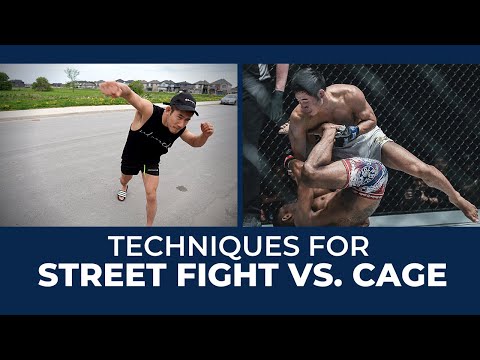
Techniques best kept for a STREET Fight VS the Cage
0
Cage Brace Defence·Jeff Chan MMAShredded
I had a fun video request, asking to discuss which MMA techniques would work in a street fight versus which techniques a…
Translation: cage brace defence
The Cage Brace Defence subfamily covers techniques where the defender uses the cage fence or wall as a structural support to resist takedown attempts, bracing against the cage to maintain standing position. [1] Cage bracing uses the vertical surface as a prop that helps maintain balance and provides a surface to push off from, compensating for the positional disadvantage of being pressed against the fence. [1],[2] The defender hooks the cage with the hands or presses the back against it while working to establish underhooks and create separation. [2],[3]
The cage brace uses the cage as support to resist takedowns by bracing against it. [1]
Developed in MMA cage fighting. [1]
Used in MMA competition. [1]
No images yet for this technique.
Sign in to suggest an image.
I had a fun video request, asking to discuss which MMA techniques would work in a street fight versus which techniques a…
No instructional courses yet for this technique.
Sign in to suggest a course.
Risk of injury to the person this technique is applied to
Sprawls and stuffs involve sudden body weight displacement; knee/hip strain risk
Skill level needed to execute this technique reliably
Whether this technique is allowed under major competition rule sets
Boxing (Edwin Haislet, 1940)
Alias sources — [1] MMA Instruction Manual (Ryan & Snowden, 2010) [2] MMA Instruction Manual (Ryan & Snowden, 2010) [3] MMA Instruction Manual (Ryan & Snowden, 2010)
Effectiveness sources — [1] Wrestling for Fighting (Couture, 2007)
Standard katakana transliteration of Western martial arts terminology (外来語) — used in Japanese MMA, boxing, and BJJ communities
Alias sources — [1] MMA Instruction Manual (Ryan & Snowden, 2010) [2] MMA Instruction Manual (Ryan & Snowden, 2010) [3] MMA Instruction Manual (Ryan & Snowden, 2010)
Effectiveness sources — [1] Wrestling for Fighting (Couture, 2007)
reaction speed, structural body mechanics, defensive awareness
quick reflexes and conditioned defensive surfaces
varies — forearms (blocking), legs (movement), core (stability)
Every move, in any martial art, shares a few universal traits. Mix and match below to pinpoint the right tool — or compare equivalents across styles.
According to Jeff Chan (MMAShredded), low kicks allow you to maintain the best balance compared to body or head kicks, which is crucial in street situations where you need to stay mobile and ready to disengage if multiple attackers appear.
Jeff Chan recommends prioritizing ground and pound from positions like knee on belly rather than submissions, because submissions tie you up with your opponent and make it difficult to disengage quickly if a second attacker arrives.
Jeff Chan emphasizes staying on your two feet using a wider stance for better balance, and recommends staying on the outside in case a second assailant suddenly appears—a key concern that changes technique selection in self-defense scenarios.
Judo throws keep you standing after execution, and Jeff Chan notes that you can easily transition to knee on belly position to strike, then quickly pop back to your feet and disengage if a second attacker arrives.
The Cage Brace Defence subfamily covers techniques where the defender uses the cage fence or wall as a structural support to resist takedown attempts, bracing against the cage to maintain standing position. Cage bracing uses the vertical surface as a prop that helps maintain balance and provides a surface to push off from, compensating for the positional disadvantage of being pressed against the fence.
Cage bracing developed as MMA fighters discovered that the fence could be used defensively to resist takedowns when trapped against the wall. The technique evolved from instinctive fence-grabbing (which is illegal) into sophisticated cage-bracing methods that use the fence legally.
Unified MMA: legal — Legal defensive technique; IBJJF: legal — Legal; IJF: legal — Legal defensive action; WBC/Boxing: legal — Legal; WKF: legal — Legal; WT: legal — Legal
Danger rating 3/10. Moderate — sprawls and stuffs involve sudden body weight displacement; knee/hip strain risk
The standard setup chain: Anticipate the Attack → Execute Defence → Recover Stance → Counter or Disengage.
Standard counters include: Timing — attack when the defence is recovering or between movements / Feint — use deception to create openings in the defensive structure / Angle Change — attack from an unexpected angle that the defence does not cover.
Common variants: Standard defence (primary defensive technique from the most common position); Reactive defence (triggered by the opponent's attack, minimal movement for …); Proactive defence (anticipating the attack and positioning to neutralise it …); Counter defence (using the defensive movement to create an immediate count…).
Used in MMA competition.
Top errors to watch for: Using the cage brace passively (just leaning) without working to improve position — referees may stand you up for sta… / Placing feet too high on the cage — feet should be at the base for maximum traction / Relying solely on the cage without hand fighting — the cage provides structure; your hands provide the active defence / Bracing against the cage with your back turned to the opponent — maintain visual contact and defensive positioning.
The Cage Brace Defence is also known as Kēji Burēsu Difensu, Wall Brace, Cage Post, Fence Brace.