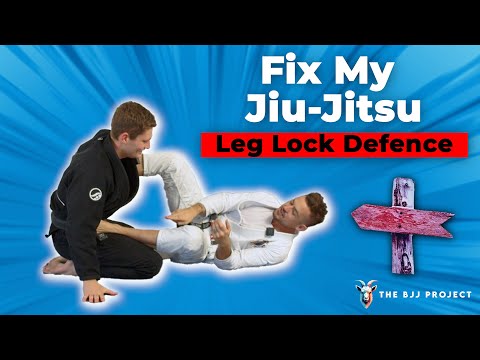
Fix my Jiu Jitsu - Leg Lock Defence
0
Hip Pressure Defence·The BJJ Project
🎯 Take our free BJJ Journey Score: https://www.thebjjproject.com/ 📕 Check out our BJJ Essential Guides here: https://…
Translation: hip pressure defence
The Hip Pressure Defence subfamily covers leg lock defence techniques where the defender drives their hips toward the opponent, reducing the space needed for the submission's rotational or extension mechanics. [1] Hip pressure defence works by closing the distance between the defender's hip and the opponent's controlling hands, which reduces the lever arm and consequently the force the opponent can generate on the joint. [1],[2] Driving the hips forward is the primary defence against kneebars and a critical secondary defence against heel hooks. [2],[3]
Hip pressure defence uses hip positioning to prevent the opponent from completing leg entanglements. [1]
Developed in modern BJJ leg lock defence methodology. [1]
Used in no-gi competition. [1]
No images yet for this technique.
Sign in to suggest an image.
🎯 Take our free BJJ Journey Score: https://www.thebjjproject.com/ 📕 Check out our BJJ Essential Guides here: https://…
No instructional courses yet for this technique.
Sign in to suggest a course.
Risk of injury to the person this technique is applied to
Submission defence involves resisting joint locks/chokes; risk of injury if defence fails or is delayed
Skill level needed to execute this technique reliably
Whether this technique is allowed under major competition rule sets
Boxing (Edwin Haislet, 1940)
Alias sources — [1] Jiu-Jitsu University (Ribeiro, 2008) [2] Fundamentals of Brazilian Jiu-Jitsu (Danaher, 2012) [3] Brazilian Jiu-Jitsu: Theory and Technique (Gracie, 2001)
Effectiveness sources — [1] Mastering Jujitsu (Gracie & Danaher, 2003)
Standard katakana transliteration of Western martial arts terminology (外来語) — used in Japanese MMA, boxing, and BJJ communities
Alias sources — [1] Jiu-Jitsu University (Ribeiro, 2008) [2] Fundamentals of Brazilian Jiu-Jitsu (Danaher, 2012) [3] Brazilian Jiu-Jitsu: Theory and Technique (Gracie, 2001)
Effectiveness sources — [1] Mastering Jujitsu (Gracie & Danaher, 2003)
reaction speed, structural body mechanics, defensive awareness
quick reflexes and conditioned defensive surfaces
varies — forearms (blocking), legs (movement), core (stability)
Every move, in any martial art, shares a few universal traits. Mix and match below to pinpoint the right tool — or compare equivalents across styles.
Keep your heel down with toes pulling and your knee angled upwards at about 45 degrees. The BJJ Project emphasizes not holding your knee downwards, as this makes heel hook attacks easier—your job is to do the opposite of what an attacker wants, so if they want your heel present, you work to slip it and clear the knee line.
Immediately grip fight—use both hands in a gable grip or whatever grip you need to prevent them from establishing control. The BJJ Project notes that grip fighting happens before any hip or leg fighting takes place, so focus on that battle first.
Place your foot on your opponent's hip to prevent them from coming forward with their hips, and your shin on their chest to prevent forward chest movement. Stay on your shoulder with sticky toes, maintaining pressure by pulling and pushing to control distance.
The BJJ Project stresses: stay sticky, stay connected, build a frame that can bear weight, don't let your feet flop around or your arms go out, and be as violent as humanly possible when your opponent starts something technical. Awareness of all your limbs and maintaining connection prevents attackers from creating space to grab submissions.
The Hip Pressure Defence subfamily covers leg lock defence techniques where the defender drives their hips toward the opponent, reducing the space needed for the submission's rotational or extension mechanics. Hip pressure defence works by closing the distance between the defender's hip and the opponent's controlling hands, which reduces the lever arm and consequently the force the opponent can generate on the joint.
Hip pressure as leg lock defence has been recognised since the earliest leg lock systems but was more thoroughly systematised during the modern leg lock revolution of the 2010s. It is now taught as a core defensive principle in all comprehensive leg lock defence curricula.
Unified MMA: legal — Legal defensive technique; IBJJF: legal — Legal — defensive techniques are fundamental to grappling; IJF: legal — Legal defensive action; ADCC: legal — Legal; UWW: legal — Legal defensive technique; FIAS Sport Sambo: legal — Legal
Danger rating 3/10. Moderate — submission defence involves resisting joint locks/chokes; risk of injury if defence fails or is delayed
The standard setup chain: Anticipate the Attack → Execute Defence → Recover Stance → Counter or Disengage.
Standard counters include: Timing — attack when the defence is recovering or between movements / Feint — use deception to create openings in the defensive structure / Angle Change — attack from an unexpected angle that the defence does not cover.
Common variants: Standard defence (primary defensive technique from the most common position); Reactive defence (triggered by the opponent's attack, minimal movement for …); Proactive defence (anticipating the attack and positioning to neutralise it …); Counter defence (using the defensive movement to create an immediate count…).
Used in no-gi competition.
Top errors to watch for: Leaning forward with the upper body instead of driving the hips — hip pressure comes from the pelvis, not the chest / Driving hips forward but leaving the knees outside — inside knee position must accompany hip pressure / Applying hip pressure without hiding the heel first — the heel must be safe before you drive forward / Driving too aggressively and losing balance — maintain a controlled forward pressure, not a dive.
The Hip Pressure Defence is also known as Hippu Puresshā Difensu, Hip Pin Defence, Hip Smash, Pressure Pass Defence.