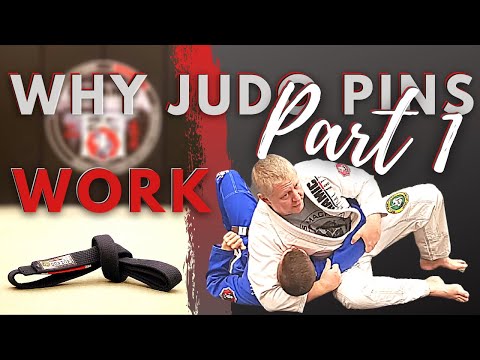
Judo Pins For BJJ - Part 1 - Spinal Control
0
Spinal Twist Defence·Takedowns For Jiu-jitsu
Why Judo Pins Work: Osaekomi Waza (pinning techniques) used in Judo are efficient by design. The intent is high level …
Translation: spinal twist defence
The Spinal Twist Defence subfamily covers defences against submissions that apply rotational force to the thoracic or lumbar spine, such as the twister, banana split, and similar techniques that rotate the torso relative to the hips. [1] Spinal twist defence focuses on preventing the opponent from isolating and controlling both the upper and lower body independently, which is the prerequisite for applying rotational force to the spine. [1],[2] The defender works to keep the hips and shoulders aligned, preventing the opponent from creating the separation needed for the twist. [2],[3]
Spinal twist defence prevents rotational spinal submissions like the twister. [1]
Developed in response to 10th Planet twister attacks. [1]
Used in no-gi competition. [1]
No images yet for this technique.
Sign in to suggest an image.
Why Judo Pins Work: Osaekomi Waza (pinning techniques) used in Judo are efficient by design. The intent is high level …
No instructional courses yet for this technique.
Sign in to suggest a course.
Risk of injury to the person this technique is applied to
Submission defence involves resisting joint locks/chokes; risk of injury if defence fails or is delayed
Skill level needed to execute this technique reliably
Whether this technique is allowed under major competition rule sets
Boxing (Edwin Haislet, 1940)
Alias sources — [1] Jiu-Jitsu University (Ribeiro, 2008) [2] Fundamentals of Brazilian Jiu-Jitsu (Danaher, 2012) [3] Brazilian Jiu-Jitsu: Theory and Technique (Gracie, 2001)
Effectiveness sources — [1] Mastering the Rubber Guard (Bravo, 2006)
Standard katakana transliteration of Western martial arts terminology (外来語) — used in Japanese MMA, boxing, and BJJ communities
Alias sources — [1] Jiu-Jitsu University (Ribeiro, 2008) [2] Fundamentals of Brazilian Jiu-Jitsu (Danaher, 2012) [3] Brazilian Jiu-Jitsu: Theory and Technique (Gracie, 2001)
Effectiveness sources — [1] Mastering the Rubber Guard (Bravo, 2006)
reaction speed, structural body mechanics, defensive awareness
quick reflexes and conditioned defensive surfaces
varies — forearms (blocking), legs (movement), core (stability)
Every move, in any martial art, shares a few universal traits. Mix and match below to pinpoint the right tool — or compare equivalents across styles.
Elongating the spine prevents the opponent from looking away from you, which removes their ability to scoot away. Additionally, it neutralizes their bridging power, making it very difficult for them to generate the core strength needed to create space and escape.
Simply pushing pressure on the opponent allows them to bridge and elongate their spine to escape. True spinal control involves lifting the head and elongating the spine while preventing them from looking away, which eliminates both their bridging ability and their ability to scoot away.
The Spinal Twist Defence subfamily covers defences against submissions that apply rotational force to the thoracic or lumbar spine, such as the twister, banana split, and similar techniques that rotate the torso relative to the hips. Spinal twist defence focuses on preventing the opponent from isolating and controlling both the upper and lower body independently, which is the prerequisite for applying rotational force to the spine.
Spinal twist defences became more important with the popularisation of the twister by Eddie Bravo and the 10th Planet Jiu-Jitsu system. The technique's potential for serious spinal injury has made its defence a priority topic in modern grappling instruction.
Unified MMA: legal — Legal defensive technique; IBJJF: legal — Legal — defensive techniques are fundamental to grappling; IJF: legal — Legal defensive action; ADCC: legal — Legal; UWW: legal — Legal defensive technique; FIAS Sport Sambo: legal — Legal
Danger rating 3/10. Moderate — submission defence involves resisting joint locks/chokes; risk of injury if defence fails or is delayed
The standard setup chain: Anticipate the Attack → Execute Defence → Recover Stance → Counter or Disengage.
Standard counters include: Timing — attack when the defence is recovering or between movements / Feint — use deception to create openings in the defensive structure / Angle Change — attack from an unexpected angle that the defence does not cover.
Common variants: Standard defence (primary defensive technique from the most common position); Reactive defence (triggered by the opponent's attack, minimal movement for …); Proactive defence (anticipating the attack and positioning to neutralise it …); Counter defence (using the defensive movement to create an immediate count…).
Used in no-gi competition.
Top errors to watch for: Allowing the opponent to control both the legs and the head simultaneously — fight to free one or the other / Resisting the twist with upper body only — the defence must include lower body repositioning (hip rotation) / Not recognizing the twister setup from back control and truck position — these are the primary entries / Ignoring the lockdown defence — the lockdown is the gateway position to the twister.
The Spinal Twist Defence is also known as Supainaru Tsuisuto Difensu, Twister Defence, Spine Lock Defence, Rotational Defence.