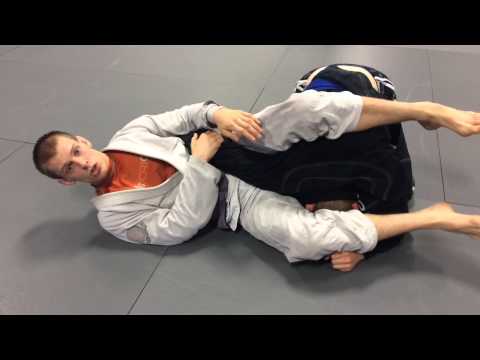
A few counters to the Hitch Hiker Escape. NICE SUBMISSIONS!
0
Standard Hitchhiker·Simplicity Jiu Jitsu·Added by Admin
Instagram - StephenJitsWizard Hey everyone! If you enjoy my videos, be sure to like and share or comment below! I will t…
Translation: standard hitchhiker
The Standard Hitchhiker executes the armbar escape by pointing the thumb of the trapped arm upward (the hitchhiker position), then rotating the entire body in the direction the thumb is pointing. [1] The rotation is performed by bridging onto the shoulder of the trapped arm and rolling toward the opponent, using the bridge to create the space needed to turn through. [1],[2] As the defender completes the rotation, the arm naturally slips free from the armbar's fulcrum because the elbow is no longer positioned against the opponent's hips. [2],[3]
The standard hitchhiker escape became a widely taught armbar defence in BJJ and MMA during the 2000s, recognised as one of the most reliable escapes from a deeply locked armbar. [1] Its effectiveness against even tightly secured armbars made it a fundamental component of grappling defence curricula. [2],[3]
The hitchhiker escape is one of the most effective late-stage armbar defences, working even when the armbar is deeply locked by exploiting the rotational weakness of the armbar fulcrum. [1] By pointing the thumb up and rolling toward the opponent, the defender changes the angle of the arm relative to the opponent's hips, causing the elbow to slip free. [2] The technique requires commitment to the roll — hesitation or partial execution can result in the arm being re-caught or the escape failing. [1]
The hitchhiker escape is a standard armbar defence in BJJ. [1]
No images yet for this technique.
Sign in to suggest an image.
Instagram - StephenJitsWizard Hey everyone! If you enjoy my videos, be sure to like and share or comment below! I will t…
No instructional courses yet for this technique.
Sign in to suggest a course.
Risk of injury to the person this technique is applied to
Submission defence involves resisting joint locks/chokes; risk of injury if defence fails or is delayed
Skill level needed to execute this technique reliably
Whether this technique is allowed under major competition rule sets
Boxing (Edwin Haislet, 1940)
Alias sources — [1] Jiu-Jitsu University (Ribeiro, 2008) [2] Fundamentals of Brazilian Jiu-Jitsu (Danaher, 2012) [3] Brazilian Jiu-Jitsu: Theory and Technique (Gracie, 2001)
Effectiveness sources — [1] Jiu-Jitsu University (Ribeiro, 2008) [2] Fundamentals of Brazilian Jiu-Jitsu (Danaher, 2012)
Standard katakana transliteration of Western martial arts terminology (外来語) — used in Japanese MMA, boxing, and BJJ communities
Alias sources — [1] Jiu-Jitsu University (Ribeiro, 2008) [2] Fundamentals of Brazilian Jiu-Jitsu (Danaher, 2012) [3] Brazilian Jiu-Jitsu: Theory and Technique (Gracie, 2001)
Effectiveness sources — [1] Jiu-Jitsu University (Ribeiro, 2008) [2] Fundamentals of Brazilian Jiu-Jitsu (Danaher, 2012)
neck flexibility, knee bend coordination, visual tracking
shorter stature for easier level changes, strong neck
neck muscles, quadriceps, obliques, calves
Pull the opponent's arm to your hip and hold it at that angle—as they attempt to hitchhiker escape and turn, the angle tightens the armbar on them. Simplicity Jiu Jitsu emphasizes keeping your legs heavy to maintain control of their arm during this escape attempt.
If they execute the escape correctly on their own terms, they gain the advantage. To stay ahead, Simplicity Jiu Jitsu recommends controlling the arm with a Kimura grip from the start, pushing their hand down and driving your chest against their tricep so they can't rip their elbow to the mat.
If their hand comes over the top of your arm rather than tucked underneath, you can use what's called a 'hangman' position—keep both your legs heavy with control of their arm to prevent the escape.
The Standard Hitchhiker executes the armbar escape by pointing the thumb of the trapped arm upward (the hitchhiker position), then rotating the entire body in the direction the thumb is pointing. The rotation is performed by bridging onto the shoulder of the trapped arm and rolling toward the opponent, using the bridge to create the space needed to turn through.
The standard hitchhiker escape became a widely taught armbar defence in BJJ and MMA during the 2000s, recognised as one of the most reliable escapes from a deeply locked armbar. Its effectiveness against even tightly secured armbars made it a fundamental component of grappling defence curricula.
Unified MMA: legal — Legal defensive technique; IBJJF: legal — Legal — defensive techniques are fundamental to grappling; IJF: legal — Legal defensive action; ADCC: legal — Legal; UWW: legal — Legal defensive technique; FIAS Sport Sambo: legal — Legal
Danger rating 3/10. Moderate — submission defence involves resisting joint locks/chokes; risk of injury if defence fails or is delayed
The standard setup chain: Anticipate the Attack → Execute Defence → Recover Stance → Counter or Disengage.
Standard counters include: Timing — attack when the defence is recovering or between movements / Feint — use deception to create openings in the defensive structure / Angle Change — attack from an unexpected angle that the defence does not cover.
Common variants: Inside slip (moving the head to the inside of the incoming punch); Outside slip (moving the head to the outside of the incoming punch); Bob and weave (ducking under a hook and rising on the other side); Pull-back (leaning the head and torso backward to make the punch fal…).
The hitchhiker escape is a standard armbar defence in BJJ.
Top errors to watch for: Performing the steps out of order — thumb rotation must happen before or simultaneously with the body turn / Bridging away from the opponent instead of toward their feet — the bridge direction matters for creating the escape a… / Using only arm strength to resist the extension — the hitchhiker is a whole-body rotation, not an arm-strength contest / Not coming to the knees after escaping — staying flat invites the opponent to re-attack.
The Standard Hitchhiker is also known as Sutandādo Hitchihaikā, Basic Hitchhiker Escape, Standard Thumb-Up Escape, Hitchhiker Roll.