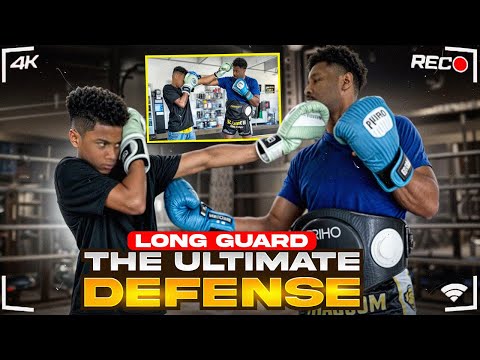
The Perfect Muay Thai Long Guard: How to Use It
0
Standard Long Guard·Kingdom Martial Arts Academy·Added by Admin
In this video, we delve into the intricacies of the Muay Thai long guard technique, demonstrating how to effectively inc…
Translation: standard long guard
The Standard Long Guard extends the lead arm fully forward, hand open or in a loose fist, placing the palm or forearm against the opponent's forehead, chin, or shoulder to create a frame that prevents them from entering striking range. [1] The rear hand remains high near the chin as a secondary defence, while the extended lead arm acts as a measuring stick that controls distance and disrupts the opponent's attacks at their point of origin. [1],[2] The standard long guard is effective against opponents who close distance aggressively, as the extended arm constantly pushes them back and obstructs their line of sight. [2],[3]
The standard long guard position became prominent in modern MMA through fighters with long reach advantages who discovered that the extended arm could serve as both a defensive tool and an offensive probe. [1] Jon Jones's use of the long guard in the UFC helped popularise the technique in contemporary MMA training. [2],[3]
The long guard is a distinctive Muay Thai defensive position that developed in Thailand's stadium fighting tradition, where managing clinch entries is a critical skill. [1]
The long guard is a standard Muay Thai defence. [1]
No images yet for this technique.
Sign in to suggest an image.
In this video, we delve into the intricacies of the Muay Thai long guard technique, demonstrating how to effectively inc…
No instructional courses yet for this technique.
Sign in to suggest a course.
Risk of injury to the person this technique is applied to
Blocking and parrying absorb strike force; hand/forearm injury from repeated blocking
Skill level needed to execute this technique reliably
Whether this technique is allowed under major competition rule sets
Karate-Do Kyohan: The Master Text (Gichin Funakoshi, 1935)
Alias sources — [1] Muay Thai: The Most Distinguished Art of Fighting (Kraitus, 1988) [2] MMA Instruction Manual (Ryan & Snowden, 2010) [3] MMA Instruction Manual (Ryan & Snowden, 2010)
Effectiveness sources — [1] Muay Thai: The Most Distinguished Art of Fighting (Kraitus, 1988) [2] Muay Thai Counters (Delp, 2005)
Standard katakana transliteration of Western martial arts terminology (外来語) — used in Japanese MMA, boxing, and BJJ communities
Alias sources — [1] Muay Thai: The Most Distinguished Art of Fighting (Kraitus, 1988) [2] MMA Instruction Manual (Ryan & Snowden, 2010) [3] MMA Instruction Manual (Ryan & Snowden, 2010)
Effectiveness sources — [1] Muay Thai: The Most Distinguished Art of Fighting (Kraitus, 1988) [2] Muay Thai Counters (Delp, 2005)
forearm conditioning, reaction speed, structural stability
dense bone structure, strong forearms
forearm flexors/extensors, deltoids, biceps, core (absorbing impact)
If your arms are flared out, you leave your body vulnerable to body kicks. Kingdom Martial Arts Academy emphasizes keeping the guard tight to prevent opponents from exploiting gaps in your defense.
You want a little bit of give in your legs rather than being super straight, as being locked creates immobility and can make you easier to counter. Kingdom Martial Arts Academy notes that maintaining slight flexibility in your stance keeps you mobile and harder to hit clean.
When blocking an uppercut, turn your chin slightly and transition from Long Guard into a fore guard position to protect against the follow-up hook and low kick combinations. Kingdom Martial Arts Academy stresses avoiding a fully locked position that leaves holes in your defense.
The Standard Long Guard extends the lead arm fully forward, hand open or in a loose fist, placing the palm or forearm against the opponent's forehead, chin, or shoulder to create a frame that prevents them from entering striking range. The rear hand remains high near the chin as a secondary defence, while the extended lead arm acts as a measuring stick that controls distance and disrupts the opponent's attacks at their point of origin.
The standard long guard position became prominent in modern MMA through fighters with long reach advantages who discovered that the extended arm could serve as both a defensive tool and an offensive probe. Jon Jones's use of the long guard in the UFC helped popularise the technique in contemporary MMA training.
Unified MMA: legal — Legal defensive technique; IBJJF: legal — Legal; IJF: legal — Legal defensive action; WBC/Boxing: legal — Legal; WKF: legal — Legal; WT: legal — Legal
Danger rating 3/10. Moderate — blocking and parrying absorb strike force; hand/forearm injury from repeated blocking
The standard setup chain: Anticipate the Attack → Execute Defence → Recover Stance → Counter or Disengage.
Standard counters include: Timing — attack when the defence is recovering or between movements / Feint — use deception to create openings in the defensive structure / Angle Change — attack from an unexpected angle that the defence does not cover.
Common variants: High block (forearm raised above the head to protect against overhead…); Low block (forearm driven downward to deflect kicks or body strikes); Cross block (forearm crosses the body to protect the opposite side); Double forearm block (both forearms together for maximum coverage).
The long guard is a standard Muay Thai defence.
Top errors to watch for: Extending both arms — only the lead arm extends; the rear stays guarding the chin / Posting with the palm facing up — the palm should face the opponent or downward / Standing still with the arm extended — the long guard is active; move your feet and adjust the post / Leaving the arm extended when the opponent is too close — retract and use a tighter guard.
The Standard Long Guard is also known as Sutandādo Rongu Gādo, Basic Long Guard, Extended Arm Guard, Muay Thai Long Guard.