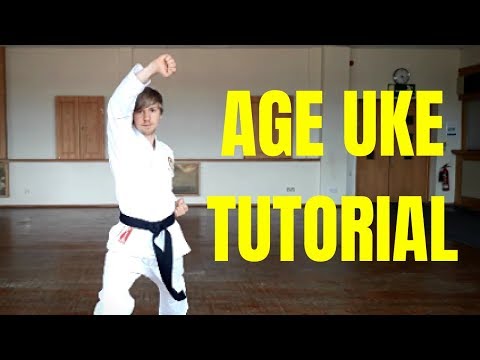
How to perform a Rising Block (Age Uke Tutorial)
0
Age Uke·EmpoweringPT·Added by Admin
Age Uke is the first block that you learn, and it remains a staple in any Karatekas arsenal due to its efficiency in pro…
Translation: rising block
Age Uke (rising block) is the traditional karate high block where the forearm rises upward in an arc to intercept a downward-striking attack, deflecting it up and away from the head. [1] The block is executed by driving the forearm from a low chambered position upward in a sweeping motion, with the blocking surface being the outer edge of the forearm (pinky side). [1],[2] The block finishes with the forearm angled above the forehead, slightly forward of the head, creating a roof-like structure that deflects attacks overhead. [2],[3]
Age uke is effective as a protective measure against overhead and downward-striking attacks in traditional martial arts contexts. [1] In full-contact competition, the technique's chamber and sweeping arc are considered too slow for use against fast combinations, and modern karate competitors typically use tighter guard positions instead. [2] However, the underlying principle of the rising forearm block remains useful in self-defence applications against untrained overhead attacks. [1]
Age uke is one of the foundational blocks codified by Gichin Funakoshi in Karate-Do Kyohan (1935), traceable to Okinawan karate's tode tradition. [1] It appears in the basic kata of virtually every karate style, including Shotokan's Heian series and Goju-ryu's Gekisai kata. [2] Masatoshi Nakayama formalised its practice methodology in Dynamic Karate (1966) for the JKA (Japan Karate Association). [3]
Age uke (rising block) is a standard karate block used in kata and kumite competition. [1]
No images yet for this technique.
Sign in to suggest an image.
Age Uke is the first block that you learn, and it remains a staple in any Karatekas arsenal due to its efficiency in pro…
No instructional courses yet for this technique.
Sign in to suggest a course.
Risk of injury to the person this technique is applied to
Blocking and parrying absorb strike force; hand/forearm injury from repeated blocking
Skill level needed to execute this technique reliably
Whether this technique is allowed under major competition rule sets
Karate-Do Kyohan: The Master Text (Gichin Funakoshi, 1935)
Alias sources — [1] Karate-Do Kyohan (Funakoshi, 1935) [2] The Kyokushin Way (Oyama, 1979) [3] Dynamic Karate (Nakayama, 1966)
Effectiveness sources — [1] Karate-Do Kyohan (Funakoshi, 1935) [2] Dynamic Karate (Nakayama, 1966)
Official karate technique names (和語/漢語)
Established Japanese martial arts naming convention — native Japanese term (和語/漢語)
Alias sources — [1] Karate-Do Kyohan (Funakoshi, 1935) [2] The Kyokushin Way (Oyama, 1979) [3] Dynamic Karate (Nakayama, 1966)
Effectiveness sources — [1] Karate-Do Kyohan (Funakoshi, 1935) [2] Dynamic Karate (Nakayama, 1966)
forearm conditioning, reaction speed, structural stability
dense bone structure, strong forearms
forearm flexors/extensors, deltoids, biceps, core (absorbing impact)
Beginners often bring the arm straight up with a 90-degree angle at the elbow, which creates a weak structure. Instead, the block should start from the hip, come across the body at an angle (almost like an uppercut), and twist at the top for proper tension and strength.
Age uke defends the head, which is the most important part of the body because it controls the limbs and organs. Keeping your guard up and using this block effectively is essential whether you're on the street or sparring.
Push upwards with your arm while using your hip to generate force, which creates tension from the floor all the way up through your body. The block is traditionally performed in a front stance, which is stronger than performing it from the side.
Make sure to get your arm all the way up above your head to properly block the punch. Stopping short of full extension is a common mistake even seen among brown belts.
Age Uke (rising block) is the traditional karate high block where the forearm rises upward in an arc to intercept a downward-striking attack, deflecting it up and away from the head. The block is executed by driving the forearm from a low chambered position upward in a sweeping motion, with the blocking surface being the outer edge of the forearm (pinky side).
Age uke is one of the fundamental blocks in traditional karate, appearing in the earliest kata (forms) of Okinawan and Japanese karate systems. It is one of the first techniques taught to beginners in Shotokan, Goju-ryu, Wado-ryu, and virtually all karate styles.
Unified MMA: legal — Legal defensive technique; WBC/Boxing: legal — Legal — blocking and evasion are core boxing skills; WKF: legal — Legal — blocking is a fundamental karate skill; Kyokushin: legal — Legal; WT: legal — Legal; WAKO: legal — Legal; K: legal — 1/GLORY — Legal; IFMA: legal — Legal
Danger rating 3/10. Moderate — blocking and parrying absorb strike force; hand/forearm injury from repeated blocking
The standard setup chain: Anticipate the Attack → Execute Defence → Recover Stance → Counter or Disengage.
Standard counters include: Timing — attack when the defence is recovering or between movements / Feint — use deception to create openings in the defensive structure / Angle Change — attack from an unexpected angle that the defence does not cover.
Common variants: High block (forearm raised above the head to protect against overhead…); Low block (forearm driven downward to deflect kicks or body strikes); Cross block (forearm crosses the body to protect the opposite side); Double forearm block (both forearms together for maximum coverage).
Age uke (rising block) is a standard karate block used in kata and kumite competition.
Top errors to watch for: Blocking directly overhead without the angle — the forearm should be tilted at roughly 45° above the head / Stopping the block with the arm too close to the head — extend it slightly away to create deflection space / Using the inside of the forearm — block with the outside (ulna bone side) for a harder surface / Not rotating the forearm during the rising motion — the rotation adds the deflective spiralling action.
The Age Uke is also known as Age Uke, Rising Block, Upward Block, Jodan Age Uke.