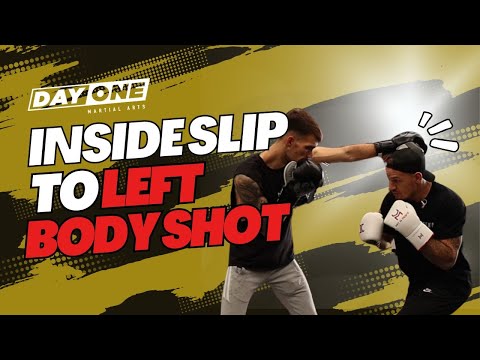
Knockout Combinations: Inside Slip Tutorial with Left Body Shot Counter
0
Inside Slip·Day One Martial Arts·Added by Admin
🥊 Welcome to our latest "Jab Defense Masterclass" straight from Melbourne, Australia! Join us as we dive deep into the …
Translation: inside slip
The Inside Slip moves the head to the inside of the incoming punch (toward the opponent's centre), rotating the upper body so the punch passes over the outside shoulder. [1] The inside slip is more aggressive than the outside slip because it moves the defender closer to the opponent, placing them in range for counter-hooks, uppercuts, and body shots. [1],[2] The risk of the inside slip is that the defender moves into the path of the opponent's rear hand, making timing and defensive awareness critical. [2],[3]
The inside slip is effective against straight punches (jabs and crosses) by moving the head to the inside of the incoming punch, simultaneously evading the strike and positioning the defender for counter-hooks and body shots. [1] However, slipping inside carries greater risk than the outside slip because it places the defender in the path of the opponent's rear hand. [2]
Slipping is one of the oldest defensive techniques in boxing, described in early prizefighting manuals and refined throughout the 20th century by defensive boxing specialists. [1]
The inside slip is a standard defensive technique in boxing and MMA. [1]
No images yet for this technique.
Sign in to suggest an image.
🥊 Welcome to our latest "Jab Defense Masterclass" straight from Melbourne, Australia! Join us as we dive deep into the …
No instructional courses yet for this technique.
Sign in to suggest a course.
Risk of injury to the person this technique is applied to
Evasion techniques avoid contact entirely; lowest injury risk of all techniques
Skill level needed to execute this technique reliably
Whether this technique is allowed under major competition rule sets
Boxing (Edwin Haislet, 1940)
Alias sources — [1] Championship Fighting (Dempsey, 1950) [2] Boxing Mastery (Hatmaker, 2004) [3] Fighter's Fact Book (Christensen, 2000)
Effectiveness sources — [1] Championship Fighting (Dempsey, 1950) [2] Boxing Mastery (Hatmaker, 2004)
Standard katakana transliteration of Western martial arts terminology (外来語) — used in Japanese MMA, boxing, and BJJ communities
Alias sources — [1] Championship Fighting (Dempsey, 1950) [2] Boxing Mastery (Hatmaker, 2004) [3] Fighter's Fact Book (Christensen, 2000)
Effectiveness sources — [1] Championship Fighting (Dempsey, 1950) [2] Boxing Mastery (Hatmaker, 2004)
neck flexibility, knee bend coordination, visual tracking
shorter stature for easier level changes, strong neck
neck muscles, quadriceps, obliques, calves
Position your rear foot in line with your front foot. When you slip to the inside, you'll be slightly off-balance, so proper foot alignment is essential for maintaining control.
Go back down to the body again. After a good body shot, repeating the same target—finishing with a combination like a one-two followed by another left body shot—is the most effective follow-up.
As you drop down to throw the shot, pull your rear shoulder back—that's what launches the punch. Load your rear leg and engage your core ('put the engine back in the water') to drive power into the strike.
The Inside Slip moves the head to the inside of the incoming punch (toward the opponent's centre), rotating the upper body so the punch passes over the outside shoulder. The inside slip is more aggressive than the outside slip because it moves the defender closer to the opponent, placing them in range for counter-hooks, uppercuts, and body shots.
The inside slip has been a fundamental boxing technique for generations, favoured by aggressive counter-punchers who want to close distance while evading. Its risk-reward profile makes it a technique associated with skilled, experienced fighters.
Unified MMA: legal — Legal defensive technique; WBC/Boxing: legal — Legal — blocking and evasion are core boxing skills; WKF: legal — Legal — blocking is a fundamental karate skill; Kyokushin: legal — Legal; WT: legal — Legal; WAKO: legal — Legal; K: legal — 1/GLORY — Legal; IFMA: legal — Legal
Danger rating 1/10. Low — evasion techniques avoid contact entirely; lowest injury risk of all techniques
The standard setup chain: Read the Punch → Bend at the Waist/Knees → Maintain Eye Contact → Counter from Angle.
Standard counters include: Timing — attack when the defence is recovering or between movements / Feint — use deception to create openings in the defensive structure / Angle Change — attack from an unexpected angle that the defence does not cover.
Common variants: Inside slip (moving the head to the inside of the incoming punch); Outside slip (moving the head to the outside of the incoming punch); Bob and weave (ducking under a hook and rising on the other side); Pull-back (leaning the head and torso backward to make the punch fal…).
The inside slip is a standard defensive technique in boxing and MMA.
Top errors to watch for: Slipping too far inside — you end up directly in front of the opponent's rear hand / Not bending the knees — the inside slip should lower your level, not just lean sideways / Dropping the rear hand while slipping inside — the rear hand must protect the chin on the inside / Staying inside after the slip — return to centre or clinch immediately; lingering is dangerous.
The Inside Slip is also known as Insaido Surippu, Inside Head Slip, Inward Slip, Counter Slip.