Judo Slip Examen
0
Slip·FamSlingerland
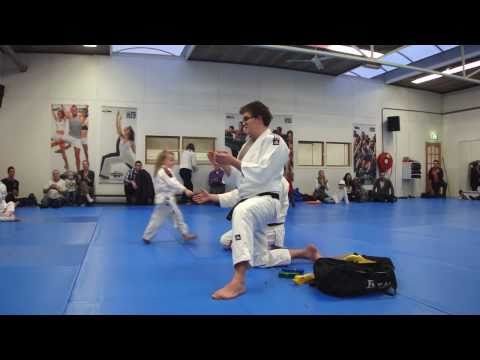
Zaterdag ochtend 12 februari 2011 het Judo examen voor blauwe slip - http://www.denedelgouda.nl
Translation: slipping
The Slip subfamily covers the defensive technique where the fighter rotates the upper body laterally to move the head off the centreline, allowing a straight punch to pass over the shoulder. [1] Slipping is the most commonly used head movement defence in boxing because it is effective against the most common attacks — jabs and crosses — while keeping the fighter in range for counter-punches. [1],[2] Slips can be executed to the inside (toward the opponent's body) or to the outside (away from the opponent's rear hand), each creating different counter-attacking opportunities and risks. [2],[3]
Slipping is one of the oldest and most fundamental boxing defensive techniques. [1]
Slipping is used at all levels of boxing and MMA competition. [1]
No images yet for this technique.
Sign in to suggest an image.
Zaterdag ochtend 12 februari 2011 het Judo examen voor blauwe slip - http://www.denedelgouda.nl
No instructional courses yet for this technique.
Sign in to suggest a course.
Risk of injury to the person this technique is applied to
Evasion techniques avoid contact entirely; lowest injury risk of all techniques
Skill level needed to execute this technique reliably
Whether this technique is allowed under major competition rule sets
Boxing (Edwin Haislet, 1940)
Alias sources — [1] Championship Fighting (Dempsey, 1950) [2] Boxing Mastery (Hatmaker, 2004) [3] Karate-Do Kyohan (Funakoshi, 1935)
Effectiveness sources — [1] Boxing: The Complete Guide to Training and Fitness (Hatmaker, 2004) [2] Mastering Jujitsu (Gracie & Danaher, 2003)
Standard katakana transliteration of Western martial arts terminology (外来語) — used in Japanese MMA, boxing, and BJJ communities
Alias sources — [1] Championship Fighting (Dempsey, 1950) [2] Boxing Mastery (Hatmaker, 2004) [3] Karate-Do Kyohan (Funakoshi, 1935)
Effectiveness sources — [1] Boxing: The Complete Guide to Training and Fitness (Hatmaker, 2004) [2] Mastering Jujitsu (Gracie & Danaher, 2003)
neck flexibility, knee bend coordination, visual tracking
shorter stature for easier level changes, strong neck
neck muscles, quadriceps, obliques, calves
Every move, in any martial art, shares a few universal traits. Mix and match below to pinpoint the right tool — or compare equivalents across styles.
The Inside Slip moves the head to the inside of the incoming punch (toward the opponent's centre), rotating the upper body so the punch passes over the outside shoulder. [1] The inside slip is more aggressive than the outside slip because it moves the defender closer to the opponent, placing them in range for counter-hooks, uppercuts, and body shots. [1,2] The risk of the inside slip is that the defender moves into the path of the opponent's rear hand, making timing and defensive awareness critical. [2,3]
The Outside Slip moves the head to the outside of the incoming punch (away from the opponent's centre), rotating the upper body so the punch passes over the inside shoulder. [1] The outside slip is the safer of the two slip directions because it moves the defender away from the opponent's rear hand, reducing the risk of being hit by the next punch in a combination. [1,2] The outside slip creates an excellent angle for counter-crosses and overhands thrown over the top of the opponent's extended arm. [2,3]
The Slip subfamily covers the defensive technique where the fighter rotates the upper body laterally to move the head off the centreline, allowing a straight punch to pass over the shoulder. Slipping is the most commonly used head movement defence in boxing because it is effective against the most common attacks — jabs and crosses — while keeping the fighter in range for counter-punches.
Slipping has been a fundamental boxing technique since the sport's formalisation, considered one of the defining skills of the sweet science. Every great defensive boxer in history has been a master of the slip, from Jack Johnson to Floyd Mayweather Jr.
Unified MMA: legal — Legal defensive technique; WBC/Boxing: legal — Legal — blocking and evasion are core boxing skills; WKF: legal — Legal — blocking is a fundamental karate skill; Kyokushin: legal — Legal; WT: legal — Legal; WAKO: legal — Legal; K: legal — 1/GLORY — Legal; IFMA: legal — Legal
Danger rating 1/10. Low — evasion techniques avoid contact entirely; lowest injury risk of all techniques
The standard setup chain: Read the Punch → Bend at the Waist/Knees → Maintain Eye Contact → Counter from Angle.
Standard counters include: Timing — attack when the defence is recovering or between movements / Feint — use deception to create openings in the defensive structure / Angle Change — attack from an unexpected angle that the defence does not cover.
Common variants: Inside slip (moving the head to the inside of the incoming punch); Outside slip (moving the head to the outside of the incoming punch); Bob and weave (ducking under a hook and rising on the other side); Pull-back (leaning the head and torso backward to make the punch fal…).
Slipping is used at all levels of boxing and MMA competition.
Top errors to watch for: Leaning at the waist instead of bending the knees — the slip should lower your level slightly, not just tilt your torso / Moving the head too far laterally — a 3-4 inch movement is sufficient; more wastes energy and position / Dropping the hands while slipping — maintain your guard throughout / Slipping straight backward instead of laterally — that's a pull-back, not a slip; slips are sideways.
The Slip is also known as Slipping, Surippingu, Head Slip.