Intermediate Concerns in Shoulder Rolls.wmv
0
Standard Shoulder Roll·Kevin Secours
For a comprehensive treatment of rolling please visit: https://combatprofessor.uscreen.io/programs/level-6-mobility-bre…
Translation: standard shoulder roll
The Standard Shoulder Roll executes the fundamental shoulder roll defence by raising the lead shoulder to chin height and rotating the torso away from the incoming punch, allowing the strike to deflect off the shoulder's surface. [1] The rotation is powered by the core and hips, not just the shoulder — the entire torso turns to redirect the force of the punch. [1],[2] Simultaneously, the rear hand stays high to catch any punch that gets past the shoulder, creating a layered defensive system. [2],[3]
The standard shoulder roll was refined in Philadelphia's boxing tradition and brought to worldwide prominence by Floyd Mayweather Jr., who used it as the centrepiece of his defensive system. [1] The technique requires exceptional timing and ring IQ, making it an advanced defensive skill typically associated with elite-level boxers. [2],[3]
The shoulder roll is one of the most effective passive defence techniques in boxing, deflecting punches off the lead shoulder while keeping the rear hand loaded for counter-punches. [1] The Philly Shell variation positions the lead arm across the body and the lead shoulder high, creating a multi-layered defence that can neutralise entire combinations. [2] The technique requires exceptional timing and is less effective against body shots to the open side. [2]
The shoulder roll was refined in Philadelphia's boxing gyms, developed through a lineage of defensive specialists including George Benton, who taught the technique to numerous world champions. [1] Floyd Mayweather Sr. and his brother Roger Mayweather further developed the Philly Shell guard, passing it to Floyd Mayweather Jr., who perfected it into the most successful defensive system in modern boxing. [2]
Floyd Mayweather Jr. used the shoulder roll as the foundation of his defensive system across his entire undefeated 50-0 career (1996-2017), compiling the lowest punches-landed-against percentage among modern champions according to CompuBox data. [1] James Toney also employed the shoulder roll extensively, notably in his dominant middleweight championship reign. [2]
No images yet for this technique.
Sign in to suggest an image.
For a comprehensive treatment of rolling please visit: https://combatprofessor.uscreen.io/programs/level-6-mobility-bre…
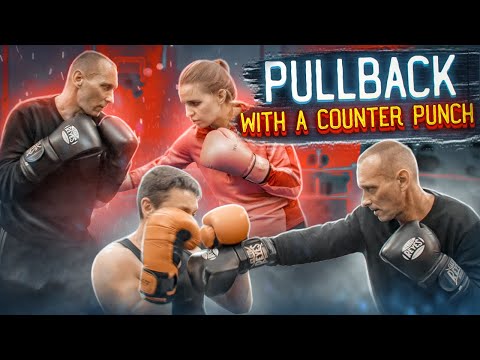
In this video, we show you how to combine shoulder protection and pullback with a counterattack. This combination is alr…
You may have seen Conor McGregor vs Donald Cerrone UFC 246. Here is how we’ve been training it at my gym. We pull this m…
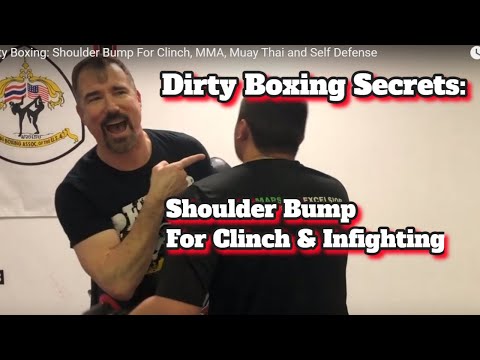
The standard shoulder roll is a foundational evasive technique taught across multiple martial disciplines with significant pedagogical overlap despite differing contexts. Kevin Secours emphasizes that proper shoulder rolling prioritizes spinal protection and force dissipation over the commonly overemphasized hand placement. The ideal roll moves diagonally from shoulder to shoulder without contacting the spine, utilizing the meat of the shoulder to distribute impact across the body rather than concentrating force at a single point—analogous to water spiraling down a drain rather than slamming into the floor. Secours stresses continuous speed maintenance and deliberate shoulder-to-shoulder transitions, citing General Alexander Brzezinski's systemic approach of switching shoulders mid-air to maximize control. Coach Ray's contribution addresses shoulder positioning in clinch contexts within MMA and Muay Thai, describing shoulder bumps as offensive drives to create striking distance and using hip and leg drive rather than isolated shoulder force. Raab Boxing Academy focuses on shoulder defense as a preparatory base for immediate counter-striking combinations, emphasizing that shoulder movement must be powered by leg drive to generate effective follow-up punches. All three instructors converge on the principle that proper shoulder mechanics require coordinated body movement—particularly hip and leg engagement—and that the shoulder movement itself serves a broader tactical purpose within fighting systems rather than existing as an isolated technique.
Synthesized from 3 instructors
No instructional courses yet for this technique.
Sign in to suggest a course.
Risk of injury to the person this technique is applied to
Evasion techniques avoid contact entirely; lowest injury risk of all techniques
Skill level needed to execute this technique reliably
Whether this technique is allowed under major competition rule sets
Boxing (Edwin Haislet, 1940)
Alias sources — [1] Championship Fighting (Dempsey, 1950) [2] Boxing Mastery (Hatmaker, 2004) [3] Fighter's Fact Book (Christensen, 2000)
Effectiveness sources — [1] Boxing Mastery (Hatmaker, 2004) [2] Championship Fighting (Dempsey, 1950)
Standard katakana transliteration of Western martial arts terminology (外来語) — used in Japanese MMA, boxing, and BJJ communities
Alias sources — [1] Championship Fighting (Dempsey, 1950) [2] Boxing Mastery (Hatmaker, 2004) [3] Fighter's Fact Book (Christensen, 2000)
Effectiveness sources — [1] Boxing Mastery (Hatmaker, 2004) [2] Championship Fighting (Dempsey, 1950)
neck flexibility, knee bend coordination, visual tracking
shorter stature for easier level changes, strong neck
neck muscles, quadriceps, obliques, calves
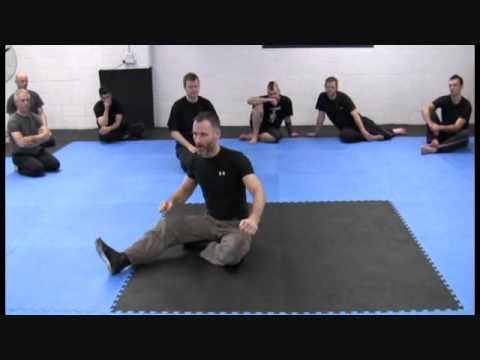
According to Kevin Secours, proper spine alignment is 90% of the importance in a shoulder roll. In a judo-style roll, your neck-to-spine connection and multiple vertebrae roll directly on the ground, which is why shoulder-to-shoulder rolling technique matters—to protect your spine from direct impact.
Kevin Secours emphasizes that you need spiral control in your lower torso, which allows you to convert the roll into any position. Maintain continuous, even speed throughout the entire range of motion without hiking up or falling back—this lets you see exactly what's required and stay balanced on your shoulder.
A comfortable roll might alternate right shoulder to left shoulder without much thought, but a controlled roll requires you to be intentional about your sequence and maintain awareness of your lower torso throughout. Without this spiral control, you end up falling where you're falling rather than controlling where you land.
The Standard Shoulder Roll executes the fundamental shoulder roll defence by raising the lead shoulder to chin height and rotating the torso away from the incoming punch, allowing the strike to deflect off the shoulder's surface. The rotation is powered by the core and hips, not just the shoulder — the entire torso turns to redirect the force of the punch.
The standard shoulder roll was refined in Philadelphia's boxing tradition and brought to worldwide prominence by Floyd Mayweather Jr. , who used it as the centrepiece of his defensive system.
Unified MMA: legal — Legal defensive technique; WBC/Boxing: legal — Legal — blocking and evasion are core boxing skills; WKF: legal — Legal — blocking is a fundamental karate skill; Kyokushin: legal — Legal; WT: legal — Legal; WAKO: legal — Legal; K: legal — 1/GLORY — Legal; IFMA: legal — Legal
Danger rating 1/10. Low — evasion techniques avoid contact entirely; lowest injury risk of all techniques
The standard setup chain: Anticipate the Attack → Execute Defence → Recover Stance → Counter or Disengage.
Standard counters include: Timing — attack when the defence is recovering or between movements / Feint — use deception to create openings in the defensive structure / Angle Change — attack from an unexpected angle that the defence does not cover.
Common variants: Inside slip (moving the head to the inside of the incoming punch); Outside slip (moving the head to the outside of the incoming punch); Bob and weave (ducking under a hook and rising on the other side); Pull-back (leaning the head and torso backward to make the punch fal…).
Floyd Mayweather Jr. used the shoulder roll as the foundation of his defensive system across his entire undefeated 50-0 career (1996-2017), compiling the lowest punches-landed-against percentage among modern champions according to CompuBox data.
Top errors to watch for: Taking the rear hand off the chin — this is the cardinal sin of the Philly shell; the rear hand is always on the chin / Rolling against hooks or uppercuts — the shoulder roll only works against straight punches / Leaning back too far during the roll — a slight rotation is sufficient; over-leaning compromises balance / Not countering — the roll without the counter is just passive defence.
The Standard Shoulder Roll is also known as Sutandādo Shorudā Rōru, Shoulder Block, Roll Defence, Shell Roll.