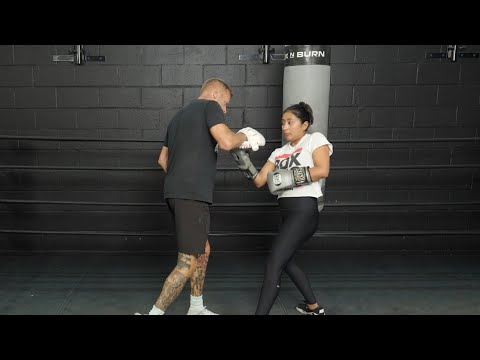
How To Punch Someone Using The Shoulder Roll Defense (The Philly Shell)
0
Shoulder Roll-Philly Shell·World Class Boxing Channel
How To Punch Someone Using The Shoulder Roll Defense (The Philly Shell). This video is from a question Tom received ask…
Translation: shoulder roll / Philly shell
The Shoulder Roll (Philly Shell) subfamily covers the defensive stance and technique where the fighter turns the lead shoulder upward to deflect punches off the shoulder while simultaneously rolling the head away from the strike. [1] The Philly Shell is both a stance (lead hand low at the waist, rear hand high by the chin, lead shoulder raised) and a defensive technique (using the raised shoulder and body rotation to deflect strikes). [1],[2] The shoulder roll is considered one of the most energy-efficient defensive techniques because it uses the body's natural structure rather than muscular effort to deflect punches. [2],[3]
The shoulder roll stance was developed in Philadelphia's boxing gyms, earning the name 'Philly Shell' from its origins in the city's rich boxing tradition. [1] James Toney popularised the technique in the 1990s, and Floyd Mayweather Jr. perfected it into the most effective defensive system in modern boxing, using the Philly Shell to achieve a 50-0 professional record. [2],[3]
The shoulder roll (Philly Shell) uses the lead shoulder to deflect punches while keeping the rear hand high for counter-striking. [1]
The Philly Shell was popularised in Philadelphia boxing gyms and perfected by Floyd Mayweather Jr. [1]
Floyd Mayweather Jr. used the Philly Shell en route to a 50-0 undefeated record. [1]
No images yet for this technique.
Sign in to suggest an image.
How To Punch Someone Using The Shoulder Roll Defense (The Philly Shell). This video is from a question Tom received ask…
Boxing is renowned and celebrated for its rich and storied history. A sport with roots that can be traced all the way ba…
No instructional courses yet for this technique.
Sign in to suggest a course.
Risk of injury to the person this technique is applied to
Evasion techniques avoid contact entirely; lowest injury risk of all techniques
Skill level needed to execute this technique reliably
Whether this technique is allowed under major competition rule sets
Boxing (Edwin Haislet, 1940)
Alias sources — [1] Championship Fighting (Dempsey, 1950) [2] Boxing Mastery (Hatmaker, 2004) [3] Fighter's Fact Book (Christensen, 2000)
Effectiveness sources — [1] Boxing: The Complete Guide to Training and Fitness (Hatmaker, 2004)
Standard katakana transliteration of Western martial arts terminology (外来語) — used in Japanese MMA, boxing, and BJJ communities
Alias sources — [1] Championship Fighting (Dempsey, 1950) [2] Boxing Mastery (Hatmaker, 2004) [3] Fighter's Fact Book (Christensen, 2000)
Effectiveness sources — [1] Boxing: The Complete Guide to Training and Fitness (Hatmaker, 2004)
neck flexibility, knee bend coordination, visual tracking
shorter stature for easier level changes, strong neck
neck muscles, quadriceps, obliques, calves
Every move, in any martial art, shares a few universal traits. Mix and match below to pinpoint the right tool — or compare equivalents across styles.
The lead hand covers the rib cage to defend against body shots, while the chin is tucked behind the lead shoulder which is elevated to defend against power shots to the head. The back hand remains in position for counter-punching. According to BoxRope's breakdown, you need to keep everything compact and slightly turned away from your opponent.
Yes—the Philly Shell requires amazing reflexes and a lot of skill to execute properly. BoxRope strongly recommends that you feel really comfortable with fundamentals and basics before attempting this style in sparring.
The shoulder roll shifts your weight to the back foot, allowing for quick counter shots. You can counter with a right hand down the center or a rear uppercut, as Floyd Mayweather frequently demonstrates rolling off the ropes.
With the lead hand covering the body in this position, the jab becomes more of a flick-up jab rather than a traditional power jab. However, the back hand is perfectly positioned for power shots.
The Shoulder Roll (Philly Shell) subfamily covers the defensive stance and technique where the fighter turns the lead shoulder upward to deflect punches off the shoulder while simultaneously rolling the head away from the strike. The Philly Shell is both a stance (lead hand low at the waist, rear hand high by the chin, lead shoulder raised) and a defensive technique (using the raised shoulder and body rotation to deflect strikes).
The shoulder roll stance was developed in Philadelphia's boxing gyms, earning the name 'Philly Shell' from its origins in the city's rich boxing tradition. James Toney popularised the technique in the 1990s, and Floyd Mayweather Jr.
Unified MMA: legal — Legal defensive technique; WBC/Boxing: legal — Legal — blocking and evasion are core boxing skills; WKF: legal — Legal — blocking is a fundamental karate skill; Kyokushin: legal — Legal; WT: legal — Legal; WAKO: legal — Legal; K: legal — 1/GLORY — Legal; IFMA: legal — Legal
Danger rating 1/10. Low — evasion techniques avoid contact entirely; lowest injury risk of all techniques
The standard setup chain: Anticipate the Attack → Execute Defence → Recover Stance → Counter or Disengage.
Standard counters include: Timing — attack when the defence is recovering or between movements / Feint — use deception to create openings in the defensive structure / Angle Change — attack from an unexpected angle that the defence does not cover.
Common variants: Inside slip (moving the head to the inside of the incoming punch); Outside slip (moving the head to the outside of the incoming punch); Bob and weave (ducking under a hook and rising on the other side); Pull-back (leaning the head and torso backward to make the punch fal…).
Floyd Mayweather Jr. used the Philly Shell en route to a 50-0 undefeated record.
Top errors to watch for: Dropping the rear hand from the chin — the rear hand MUST protect the chin at all times in the Philly shell / Rolling the shoulder against hooks — the shoulder roll is for straight punches; hooks come around the shoulder / Using the Philly shell against body attacks — the lead hand must be available to check body shots / Attempting the shoulder roll without sufficient experience — it requires elite timing and reflexes.
The Shoulder Roll-Philly Shell is also known as Shorudā Rōru, Philly Shell, Crab Defence, Mayweather Defence.