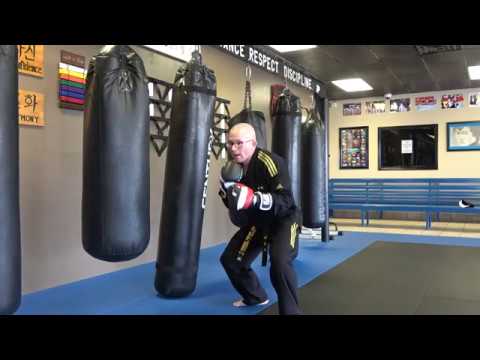
How to Bob & Weave- Step by Step Tutorial
0
Standard Bob And Weave·Maximum Martial Arts University·Added by Admin
What is a Bob & Weave motion?!? How do I do it? Which way should I move??? Let's answer those questions! Following along…
Translation: standard bob and weave
The Standard Bob And Weave executes the fundamental bob-and-weave where the fighter drops the level by bending the knees (not the waist), ducking below the incoming hook or overhand, then weaves laterally by shifting the weight to one side while rising back to fighting stance. [1] The key mechanics are: bend the knees to drop level, keep the eyes on the opponent throughout, shift laterally during the rise, and re-emerge in a balanced stance ready to counter. [1],[2] The standard bob and weave must be performed in a U-shaped motion, not a V-shape, to maintain balance and avoid popping straight back up into the next punch. [2],[3]
The bob and weave is highly effective against hooks and wide punches, as it removes the head below the arc of the strike while simultaneously loading the body for a counter-punch. [1] Dempsey identified the bob and weave as essential for inside fighting, noting that it allows shorter fighters to close distance safely against taller opponents. [1] The technique is less effective against uppercuts and knee strikes, which target the space the head moves into when ducking. [2]
The bob and weave became a signature technique of the peek-a-boo style developed by trainer Cus D'Amato, who taught it to Floyd Patterson and later Mike Tyson. [1] D'Amato's system emphasised continuous head movement with the bob and weave as its centrepiece, creating a seamless offensive-defensive cycle. [2]
Mike Tyson's bob-and-weave offence was central to his 37 knockouts in his first 44 professional fights (1985-1990), allowing him to close distance against larger opponents and deliver devastating hooks and uppercuts. [1]
No images yet for this technique.
Sign in to suggest an image.
What is a Bob & Weave motion?!? How do I do it? Which way should I move??? Let's answer those questions! Following along…
No instructional courses yet for this technique.
Sign in to suggest a course.
Risk of injury to the person this technique is applied to
Evasion techniques avoid contact entirely; lowest injury risk of all techniques
Skill level needed to execute this technique reliably
Whether this technique is allowed under major competition rule sets
Boxing (Edwin Haislet, 1940)
Alias sources — [1] Championship Fighting (Dempsey, 1950) [2] Boxing Mastery (Hatmaker, 2004) [3] Fighter's Fact Book (Christensen, 2000)
Effectiveness sources — [1] Championship Fighting (Dempsey, 1950) [2] Muay Thai Counters (Delp, 2005)
Standard katakana transliteration of Western martial arts terminology (外来語) — used in Japanese MMA, boxing, and BJJ communities
Alias sources — [1] Championship Fighting (Dempsey, 1950) [2] Boxing Mastery (Hatmaker, 2004) [3] Fighter's Fact Book (Christensen, 2000)
Effectiveness sources — [1] Championship Fighting (Dempsey, 1950) [2] Muay Thai Counters (Delp, 2005)
neck flexibility, knee bend coordination, visual tracking
shorter stature for easier level changes, strong neck
neck muscles, quadriceps, obliques, calves
Bob and weave are two separate things according to Maximum Martial Arts University. You bob first to drop level, then choose which direction to weave based on watching your opponent's reaction and positioning, rather than using the same weave after every punch.
Set your shoulders up to create power in the direction you're moving. When weaving right, bring your right shoulder up so your left hand has power; when weaving left, bring your left shoulder up so your right hand has power, explains Maximum Martial Arts University.
When weaving right, move your right foot first and let your left foot follow. When weaving left, move your left foot first with your right foot following, according to Maximum Martial Arts University.
You must practice recovery immediately after missing or glancing because you have to be ready for your opponent's counter, as emphasized by Maximum Martial Arts University.
The Standard Bob And Weave executes the fundamental bob-and-weave where the fighter drops the level by bending the knees (not the waist), ducking below the incoming hook or overhand, then weaves laterally by shifting the weight to one side while rising back to fighting stance. The key mechanics are: bend the knees to drop level, keep the eyes on the opponent throughout, shift laterally during the rise, and re-emerge in a balanced stance ready to counter.
The standard bob and weave has been a fundamental boxing defensive technique for over a century, taught as a basic skill in boxing gyms worldwide. It is considered one of the essential defensive techniques that every boxer must master.
Unified MMA: legal — Legal defensive technique; WBC/Boxing: legal — Legal — blocking and evasion are core boxing skills; WKF: legal — Legal — blocking is a fundamental karate skill; Kyokushin: legal — Legal; WT: legal — Legal; WAKO: legal — Legal; K: legal — 1/GLORY — Legal; IFMA: legal — Legal
Danger rating 1/10. Low — evasion techniques avoid contact entirely; lowest injury risk of all techniques
The standard setup chain: Read the Punch → Bend at the Waist/Knees → Maintain Eye Contact → Counter from Angle.
Standard counters include: Timing — attack when the defence is recovering or between movements / Feint — use deception to create openings in the defensive structure / Angle Change — attack from an unexpected angle that the defence does not cover.
Common variants: Inside slip (moving the head to the inside of the incoming punch); Outside slip (moving the head to the outside of the incoming punch); Bob and weave (ducking under a hook and rising on the other side); Pull-back (leaning the head and torso backward to make the punch fal…).
Mike Tyson's bob-and-weave offence was central to his 37 knockouts in his first 44 professional fights (1985-1990), allowing him to close distance against larger opponents and deliver devastating hooks and uppercuts.
Top errors to watch for: Dipping straight down without the lateral weave — you come up in the same spot, still in the line of fire / Rising too slowly — the emergence should be explosive; a slow rise gets caught by the follow-up / Dropping the hands during the bob — maintain your guard throughout the motion / Bending forward at the waist — bend the KNEES; the waist stays relatively upright.
The Standard Bob And Weave is also known as Sutandādo Bobu Ando Wību, Standard Bob, U-Shape Weave, Level Change Weave.