Defensive Tactics - Body Lock Clinch
0
Standard Side Body Lock·Valhalla Academy
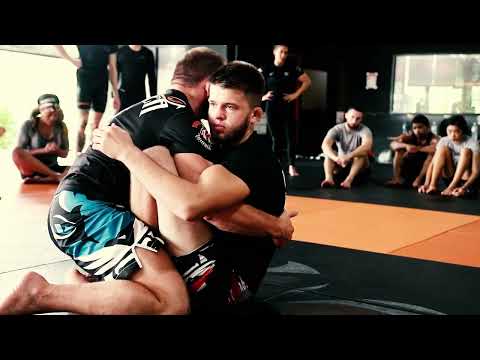
The body lock clinch is a great way to nullify an opponent's striking and get inside for control or a takedown. This tec…
Translation: standard side body lock
The Standard Side Body Lock positions the attacker at the opponent's side with arms locked around the torso, the near hip pressing into the opponent's hip as a pivot point. [1] The attacker uses the hip-to-hip contact to create a fulcrum for rotational forces, driving the opponent sideways and downward in a twisting motion. [1],[2] This position is effective for hip-bump takedowns, lateral lifts, and inside trip combinations that exploit the perpendicular angle. [2],[3]
The side body lock provides lateral control that enables hip throws, trips, and lateral takedowns. [1] The position is tactically important because it can be reached from many other clinch positions — overhook battles, underhook exchanges, and scrambles frequently resolve into side body lock configurations. [1]
A transitional clinch position taught in wrestling and judo. [1]
The standard side body lock is a fundamental wrestling position used in freestyle and Greco-Roman competition at all levels. [1]
No images yet for this technique.
Sign in to suggest an image.
The body lock clinch is a great way to nullify an opponent's striking and get inside for control or a takedown. This tec…
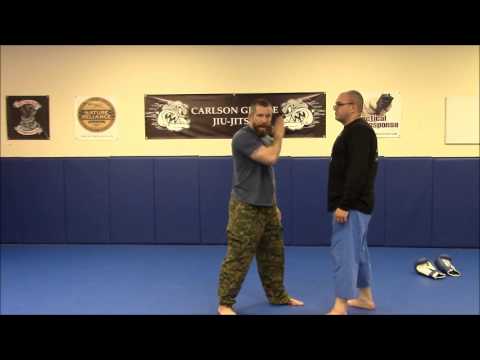
Coach Aleksei Perederiy teaches a couple of methods of passing an opponent's butterfly guard, in the morning all levels …
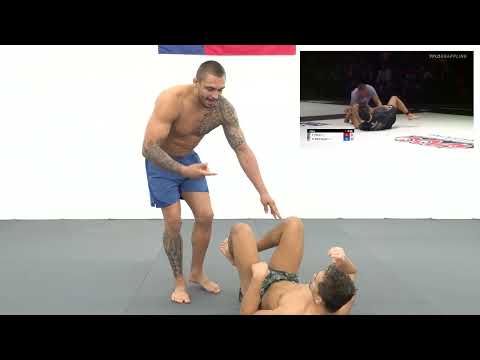
ADCC 2022 Silver Medalist Nick Rodrigue (Nicky Rod) breaks down his Body Lock Pass technique on Felipe Pena at ADCC 2022…
The standard side body lock is a clinch control technique used across grappling and self-defense contexts to immobilize an opponent's torso and create positional dominance. Nicky Rod (Learn Faster BJJ) demonstrates the technique as a transitional pass in no-gi jiu-jitsu, initiated from a prone position where the passer locks hands around the opponent's lower waist after the opponent attempts to sit up, then progresses to head-and-arm control and deep half guard before completing the pass. Brian Jones (Valhalla Academy) addresses the body lock clinch from a self-defense and striking-prevention perspective, emphasizing the critical principle of closing distance and eliminating strike range by achieving chest-to-chest contact with a tight hand lock around the opponent's torso while keeping hips in close and maintaining a lower level to disrupt balance. The Tiger Muay Thai instructor focuses on body lock mechanics against butterfly guard, stressing precise hip positioning (low and wide knees, hips thrust forward), hand placement directly under the spine at shoulder level, and the strategic decision-making required to identify which side offers the most effective passing angle while managing the opponent's leg hooks and frame defenses. All three instructors agree on the fundamental principle of eliminating space between bodies and locking the hands firmly around the torso, though they diverge in application context: jiu-jitsu passing, self-defense clinch work, and guard passing with positional awareness.
Synthesized from 3 instructors
No instructional courses yet for this technique.
Sign in to suggest a course.
Risk of injury to the person this technique is applied to
Body clinch positions enable throws and takedowns; rib compression risk
Skill level needed to execute this technique reliably
Whether this technique is allowed under major competition rule sets
Freestyle Wrestling: A Complete Guide for Coaches and Wrestlers (Petrov, 1977)
Alias sources — [1] Greco-Roman Wrestling (Petrov, 1987) [2] Wrestling Physical Conditioning Encyclopedia (Welker, 2010) [3] Clinch Fighting for MMA (Couture, 2011)
Effectiveness sources — [1] Clinch Fighting for MMA (Couture, 2011)
Standard katakana transliteration of Western martial arts terminology (外来語) — used in Japanese MMA, boxing, and BJJ communities
Alias sources — [1] Greco-Roman Wrestling (Petrov, 1987) [2] Wrestling Physical Conditioning Encyclopedia (Welker, 2010) [3] Clinch Fighting for MMA (Couture, 2011)
Effectiveness sources — [1] Clinch Fighting for MMA (Couture, 2011)
arm length to wrap the torso, squeeze strength, hip drive
long arms and strong grip, powerful lower back
biceps, pectorals, forearms, erector spinae, glutes
There should be no space between you and your opponent. Valhalla Academy emphasizes wrapping your legs around their legs to prevent them from taking a knee, while simultaneously crunching in on their lower back to maintain a tight lock.
Tiger Muay Thai instructs that your grip should be really low and directly under the opponent's spine, with your hands positioned right under your shoulders so you can break pressure using both your shoulder and hands together.
Tiger Muay Thai explains that when your hips are low and knees are wide, it becomes very difficult for your opponent to push you away, whereas if you stay high, their leg strength can easily create distance.
Tiger Muay Thai recommends pulling your grip down with yourself to lower the position, making it harder and more uncomfortable for your opponent to defend or escape.
The Standard Side Body Lock positions the attacker at the opponent's side with arms locked around the torso, the near hip pressing into the opponent's hip as a pivot point. The attacker uses the hip-to-hip contact to create a fulcrum for rotational forces, driving the opponent sideways and downward in a twisting motion.
The standard side body lock is a common transitional clinch position in wrestling, occurring frequently during clinch exchanges and body lock battles where the fighters shift angles. It is taught as a standard clinch variation in both wrestling and MMA programmes.
Unified MMA: legal — Legal — clinching is integral to MMA; IJF: legal — Legal — kumi-kata (grip fighting) is fundamental to judo; IBJJF: legal — Legal — standing grip fighting and clinch work permitted; IFMA: legal — Legal — the clinch is a core element of Muay Thai, clinch dominance is highly…; WBC/Boxing: restricted — Holding is technically a foul — referee breaks clinch, excessive holding resu…; K: restricted — 1/GLORY — One attack from clinch allowed, then referee breaks; WAKO: restricted — Clinch generally broken by referee — limited or no clinch fighting in most fo…; UWW: legal — Legal — clinch is fundamental to wrestling, the primary position in Greco-Roman
Danger rating 4/10. Moderate — body clinch positions enable throws and takedowns; rib compression risk
The standard setup chain: Close Distance → Secure Both Arms → Clasp Hands → Hip Drive.
Standard counters include: Pummeling — fight for inside position by swimming arms under opponent's grips / Frame and Push — create distance using forearm frames against the chest or neck / Grip Break — systematically strip the opponent's controlling grips / Posture Up — straighten the spine and drive the hips forward to break clinch control.
Common variants: Front body lock (locked hands around the torso face-to-face); Rear body lock (hands locked around the torso from behind); Side body lock (angled body lock for trips and throws); Over-arms body lock (locking over both arms to pin the opponent's arms to thei…).
The standard side body lock is a fundamental wrestling position used in freestyle and Greco-Roman competition at all levels.
Top errors to watch for: Locking hands behind the opponent's back without hip contact — the hip must be engaged for throws / Standing too far from the opponent — your body must be tight against their side / Not having a plan when the opponent rotates — anticipate the turn direction and adjust / Trying to throw without first popping the hips — the hip pop initiates all rotational throws.
The Standard Side Body Lock is also known as Sutandādo Saido Bodi Rokku, Basic Side Body Lock, Standard Lateral Lock, Side Clinch Lock Position.