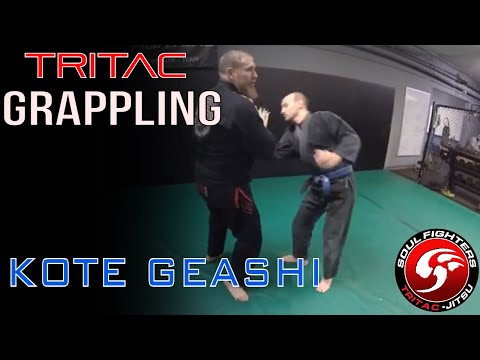
TRITAC Grappling: 2 on 1 Russian Tie - Kote Gaeshi
0
Standard Russian Tie Position·TRITAC Martial Arts·Added by Admin
The 2 on 1 Russian Tie is a very powerful position that opens up many takedown or submissions. Here we are having a litt…
Translation: standard Russian tie position
The Standard Russian Tie Position is the genus-level execution of the classical two-on-one grip where the attacker secures the opponent's wrist with the far hand, grips the tricep with the near hand, and presses the chest into the controlled arm at the elbow bend. [1] From this position, the attacker can execute snap-downs by pulling the arm forward, arm drags by redirecting the arm across the body, go-behinds by circling behind the opponent, or single-leg entries by level-changing under the controlled arm. [1],[2] The three-point control system (wrist grip, tricep grip, chest pressure) makes the standard Russian tie extremely difficult to escape. [2],[3]
This position represents the fundamental two-on-one control as codified in Soviet and Russian wrestling methodology, where it remains a primary offensive clinch position taught from youth through senior levels. [1] The position's versatility has made it a staple across wrestling, MMA, and submission grappling worldwide. [2],[3]
The standard Russian tie position provides reliable two-on-one control that allows immediate access to snap-downs, single-leg entries, and go-behinds. [1] Petrov describes the standard configuration — one hand on the wrist, one hand on the upper arm above the elbow — as the most stable and versatile two-on-one grip. [1]
The standard Russian tie position was developed in Soviet wrestling and is now taught globally. [1]
The standard Russian tie position is a baseline wrestling control grip used in freestyle and MMA competition worldwide. [1]
No images yet for this technique.
Sign in to suggest an image.
The 2 on 1 Russian Tie is a very powerful position that opens up many takedown or submissions. Here we are having a litt…
No instructional courses yet for this technique.
Sign in to suggest a course.
Risk of injury to the person this technique is applied to
Arm control positions limit opponent's offense; low direct injury risk
Skill level needed to execute this technique reliably
Whether this technique is allowed under major competition rule sets
Freestyle Wrestling: A Complete Guide for Coaches and Wrestlers (Petrov, 1977)
Alias sources — [1] Wrestling Physical Conditioning Encyclopedia (Welker, 2010) [2] Freestyle Wrestling: A Complete Guide (Petrov, 2005) [3] FIAS Sambo Technical Terminology (FIAS, 2015)
Effectiveness sources — [1] Freestyle Wrestling: A Complete Guide (Petrov, 2005)
Standard katakana transliteration of Western martial arts terminology (外来語) — used in Japanese MMA, boxing, and BJJ communities
Alias sources — [1] Wrestling Physical Conditioning Encyclopedia (Welker, 2010) [2] Freestyle Wrestling: A Complete Guide (Petrov, 2005) [3] FIAS Sambo Technical Terminology (FIAS, 2015)
Effectiveness sources — [1] Freestyle Wrestling: A Complete Guide (Petrov, 2005)
grip strength, upper body endurance, balance under pressure
strong arms and shoulders, stable base
forearms, deltoids, core, hip muscles
According to TRITAC Martial Arts, you need to use your body weight against the small joint rather than just applying isolated pressure on the arm. By positioning your body to apply weight against one small joint, you create leverage that makes the technique work effectively.
TRITAC Martial Arts instructs you to create a 90-degree angle or 'box' shape with your hands, using three fingers in the meat of the opponent's hand to establish proper positioning before applying the wrist twist.
The Russian Tie is built on controlling a person's body and movement through manipulation of one small point. TRITAC Martial Arts emphasizes understanding body mechanics so you can control someone's structure and movement from that single small joint contact.
The Standard Russian Tie Position is the genus-level execution of the classical two-on-one grip where the attacker secures the opponent's wrist with the far hand, grips the tricep with the near hand, and presses the chest into the controlled arm at the elbow bend. From this position, the attacker can execute snap-downs by pulling the arm forward, arm drags by redirecting the arm across the body, go-behinds by circling behind the opponent, or single-leg entries by level-changing under the controlled arm.
This position represents the fundamental two-on-one control as codified in Soviet and Russian wrestling methodology, where it remains a primary offensive clinch position taught from youth through senior levels. The position's versatility has made it a staple across wrestling, MMA, and submission grappling worldwide.
Unified MMA: legal — Legal — clinching is integral to MMA; IJF: legal — Legal — kumi-kata (grip fighting) is fundamental to judo; IBJJF: legal — Legal — standing grip fighting and clinch work permitted; IFMA: legal — Legal — the clinch is a core element of Muay Thai, clinch dominance is highly…; WBC/Boxing: restricted — Holding is technically a foul — referee breaks clinch, excessive holding resu…; K: restricted — 1/GLORY — One attack from clinch allowed, then referee breaks; WAKO: restricted — Clinch generally broken by referee — limited or no clinch fighting in most fo…; UWW: legal — Legal — clinch is fundamental to wrestling, the primary position in Greco-Roman
Danger rating 3/10. Moderate — arm control positions limit opponent's offense; low direct injury risk
The standard setup chain: Close Distance → Establish Primary Grip → Position the Hips → Apply Pressure.
Standard counters include: Pummeling — fight for inside position by swimming arms under opponent's grips / Frame and Push — create distance using forearm frames against the chest or neck / Grip Break — systematically strip the opponent's controlling grips / Posture Up — straighten the spine and drive the hips forward to break clinch control.
Common variants: Standard Russian tie (two hands controlling one arm at the wrist and upper arm); Russian tie to arm drag (transitioning the two-on-one into an arm drag for angle); Russian tie to snap-down (using the two-on-one to snap the opponent's posture down).
The standard Russian tie position is a baseline wrestling control grip used in freestyle and MMA competition worldwide.
Top errors to watch for: Facing the opponent square-on instead of at an angle — the 45° angle gives you leverage and creates the circling path / Holding the position without moving — static Russian tie is easily broken / Having elbows flared out — this disconnects the grip from your core strength / Not feeling the opponent's resistance direction — the Russian tie is a sensitivity position; read their pushes and pulls.
The Standard Russian Tie Position is also known as Roshian Tai Pojishon (Kihon-gata), 2-on-1 Tie Position, Russian Arm Control Position, Dvoinoi Zakhvat.