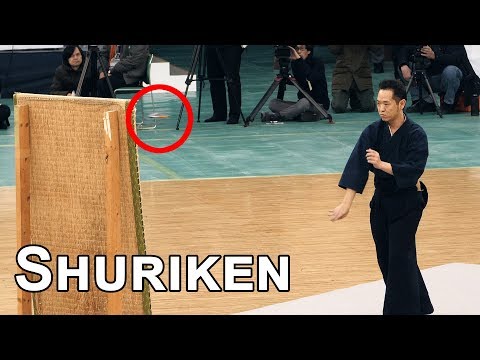
Negishi-ryu Shuriken-jutsu - 42nd Japanese Kobudo Demonstration (2019)
0
Thrown Weapon·Aikido - Guillaume Erard
Hayasaka Yoshifumi Sensei and his students demonstrating Negishi-ryu Shuriken-jutsu during the 42nd Nihon Kobudo Embutai…
Перевод: thrown weapon
Techniques for projecting weapons at a target from a distance, including Japanese shuriken, knife throwing, and javelin arts.
Thrown weapons represent one of humanity's oldest ranged combat technologies, with archaeological evidence of purpose-made throwing spears (javelins) dating to at least 400,000 years ago at the Schöningen site in Germany. [1] Throwing weapons were used across virtually all ancient military cultures: the Roman pilum was a core infantry weapon, the African assegai served Zulu warriors, and Japanese shurikenjutsu developed as a supplementary combat art within koryu schools. [2] In the medieval and early modern periods, thrown weapons declined in military significance as archery and firearms evolved, but they persisted in martial arts traditions, sport contexts (javelin throw, knife throwing competitions), and specialised military applications. [1],[2]
Thrown weapons provide ranged attack capability, allowing a fighter to engage from a distance where melee weapons cannot reach. The trade-off is losing the weapon after throwing. [1]
Thrown weapon competition includes javelin (Olympic since 1906), knife/axe throwing (IKTHOF), and shurikenjutsu demonstrations at Japanese budo events. [1]
Изображений для этой техники пока нет.
Войдите, чтобы предложить изображение.
Hayasaka Yoshifumi Sensei and his students demonstrating Negishi-ryu Shuriken-jutsu during the 42nd Nihon Kobudo Embutai…
Учебных курсов по этой технике пока нет.
Войдите, чтобы предложить курс.
Риск травмы для человека, к которому применяется техника
Projectile weapons including shuriken, throwing knives; high penetration risk
Уровень мастерства, необходимый для надёжного выполнения техники
Разрешена ли техника по основным соревновательным правилам
Bubishi: The Classic Manual of Combat (Patrick McCarthy, 2008)
Alias sources — [1] MMA Instruction Manual (UFC, 2008) [2] MMA Instruction Manual (UFC, 2008) [3] MMA Instruction Manual (UFC, 2008)
History sources — [1] Anglo, S., The Martial Arts of Renaissance Europe (Yale University Press, 2000) [2] Draeger, D. & Smith, R., Comprehensive Asian Fighting Arts (Kodansha, 1969)
Established Japanese martial arts naming convention — native Japanese term (和語/漢語)
Alias sources — [1] MMA Instruction Manual (UFC, 2008) [2] MMA Instruction Manual (UFC, 2008) [3] MMA Instruction Manual (UFC, 2008)
History sources — [1] Anglo, S., The Martial Arts of Renaissance Europe (Yale University Press, 2000) [2] Draeger, D. & Smith, R., Comprehensive Asian Fighting Arts (Kodansha, 1969)
close-range reflexes, wrist dexterity, grip transitions
quick hands, strong wrists for grip changes
forearm flexors, wrist rotators, deltoids, core
Каждое движение в любом боевом искусстве обладает рядом универсальных свойств. Комбинируйте параметры ниже, чтобы найти нужный инструмент или сравнить аналоги из разных стилей.
Techniques for throwing spear-like projectiles, from ancient javelins to smaller darts, used across historical military and tribal combat traditions.
The sport and combat discipline of throwing knives at targets, practiced in competitive circuits and military training.
Japanese art of throwing bladed projectiles, divided into bo-shuriken (spike-type) and hira-shuriken (star-type) methods.
Thrown weapon techniques — shuriken (505 passages/33 books), knife throwing (265/20), javelin (91/26) — cover projectile weapons launched by hand. These are supplementary combat skills — used to create distance, distract, or set up primary weapon attacks. (33+ books; Draeger, Classical Budo; throwing arts texts)
Techniques for projecting weapons at a target from a distance, including Japanese shuriken, knife throwing, and javelin arts.
Thrown weapons represent one of humanity's oldest ranged combat technologies, with archaeological evidence of purpose-made throwing spears (javelins) dating to at least 400,000 years ago at the Schöningen site in Germany. Throwing weapons were used across virtually all ancient military cultures: the Roman pilum was a core infantry weapon, the African assegai served Zulu warriors, and Japanese shurikenjutsu developed as a supplementary combat art within koryu schools.
Traditional martial arts: разрешён — Practiced in traditional kata/forms and weapon-specific competition under var…; IWUF: разрешён — Legal in wushu taolu if applicable; HEMA: разрешён — Legal in applicable historical weapon categories
Оценка опасности 8/10. Very High — projectile weapons including shuriken, throwing knives; high penetration risk
Стандартная цепочка подготовки: Ready Position → Distance Control → Execute Technique → Return to Guard.
Стандартные контрприёмы: Guard Position — return to a defensive ready stance / Distance Management — control the measure to avoid being in range / Counter-Attack — strike during the opponent's recovery or between movements.
Распространённые варианты: Forward grip slash (cutting with the blade in a forward (hammer) grip); Reverse grip stab (thrusting with the blade in an icepick (reverse) grip); Forward grip thrust (straight thrust targeting the body or limbs); Defensive cut (slashing the opponent's attacking limb to disable it).
Thrown weapon competition includes javelin (Olympic since 1906), knife/axe throwing (IKTHOF), and shurikenjutsu demonstrations at Japanese budo events.
Основные ошибки, на которые стоит обратить внимание: Throwing with arm strength alone — the power comes from the body mechanics: step, hip rotation, and follow-through / Not calibrating distance for rotation — thrown weapons rotate; the distance must match the rotation for the point/edg… / Inconsistent grip — the same grip must be used every time for consistent throws / Not following through after the release — the follow-through determines accuracy.
Thrown Weapon также известен как Tōteki Buki, Projectile Weapons, Throwing Arts, Ranged Weapons.