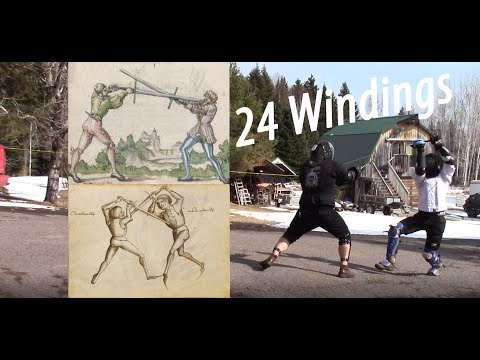
Liechtenauer's Zettel - Ep 32 | Hengen & Winden + All 24 Windings
0
Standard Winden·SuperiorHEMA
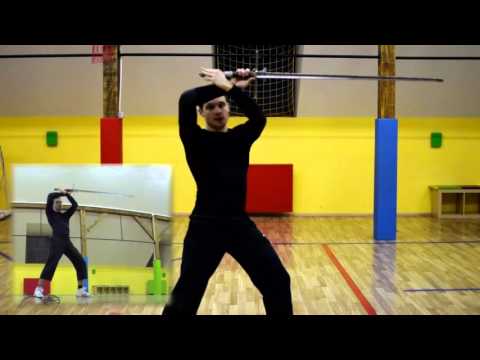
Something I said that's incorrect is saying setting on is just longpoint. Setting on is usually described with long poin…
Перевод: standard winden
Standard Winding (Winden) is the fundamental blade-rotation technique of the German longsword tradition: from the bind, the fencer turns the sword by rotating the short edge toward the opponent and driving the point toward an upper or lower opening while maintaining blade contact. [1] The four standard windings move the sword between Ochs and Pflug on both left and right sides, creating eight potential positions from which to thrust or cut. [1],[2] Correct winding requires sensitivity (Fühlen) to detect the opponent's pressure and Indes (meanwhile) to exploit the opening before the opponent can react. [2],[3]
Winding was a central concept in the Liechtenauer tradition, described extensively in Fechtbücher as the key to fighting at the bind (Krieg). [1]
Winding actions at the bind are a distinguishing feature of technically skilled HEMA longsword competitors. [1]
Изображений для этой техники пока нет.
Войдите, чтобы предложить изображение.
Something I said that's incorrect is saying setting on is just longpoint. Setting on is usually described with long poin…
So just a short description of the most basic stances. I consider the lower stances to be more difficult to use, the Sch…
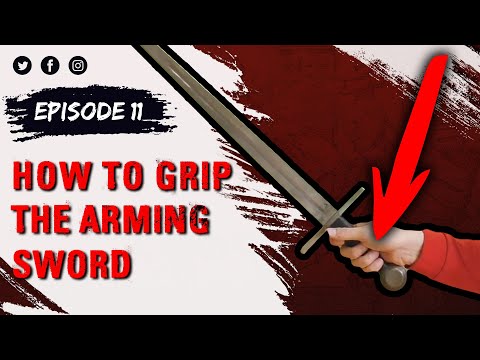
In this video I show you the standard grip with the one-handed sword(arming sword). There are many special features to c…
Standard Winden (winding) in Liechtenauer longsword fencing refers to the rotational movement into a hanging position, fundamentally defined as turning, spinning, or rotating the blade while engaging the opponent's sword. According to SuperiorHEMA, winding serves both offensive and defensive purposes and is categorized two ways: by target area (ox for upper openings, plow for lower openings) and by opponent blade pressure (soft winds when the opponent holds the centerline, hard winds when pushing offline). Soft winds are simpler, establishing strong-on-weak positioning to take the centerline and strike. Hard winds, performed on the outside of the opponent's blade when they push offline, require more practice but place the fencer closer and safer despite the counterintuitive positioning. SuperiorHEMA emphasizes that winding is not about extended reach but about stepping with control to maintain blade dominance—passing steps, advancing steps, and angular steps all apply contextually. The three ways to harm (cut, thrust, slice) can be executed from any wind, yielding 24 variations. Critically, winding generates actual threats requiring committed steps and solid positioning; careless winding invites counterattack. HEMAreviews contributes detailed guard instruction relevant to winding foundations, particularly the ox position variations, though offers less specific winding theory. Paul Becker's transcript contains insufficient substantive winding content.
Сформировано на основе 3 инструкторов
Учебных курсов по этой технике пока нет.
Войдите, чтобы предложить курс.
Риск травмы для человека, к которому применяется техника
Edged weapons cause fatal lacerations; historical battlefield mortality rates >30% (Amberger 1999)
Уровень мастерства, необходимый для надёжного выполнения техники
Разрешена ли техника по основным соревновательным правилам
The Art of Combat (Joachim Meyer, 1570)
Alias sources — [1] Sigmund Ringeck's Knightly Arts of Combat [2] Sigmund Ringeck's Knightly Arts of Combat [3] Sigmund Ringeck's Knightly Arts of Combat
Effectiveness sources — [1] Fighting with the German Longsword (Tobler, 2004) [2] Medieval Combat (Talhoffer, 2000 translation)
Standard katakana transliteration of Western martial arts terminology (外来語) — used in Japanese MMA, boxing, and BJJ communities
Alias sources — [1] Sigmund Ringeck's Knightly Arts of Combat [2] Sigmund Ringeck's Knightly Arts of Combat [3] Sigmund Ringeck's Knightly Arts of Combat
Effectiveness sources — [1] Fighting with the German Longsword (Tobler, 2004) [2] Medieval Combat (Talhoffer, 2000 translation)
wrist control for edge alignment, grip endurance, footwork precision
quick wrists, strong forearms, good posture
forearm extensors/flexors, deltoids, core, calves
SuperiorHEMA emphasizes that stepping is critical because the further something is from the body, the weaker it is, and as something goes forward, the easier it moves side to side. By stepping instead of reaching, you keep the opponent's blade controlled and maintain proper leverage.
SuperiorHEMA notes that the choice of step depends on range and context—passing steps, advancing steps, triangle steps, and stepping offline in different ways can all be used. The key is that you are stepping deliberately as part of the technique.
SuperiorHEMA explains that outer windings work significantly less in a HEMA environment and often lead to doubles, though they can occasionally be achieved in tournament play.
SuperiorHEMA advises that if you fight shortened in the hangings, your opponent can change through and hit you. For explicit counters to winding, they recommend studying the Shilhau technique, which contains detailed instruction on defeating windings.
Standard Winding (Winden) is the fundamental blade-rotation technique of the German longsword tradition: from the bind, the fencer turns the sword by rotating the short edge toward the opponent and driving the point toward an upper or lower opening while maintaining blade contact. The four standard windings move the sword between Ochs and Pflug on both left and right sides, creating eight potential positions from which to thrust or cut.
The four windings and their eight positions are described in detail by Ringeck and von Danzig as the core skill for fighting in the bind. Mastery of Winden is considered the intermediate-to-advanced skill that separates competent longsword fencers from beginners.
Traditional martial arts: разрешён — Practiced in traditional kata/forms and weapon-specific competition under var…; IWUF: разрешён — Legal in wushu taolu if applicable; HEMA: разрешён — Legal in applicable historical weapon categories
Оценка опасности 9/10. Extreme — edged weapons cause fatal lacerations; historical battlefield mortality rates >30% (Amberger 1999)
Стандартная цепочка подготовки: Assume Guard (Kamae/Hut) → Measure Distance (Ma-ai) → Initiate Cut/Thrust → Follow Through (Zanshin).
Стандартные контрприёмы: Parry (Absetzen) — deflect the incoming blade with a counter-displacement / Void (Step Back) — withdraw from measure to avoid the cutting arc / Counter-Cut (Nachreisen) — strike into the opponent's opening during their attack.
Распространённые варианты: Standard cut (primary cutting angle from the ready stance); Thrust (tsuki) (straight thrust targeting the throat, chest, or face); Rising cut (kiri-age) (upward diagonal cut from low to high); Diagonal cut (kesa-giri) (downward diagonal cut following the kimono line).
Winding actions at the bind are a distinguishing feature of technically skilled HEMA longsword competitors.
Основные ошибки, на которые стоит обратить внимание: Not maintaining blade contact during the wind — the sword must stay on the opponent's blade throughout / Winding too slowly — the wind must be quick enough to exploit the opening before the opponent adjusts / Using strength to push through instead of winding around — winding uses mechanical advantage, not force / Not feeling the opponent's pressure before winding — the direction of the wind depends on their pressure.
Standard Winden также известен как Sutandādo Vinden, Basic Winding, Standard Wind, Simple Winden.