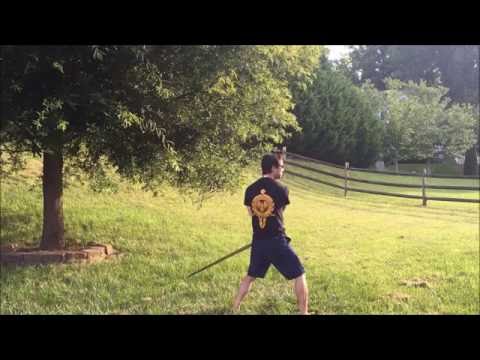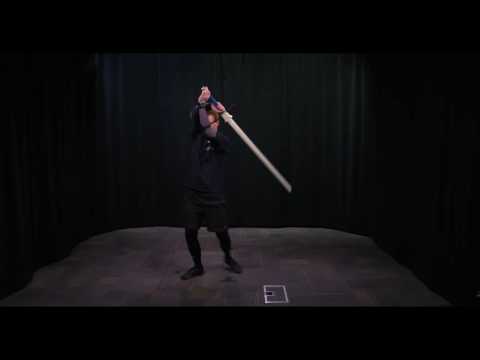
Tail/Nebenhut guard
0
Schrankhut·VCU HEMA
Here we discuss the 3 transfers for the tail guard and how to drill all 3. The official channel of the HEMA Club @ VCU.…
Перевод: barrier guard (HEMA low sword guard creating a barrier)
Schrankhut (Barrier Guard) is a HEMA longsword guard where the sword is held low with the blade crossed in front of the body, creating a barrier between the fighter and the opponent. [1] The sword is typically held with the point directed to one side and the blade angled across the body at hip or knee level. It is a defensive guard that invites the opponent to attack high while positioning the blade for a rising counter-cut. [1] The guard appears in the German longsword tradition of Johannes Liechtenauer. [1]
German longsword lineage: Johannes Liechtenauer (14th century) → transmitted through the Gesellschaft Liechtenauers (Society of Liechtenauer) → documented in Fechtbücher by Sigmund Ringeck (c. 1440), Peter von Danzig (1452), Hans Talhoffer (1459), and Paulus Kal (1470). Reconstructed in modern HEMA from manuscript study beginning in the 1990s–2000s. [1]
Used in modern HEMA longsword tournaments sanctioned by HEMAA, HEMA Alliance, and regional federations. Scoring varies by ruleset (afterblow, first-touch, or exchange-based). [1]
Изображений для этой техники пока нет.
Войдите, чтобы предложить изображение.
Here we discuss the 3 transfers for the tail guard and how to drill all 3. The official channel of the HEMA Club @ VCU.…
A detailed look at nebenhut, addressing historicity, our preferred "default" version for beginners, and common errors.
Schrankhut (also called Nebenhut or "tail" guard) is a secondary guard in which the sword is rotated 180 degrees from fool, pointing directly behind the practitioner. Both VCU HEMA and Swordwind Historical Swordsmanship emphasize the critical importance of maintaining a loose grip on the pommel—nearly palming it—to enable the necessary arm crossing and weight shifts inherent to the position. The blade is held nearly perpendicular to the body, with the point online and presenting an active threat to the opponent. VCU HEMA identifies three primary transitions into Schrankhut: the unter-how (cutting true edge diagonally into ox before dropping to tail), the middle-how (using false edge in a sweeping motion with knuckles toward the ground), and the over-how (false edge cut with knuckles toward the ceiling). Swordwind stresses maintaining proper hip coiling and a default cutting grip when possible, though they note that left-side Schrankhut requires crossed hands that complicate the non-dominant hand's grip contact. Both instructors acknowledge the guard's versatility for varied cutting angles and its utility in pressing advantage. However, both caution that the rear-pointing blade makes deflecting thrusts difficult and leaves the practitioner vulnerable to long-point attacks if unprepared to transition quickly.
Сформировано на основе 2 инструкторов
Учебных курсов по этой технике пока нет.
Войдите, чтобы предложить курс.
Риск травмы для человека, к которому применяется техника
Guard position.
Уровень мастерства, необходимый для надёжного выполнения техники
Разрешена ли техника по основным соревновательным правилам
Clements, J. Medieval Swordsmanship. Paladin Press.
[1] Clements, Medieval Swordsmanship, Guard Positions chapter
[1] Clements, Medieval Swordsmanship, Guard Positions chapter
patience to hold the low position, explosive speed for the counter
forearms, core, legs (stable low stance)
Schrankhut (barrier guard) is a HEMA longsword guard where the sword is held across the body — creating a barrier. Documented in the Fechtbücher of the Liechtenauer tradition. A defensive guard that invites specific attacks which can then be countered. (Clements, Medieval Swordsmanship; Tobler, Secrets of German Medieval Swordsmanship)
A loose grip on the pommel is essential for Schrankhut to work effectively on either side, as a tight grip will prevent the guard from functioning properly. You should almost be palming the pommel rather than gripping it firmly.
Both true edge and false edge cuts become important in Schrankhut, especially when performing different cuts from this position. The true edge is most readily available when cutting upward, while false edge cuts are particularly useful for other variations from tail, making this guard very versatile.
When in Schrankhut, your sword is directly behind you with the point online and presenting an active threat to your opponent, so be aware of this positioning advantage. It's also a fantastic move when you want to press the advantage and be sneaky, and it's especially useful for handling grills with a wide variety of cuts and angles.
Keep your arms comfortably extended toward the ground rather than hiked up, and maintain a default cutting grip. Your blade should be kept vertical with the short edge up and long edge down, positioned back at a natural angle at your side.
Schrankhut (Barrier Guard) is a HEMA longsword guard where the sword is held low with the blade crossed in front of the body, creating a barrier between the fighter and the opponent. The sword is typically held with the point directed to one side and the blade angled across the body at hip or knee level.
Schrankhut is documented in the German Liechtenauer longsword tradition as one of the secondary guards. It represents the concept of Einladung (invitation) — deliberately exposing a target to provoke a predictable attack that can be countered.
HEMA tournaments: Legal: разрешён — standard technique in longsword competition; SCA Heavy Combat: Legal: разрешён — permitted in armored combat; HEMAA/HEMA Alliance: Legal: разрешён — recognized in all affiliated tournaments
Оценка опасности 2/10. Low — guard position.
Стандартная цепочка подготовки: Adopt Schrankhut → opponent cuts to exposed head → rising counter-cut (Unterhau) to their arms → From Vom Tag → lower to Schrankhut to change tempo → counter when they commit.
Стандартные контрприёмы: Don't take the bait — attack low instead of high / Thrust rather than cut — thrusts bypass the barrier / Feint high then attack the exposed lower body.
Распространённые варианты: Right Schrankhut (barrier extends to the right); Left Schrankhut (barrier extends to the left); High barrier (blade across at waist level); Low barrier (blade across at knee level).
Used in modern HEMA longsword tournaments sanctioned by HEMAA, HEMA Alliance, and regional federations. Scoring varies by ruleset (afterblow, first-touch, or exchange-based).
Основные ошибки, на которые стоит обратить внимание: Holding the guard against low attacks — it protects high, not low / Responding too slowly to the invited attack — the counter must be immediate / Blade positioned too far to one side — no longer protects center line.
Schrankhut также известен как Shurankufūto, Barrier Guard, Schrankhut Guard, Schranckhut.