Fencing 101: Skills to Win! The In Quartata, Passata-sotto, and Balestra
0
Balestra·RecSport Education
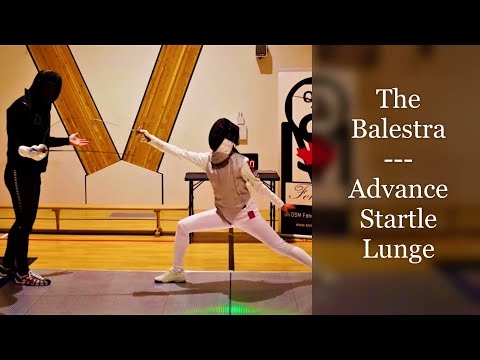
This video demos the skill based techniques known as the in quartata, passata-sotto, and the balestra. These are difficu…
Перевод: Jump lunge
The Balestra is a preparation combining a forward jump (appel) with an immediate lunge, used to close distance explosively while maintaining the structure of a lunge. [1] The jump startles the opponent and closes distance, while the lunge that follows delivers the touch. [1] It is one of the most commonly used compound attacks in foil fencing. [1]
The Balestra remains a core technique in modern competitive fencing and historical swordsmanship. [1]
Used in FIE international fencing competition
Изображений для этой техники пока нет.
Войдите, чтобы предложить изображение.
This video demos the skill based techniques known as the in quartata, passata-sotto, and the balestra. These are difficu…
Opponents always escaping your advance lunges? Finding it hard to surprise your opponent? Needing a new action to introd…
An examination of two classic rapier fencing techniques, the inquartata and the half inquartata including examples of th…
The balestra is an explosive footwork preparation consisting of a forward hop or jump, derived from the French word meaning 'sudden leap forward.' Instructors across RecSport Education, SSOA & Tasmanian Academy of Swordsmanship, and OSM Fencing agree on its fundamental purpose: to change timing and rhythm while closing distance more rapidly than a traditional advance. RecSport Education emphasizes that the balestra is faster than a standard advance and can be modified with variations such as leaping off the front foot, leaping off the back foot, or executing a double jump to further surprise an opponent. OSM Fencing provides detailed tactical applications, noting the balestra is most commonly used as a transition into a lunge, but also serves to disrupt opponent tempo and provoke responses. OSM Fencing distinguishes between classical and advanced forms: the classical version lands with both feet flat before lunging, while the advanced version lands on the heel only, allowing immediate explosive transition into the lunge without a pause. OSM Fencing also emphasizes that effective balesters should be short, covering roughly one foot of distance, and are used to read opponent habits and exploit weaknesses through tempo variation. All instructors stress that despite its apparent simplicity, the balestra requires significant training to apply effectively in actual bouts.
Сформировано на основе 3 инструкторов
Учебных курсов по этой технике пока нет.
Войдите, чтобы предложить курс.
Риск травмы для человека, к которому применяется техника
Sport fencing with protective equipment; historically lethal with sharp weapons
Уровень мастерства, необходимый для надёжного выполнения техники
Разрешена ли техника по основным соревновательным правилам
Fencing (Pollock, Grove & Prevost, 1902)
description, historyOrigin: sourced from Pollock, W
description, historyOrigin: sourced from Pollock, W
Requires good arm extension
Quick reflexes
Balance and footwork
The balestra appears in 5 passages in our corpus. A short jump-forward used to close distance before a lunge — the fencer hops forward with both feet before extending the attack. A fundamental footwork pattern in sport fencing. (Biomechanics of Human Motion; fencing manuals)
A balestra is a hopping forward movement used to close distance and prepare for a lunge while also disrupting your opponent's tempo and provoking a response. According to OSM Fencing, it allows you to change your rhythm and trigger defensive or offensive reactions from your opponent.
Instead of marching forward slowly and methodically, a balestra involves a quick hop that speeds up the transition into a lunge and gives you a wider range of tempo options in your attack sequence. OSM Fencing notes that this tempo change makes it harder for opponents to predict your timing.
According to RecSport Education, same-side opponents may be able to counter the balestra more easily, though you can attempt variations like crossing over with your rear foot—though this approach temporarily exposes more of your target.
The Balestra is a preparation combining a forward jump (appel) with an immediate lunge, used to close distance explosively while maintaining the structure of a lunge. The jump startles the opponent and closes distance, while the lunge that follows delivers the touch.
The Balestra was codified in European fencing treatises from the 16th century onward. Italian and French schools developed the technique into its modern form through centuries of refinement.
FIE: разрешён — Legal fencing technique — governed by FIE rules for foil, épée, and sabre; HEMA: разрешён — Legal in historical fencing competition
Оценка опасности 3/10. Sport fencing with protective equipment; historically lethal with sharp weapons
Стандартная цепочка подготовки: En garde → Preparation → Balestra → Recovery.
Стандартные контрприёмы: Counter-parry / Distance management / Stop-hit.
Распространённые варианты: Direct balestra; Indirect balestra; Compound balestra.
Used in FIE international fencing competition
Основные ошибки, на которые стоит обратить внимание: Over-extending / Telegraphing the action / Poor recovery.
Balestra также известен как Baresutora, Balestra, Jump Lunge, Appel et Fente.