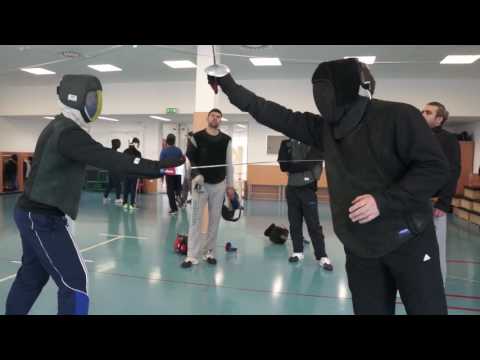
Sabre Quinte parry development
0
Sabre Parry·Beth Speedy
FIE Coaching course 2017
Перевод: sabre parry
The Sabre Parry subfamily covers all defensive blade actions in sabre where the fencer deflects an incoming cut or thrust with their own blade, transferring right-of-way and earning the right to riposte. [1] Sabre parries must defend a larger and more varied set of attacks than foil or epee parries because sabre attacks can come as cuts from any angle (head, chest, flank, cheek) in addition to thrusts. [1],[2] The primary sabre parries are quarte (inside defence, protecting the chest), tierce (outside defence), quinte (head defence, blade held horizontally above the head), and prime/seconde (low-line defences). [2],[3]
Sabre parry technique was developed through the Hungarian, Italian, and Russian schools of sabre fencing, each contributing refinements to the defensive system. [1] The quinte parry (head parry) is unique to sabre fencing and does not exist in foil or epee, reflecting sabre's distinct target area and cutting attacks. [2],[3]
Sabre parry positions evolved from military cavalry defence and were systematised for competition by Hungarian and Italian masters. [1]
In Olympic sabre, parry-riposte is a key scoring pattern, though the speed of the weapon means many touches come from attack-counterattack exchanges. [1]
Изображений для этой техники пока нет.
Войдите, чтобы предложить изображение.
FIE Coaching course 2017
Учебных курсов по этой технике пока нет.
Войдите, чтобы предложить курс.
Риск травмы для человека, к которому применяется техника
Modern sport fencing uses blunted weapons and full protective gear; injury rate ~2.5 per 1000 exposures (Harmer 2008)
Уровень мастерства, необходимый для надёжного выполнения техники
Разрешена ли техника по основным соревновательным правилам
The Art of Fencing (Luigi Barbasetti, 1932)
Alias sources — [1] FIE Rules of Competition [2] Classical Fencing (Rogers, 2014)
Effectiveness sources — [1] The Art and Science of Fencing (Evangelista, 1996) [2] FIE coaching manuals
Mixed Japanese-Western terminology — combines traditional Japanese terms with katakana loanwords
Alias sources — [1] FIE Rules of Competition [2] Classical Fencing (Rogers, 2014)
Effectiveness sources — [1] The Art and Science of Fencing (Evangelista, 1996) [2] FIE coaching manuals
explosive lunge speed, finger/wrist dexterity, cardiovascular endurance
long reach (tall, long arms), fast-twitch legs
quadriceps (lunge), calves, forearm/finger flexors, core
Каждое движение в любом боевом искусстве обладает рядом универсальных свойств. Комбинируйте параметры ниже, чтобы найти нужный инструмент или сравнить аналоги из разных стилей.
Overexaggerating the movement by moving too far in all directions. Beth Speedy emphasizes keeping the parry to the shortest critical movement necessary to block the incoming blade.
The Sabre Parry subfamily covers all defensive blade actions in sabre where the fencer deflects an incoming cut or thrust with their own blade, transferring right-of-way and earning the right to riposte. Sabre parries must defend a larger and more varied set of attacks than foil or epee parries because sabre attacks can come as cuts from any angle (head, chest, flank, cheek) in addition to thrusts.
Sabre parry technique was developed through the Hungarian, Italian, and Russian schools of sabre fencing, each contributing refinements to the defensive system. The quinte parry (head parry) is unique to sabre fencing and does not exist in foil or epee, reflecting sabre's distinct target area and cutting attacks.
FIE: разрешён — Legal fencing technique — governed by FIE rules for foil, épée, and sabre; HEMA: разрешён — Legal in historical fencing competition
Оценка опасности 2/10. Low — modern sport fencing uses blunted weapons and full protective gear; injury rate ~2.5 per 1000 exposures (Harmer 2008)
Стандартная цепочка подготовки: En Garde → Advance/Lunge Preparation → Attack → Recovery.
Стандартные контрприёмы: Parry (Absetzen) — deflect the incoming blade with a counter-displacement / Void (Step Back) — withdraw from measure to avoid the cutting arc / Counter-Cut (Nachreisen) — strike into the opponent's opening during their attack.
Распространённые варианты: Simple attack (single blade action (disengage, beat, or direct) to score); Compound attack (multiple blade actions (feint then disengage) to create a…); Riposte (immediate counter after a successful parry); Counter-attack (attacking into the opponent's attack with priority or rig…).
In Olympic sabre, parry-riposte is a key scoring pattern, though the speed of the weapon means many touches come from attack-counterattack exchanges.
Основные ошибки, на которые стоит обратить внимание: Making parries too slow — sabre attacks are extremely fast; the parry must match their speed / Not riposting immediately after the parry — the right of way advantage is brief in sabre / Using the wrong parry for the attack — quinte for head, tierce for outside, quarte for inside / Making the parry too large — the parry should be just sufficient to deflect the attack.
Sabre Parry также известен как Sāburu Uke, Parade au Sabre, Sabre Defence.