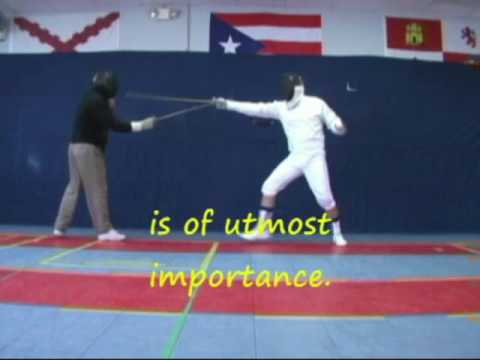
Foil Lesson, Feint Deceive
0
Foil Riposte·Coach GerryD
Foil Feint Deceive Part 1 from CoachGerryD
Перевод: foil riposte
The Foil Riposte subfamily covers all counter-attacking actions executed immediately after a successful parry, which under right-of-way rules gives the defender priority to score. [1] The riposte is the second half of the parry-riposte sequence — the fundamental defensive-offensive combination in foil — and it carries priority, meaning that if the riposte and a remise (renewed attack) both land, only the riposte scores. [1],[2] Ripostes can be direct (thrusting immediately back in the same line as the parry), indirect (changing line via disengage or coupe before thrusting), or compound (using multiple blade movements before the final thrust). [2],[3]
The riposte (from Italian 'risposta' meaning response) has been a fundamental concept in fencing since the earliest treatises, codified as the natural follow-up to a successful parry. [1] The parry-riposte sequence became the cornerstone of classical fencing pedagogy, teaching fencers the principle of defence followed by counter-attack. [2],[3]
The riposte concept was formalised in European fencing academies as part of the parry-riposte defensive system developed by French and Italian masters. [1]
Изображений для этой техники пока нет.
Войдите, чтобы предложить изображение.
Foil Feint Deceive Part 1 from CoachGerryD
Учебных курсов по этой технике пока нет.
Войдите, чтобы предложить курс.
Риск травмы для человека, к которому применяется техника
Modern sport fencing uses blunted weapons and full protective gear; injury rate ~2.5 per 1000 exposures (Harmer 2008)
Уровень мастерства, необходимый для надёжного выполнения техники
Разрешена ли техника по основным соревновательным правилам
The Art of Fencing (Luigi Barbasetti, 1932)
Alias sources — [1] FIE Rules of Competition [2] Classical Fencing (Rogers, 2014)
Effectiveness sources — [1] The Art and Science of Fencing (Evangelista, 1996) [2] FIE coaching manuals
Standard katakana transliteration of Western martial arts terminology (外来語) — used in Japanese MMA, boxing, and BJJ communities
Alias sources — [1] FIE Rules of Competition [2] Classical Fencing (Rogers, 2014)
Effectiveness sources — [1] The Art and Science of Fencing (Evangelista, 1996) [2] FIE coaching manuals
explosive lunge speed, finger/wrist dexterity, cardiovascular endurance
long reach (tall, long arms), fast-twitch legs
quadriceps (lunge), calves, forearm/finger flexors, core
Каждое движение в любом боевом искусстве обладает рядом универсальных свойств. Комбинируйте параметры ниже, чтобы найти нужный инструмент или сравнить аналоги из разных стилей.
Coach GerryD emphasizes that timing and distance are critical—use a small point drop with minimal forward foot movement to provoke your opponent's parry, then disengage and hit when they commit to the parry.
Keep your point moving forward continuously throughout the feint and tempo—it should never stop or go off-target ('Never Never Land'), allowing you to recover quickly for your final attack.
If you pop and hold your point, the referee will consider it a feint, and if your opponent counter-attacks into it while you disengage or hit later, they'll be awarded the point instead.
The Foil Riposte subfamily covers all counter-attacking actions executed immediately after a successful parry, which under right-of-way rules gives the defender priority to score. The riposte is the second half of the parry-riposte sequence — the fundamental defensive-offensive combination in foil — and it carries priority, meaning that if the riposte and a remise (renewed attack) both land, only the riposte scores.
The riposte (from Italian 'risposta' meaning response) has been a fundamental concept in fencing since the earliest treatises, codified as the natural follow-up to a successful parry. The parry-riposte sequence became the cornerstone of classical fencing pedagogy, teaching fencers the principle of defence followed by counter-attack.
FIE: разрешён — Legal fencing technique — governed by FIE rules for foil, épée, and sabre; HEMA: разрешён — Legal in historical fencing competition
Оценка опасности 2/10. Low — modern sport fencing uses blunted weapons and full protective gear; injury rate ~2.5 per 1000 exposures (Harmer 2008)
Стандартная цепочка подготовки: En Garde → Advance/Lunge Preparation → Attack → Recovery.
Стандартные контрприёмы: Parry (Absetzen) — deflect the incoming blade with a counter-displacement / Void (Step Back) — withdraw from measure to avoid the cutting arc / Counter-Cut (Nachreisen) — strike into the opponent's opening during their attack.
Распространённые варианты: Simple attack (single blade action (disengage, beat, or direct) to score); Compound attack (multiple blade actions (feint then disengage) to create a…); Riposte (immediate counter after a successful parry); Counter-attack (attacking into the opponent's attack with priority or rig…).
Parry-riposte is statistically the most common scoring pattern in Olympic foil competition. Champions like Valentina Vezzali built careers on superior parry-riposte timing.
Основные ошибки, на которые стоит обратить внимание: Pausing between the parry and the riposte — the two actions must be continuous / Not extending the arm for the riposte — the riposte is a thrust; the arm must extend toward the target / Riposting to a closed line — the riposte should target the opening created by the parry / Making the riposte too complex when a direct riposte would score — use the simplest riposte that works.
Foil Riposte также известен как Furūre Riposuto, Riposte au Fleuret, Counter-Attack After Parry.