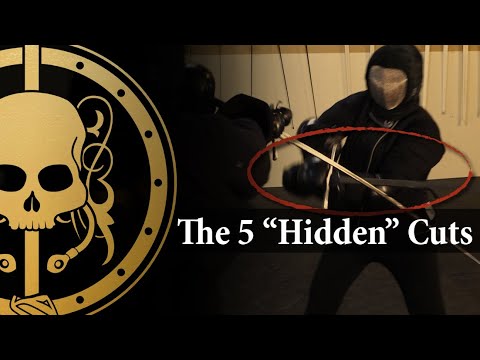
All 5 German Longsword "Hidden" Master Cuts
0
Coupe Attack·Blood and Iron HEMA
The master cuts, (sometimes referred to as the "hidden" cuts) can be found in every German longsword source, and even so…
Перевод: coupe attack
The Coupe Attack (also called the cut-over) is an indirect attack where the fencer lifts the blade over the opponent's tip by withdrawing the point upward and forward, passing over the top of the opponent's blade to land on the opposite side. [1] The coupe is executed by pulling the hand back slightly while raising the point, clearing the opponent's blade, and then driving the thrust forward to the target on the other side. [1],[2] The coupe is particularly effective against opponents who use strong lateral parries, as the blade passes over rather than around the defensive blade. [2],[3]
The coupe is less frequently used than the disengage but highly effective as a surprise action, particularly against opponents who react to lateral blade movements with strong parries. [1] Its over-the-top trajectory avoids lateral blade contact entirely, making it an ideal response to heavy parry-chasers. [1]
The coupé (cut-over) was developed in French fencing, passing the blade over the opponent's tip rather than around it as in a disengage. [1]
Coupé attacks are used at all levels of FIE foil competition, particularly effective against opponents with extended blades. [1]
Изображений для этой техники пока нет.
Войдите, чтобы предложить изображение.
The master cuts, (sometimes referred to as the "hidden" cuts) can be found in every German longsword source, and even so…
SCA Tutorial Video See my SCA Spear Tutorial playlist for more content.
Today I go through how to do a draw cut and some tips and tricks of how to add more force and mass into the strike for a…
The provided transcripts address three distinct martial disciplines (SCA polearm combat, Japanese wakizashi cutting, and German longsword fencing) rather than a unified technique called 'Coupe Attack' in foil fencing. Barry1492 discusses back-edge polearm strikes executed by stepping past an opponent and striking with the blade's rear edge, emphasizing power generation through combined arm pulling, hip rotation, and body weight transfer. Just a Bug covers Japanese draw-cutting (nukiuchi) with wakizashi, detailing three directional variations (downward, sideways, upward) and stressing safety protocols, proper unsheathing technique, edge alignment, and body-mass integration into cuts. Blood and Iron HEMA presents five German longsword master cuts (Zornhau, Zwerchau, Krumphau, Schildhau, Schielhau) as simultaneous attack-defense techniques that break guards and seize initiative through structured footwork, blade geometry, and grip transitions. None of these sources address the coupe—a classical foil technique involving circular blade movement to evade the opponent's blade and attack. The transcripts appear mismatched to the requested technique topic.
Сформировано на основе 3 инструкторов
Учебных курсов по этой технике пока нет.
Войдите, чтобы предложить курс.
Риск травмы для человека, к которому применяется техника
Modern sport fencing uses blunted weapons and full protective gear; injury rate ~2.5 per 1000 exposures (Harmer 2008)
Уровень мастерства, необходимый для надёжного выполнения техники
Разрешена ли техника по основным соревновательным правилам
The Art of Fencing (Luigi Barbasetti, 1932)
Alias sources — [1] FIE Rules of Competition [2] Classical Fencing (Rogers, 2014) [3] Classical Fencing (Rogers, 2014)
Effectiveness sources — [1] Czajkowski, Z., Understanding Fencing (SKA Swordplay Books, 2005)
Standard katakana transliteration of Western martial arts terminology (外来語) — used in Japanese MMA, boxing, and BJJ communities
Alias sources — [1] FIE Rules of Competition [2] Classical Fencing (Rogers, 2014) [3] Classical Fencing (Rogers, 2014)
Effectiveness sources — [1] Czajkowski, Z., Understanding Fencing (SKA Swordplay Books, 2005)
explosive lunge speed, finger/wrist dexterity, cardiovascular endurance
long reach (tall, long arms), fast-twitch legs
quadriceps (lunge), calves, forearm/finger flexors, core
According to Blood and Iron HEMA, leading with the tip of your sword rather than your hands is critical to the success of the attack; if you lead with your hands instead, the outcome will not be favorable.
Blood and Iron HEMA emphasizes that stepping offline to the right gets you out of the way when you land your strike, since stepping only forward into your opponent is unlikely to place you far enough away from the path of the sword to avoid getting hit yourself.
According to Blood and Iron HEMA, structure is very important in this attack—a broken wrist or having a guard too close to your head will not result in as good an outcome when cutting across the line.
The Coupe Attack (also called the cut-over) is an indirect attack where the fencer lifts the blade over the opponent's tip by withdrawing the point upward and forward, passing over the top of the opponent's blade to land on the opposite side. The coupe is executed by pulling the hand back slightly while raising the point, clearing the opponent's blade, and then driving the thrust forward to the target on the other side.
The coupe (French for 'cut') derives from classical French fencing technique and was originally used in small sword combat to evade the opponent's blade. It is one of the three fundamental indirect attacks in classical fencing theory alongside the disengage and the counter-disengage.
FIE: разрешён — Legal fencing technique — governed by FIE rules for foil, épée, and sabre; HEMA: разрешён — Legal in historical fencing competition
Оценка опасности 2/10. Low — modern sport fencing uses blunted weapons and full protective gear; injury rate ~2.5 per 1000 exposures (Harmer 2008)
Стандартная цепочка подготовки: En Garde → Advance/Lunge Preparation → Attack → Recovery.
Стандартные контрприёмы: Parry (Absetzen) — deflect the incoming blade with a counter-displacement / Void (Step Back) — withdraw from measure to avoid the cutting arc / Counter-Cut (Nachreisen) — strike into the opponent's opening during their attack.
Распространённые варианты: Simple attack (single blade action (disengage, beat, or direct) to score); Compound attack (multiple blade actions (feint then disengage) to create a…); Riposte (immediate counter after a successful parry); Counter-attack (attacking into the opponent's attack with priority or rig…).
Coupé attacks are used at all levels of FIE foil competition, particularly effective against opponents with extended blades.
Основные ошибки, на которые стоит обратить внимание: Making the coupe too large — the blade should pass just over the tip of the opponent's blade; large coupes are slow / Pausing at the top of the coupe — the blade must pass over and descend in one smooth motion / Using the coupe when a disengage would be faster — the coupe is for specific situations where the disengage is blocked / Not extending the arm during the coupe — the arm extension must continue throughout the blade movement.
Coupe Attack также известен как Kūpe Kōgeki, Coupe, Cut-Over Attack, Coupez.
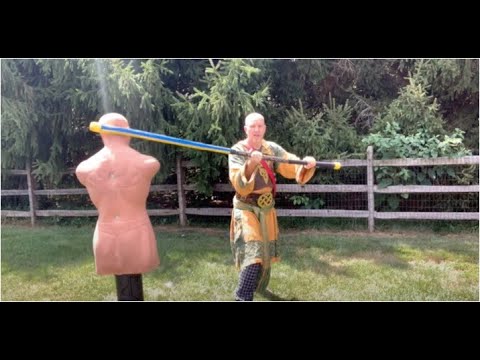
![Advanced wakizashi technique-draw cutting [wakizashi tutorial/tameshigiri]](https://img.youtube.com/vi/tD-rXB924CA/hqdefault.jpg)