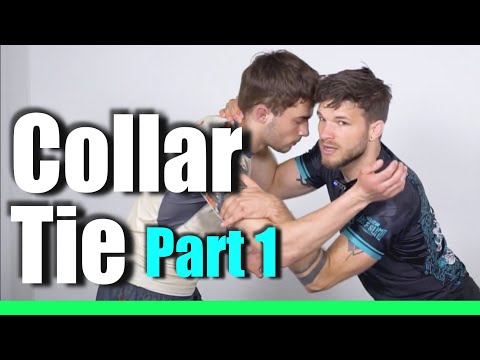
TAKEDOWNS from the collar tie
0
Standard Collar Tie Snap·Energia Martial Arts·Added by Admin
TAKEDOWNS from the collar tie Let's get into a great upper body control mechanic to deny your opponent's takedowns and s…
Перевод: standard collar tie snap down
The Standard Collar Tie Snap executes the fundamental collar tie snap down where the attacker, with one hand gripping behind the opponent's neck (collar tie), pulls sharply downward to break the opponent's posture and drive their head toward the mat. [1] The snap is a short, explosive action — the attacker yanks the head down while simultaneously stepping back or to the side, using the distance change to amplify the postural break. [1],[2] The opponent, pulled forward and down, must either stumble or post their hands on the mat to recover, both of which create offensive opportunities for the attacker. [2] The standard collar tie snap is the starting point of many wrestling attack chains. [2],[3]
The collar tie snap down is one of the most fundamental and effective upper-body takedown techniques because it uses the opponent's own posture and balance against them. [1] A sharp downward pull on the collar tie forces the opponent's head below their hips, creating an immediate scramble situation that favours the attacker. [1] The technique requires minimal energy and can be chained into single legs, front headlocks, or go-behind positions. [2]
The standard collar tie snap is the baseline version of the collar tie snap down taught in wrestling. [1]
Изображений для этой техники пока нет.
Войдите, чтобы предложить изображение.
TAKEDOWNS from the collar tie Let's get into a great upper body control mechanic to deny your opponent's takedowns and s…
Учебных курсов по этой технике пока нет.
Войдите, чтобы предложить курс.
Риск травмы для человека, к которому применяется техника
Snap down forces opponent to mat; neck strain risk
Уровень мастерства, необходимый для надёжного выполнения техники
Разрешена ли техника по основным соревновательным правилам
Japanese amateur wrestling terminology
Japanese amateur wrestling terminology
Standard katakana transliteration of Western martial arts terminology (外来語) — used in Japanese MMA, boxing, and BJJ communities
Standard katakana transliteration used in Japanese wrestling (レスリング)
grip strength, explosive downward pull, core stability
strong neck and traps for controlling the clinch
latissimus dorsi, biceps, forearms, core
Don't extend your arm all the way; instead, reach in from the inside to get an angle, as this gives you better control and positioning for the subsequent takedown.
Keep your back straight and your neck up rather than circling your head out (what instructors call the 'shampoo commercial')—this maintains better posture and leaves your options open for leg attacks.
Control the inside space by getting in with your own kolotai first, and if your opponent does establish a grip, keep your neck tight, block the wrist, and disengage so their hand goes over your head rather than pulling you down.
Keep your leg back on the same side as the collar grip to make it harder for your opponent to slip through and catch a single-leg takedown.
The Standard Collar Tie Snap executes the fundamental collar tie snap down where the attacker, with one hand gripping behind the opponent's neck (collar tie), pulls sharply downward to break the opponent's posture and drive their head toward the mat. The snap is a short, explosive action — the attacker yanks the head down while simultaneously stepping back or to the side, using the distance change to amplify the postural break.
The standard collar tie snap has been taught as a fundamental offensive tool in wrestling since the sport's modern codification. It remains one of the most frequently used techniques in practice and competition across all wrestling styles.
IJF: разрешён — Legal takedown technique; IBJJF: разрешён — Legal at all belt levels, scored as takedown (2 points); UWW: разрешён — Legal in both freestyle and Greco-Roman; Unified MMA: разрешён — Legal takedown technique; ADCC: разрешён — Legal, scored 2-4 points in second half of match; FIAS Sport Sambo: разрешён — Legal — all takedowns permitted; FIAS Combat Sambo: разрешён — Legal; NCAA Folkstyle: разрешён — Legal, scored as takedown (2 points)
Оценка опасности 4/10. Moderate — snap down forces opponent to mat; neck strain risk
Стандартная цепочка подготовки: Establish Contact → Create Off-Balance → Execute the Takedown → Follow to Ground.
Стандартные контрприёмы: Sprawl — drop hips back and drive weight down to stuff the takedown attempt / Underhook — establish inside position to control distance and prevent the takedown entry / Post and Circle — post on the attacker's head and circle away to break their angle / Level Change Defence — recognize the shot early and react with appropriate hip defence.
Распространённые варианты: Collar tie snap-down (snapping with hand on the nape of the neck); Two-on-one snap (using two-on-one grip to snap the posture down); Snap-down to front headlock (following the snap with a front headlock for further attacks).
The snap down is one of the most commonly scored techniques in NCAA folkstyle wrestling, used by wrestlers at every level as a primary scoring tool and set-up technique. In MMA, fighters with wrestling backgrounds routinely use snap downs to initiate grappling exchanges.
Основные ошибки, на которые стоит обратить внимание: Gripping too far back on the head instead of behind the neck — no leverage for the snap / Elbow flaring out during the snap, reducing pulling power / Not stepping back, so the opponent's dropping head hits your chest / Snapping with just the arm instead of using body weight — drop your level as you pull.
Standard Collar Tie Snap также известен как Karā Tai Sunappu Daun, Standard Collar Snap, Collar Tie Snap Down TD, Front Head Snap.