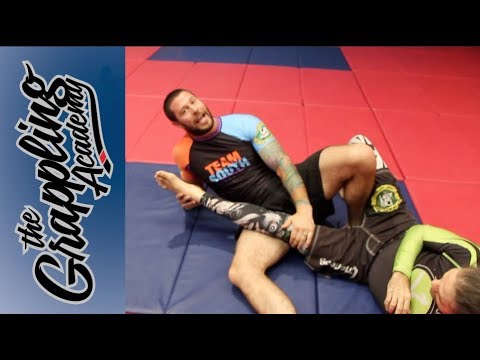
Heel Hook Guide - Positions and submissions
0
Heel Hook Lock·The Grappling Academy
SALE SALE SALE OVER 50% OFF – BOX SET – ALL 4 COURSES 50% OFF CLICK HERE – https://bit.ly/2lAOHmp • The Blue Belt Sup…
Перевод: heel hook lock
Heel hooks are among the most powerful and dangerous joint lock submissions in grappling, attacking the knee's rotational ligaments (ACL, MCL, LCL, meniscus) by controlling the heel and twisting the lower leg while the upper leg is immobilized. [1],[2] The inside heel hook rotates the foot inward (medially), primarily attacking the LCL and ACL; the outside heel hook rotates outward (laterally), primarily attacking the MCL. Heel hooks are considered the highest-danger submission in grappling because the knee's rotational ligaments provide minimal pain feedback before catastrophic tearing — opponents often suffer serious injury before feeling sufficient pain to tap. [1] Heel hooks are prohibited at most belt levels in IBJJF gi competition; they are legal in IBJJF no-gi at brown/black belt, in ADCC, and in MMA under Unified Rules. [3]
Heel hooks have roots in catch wrestling and sambo, where rotational leg attacks were standard competition techniques long before their adoption in Brazilian Jiu-Jitsu. [1],[2] In BJJ, heel hooks were historically discouraged due to injury risk and prohibited under most competition rule sets. The 'leg lock revolution' of the 2010s, driven primarily by John Danaher's systematization of ashi garami (leg entanglement) positions and the competitive success of his students (the Danaher Death Squad — Gordon Ryan, Garry Tonon, Eddie Cummings), transformed the heel hook from a fringe technique to the most feared submission in no-gi grappling. [3] This shift forced IBJJF to legalize heel hooks in no-gi competition at advanced belt levels.
The heel hook attacks the knee and ankle ligaments by rotating the heel while controlling the leg, capable of causing severe ligament damage. [1]
Heel hooks come from catch wrestling and sambo, and were popularised in modern no-gi BJJ by John Danaher's squad. [1]
Heel hooks are the most commonly finished submission at ADCC and modern no-gi events. Gordon Ryan, Craig Jones, and the Danaher Death Squad made them the dominant submission in no-gi competition. [1]
Изображений для этой техники пока нет.
Войдите, чтобы предложить изображение.
SALE SALE SALE OVER 50% OFF – BOX SET – ALL 4 COURSES 50% OFF CLICK HERE – https://bit.ly/2lAOHmp • The Blue Belt Sup…
Учебных курсов по этой технике пока нет.
Войдите, чтобы предложить курс.
Риск травмы для человека, к которому применяется техника
Heel hooks attack the knee via rotational force on the heel; among the most dangerous submissions due to lack of pain warning before ligament rupture
Уровень мастерства, необходимый для надёжного выполнения техники
Разрешена ли техника по основным соревновательным правилам
Shooto Official Rules — Leg Lock Classification
Japanese terminology sourced from Shooto Official Rules — Leg Lock Classification
Japanese MMA pioneer organization — technique classification
Standard katakana transliteration of Western martial arts terminology (外来語) — used in Japanese MMA, boxing, and BJJ communities
Japanese terminology sourced from Shooto Official Rules — Leg Lock Classification
hip control, rotational power, leg entanglement dexterity
strong hips and flexible legs for entanglement entries
hip rotators, adductors, forearm grip (for heel control)
The inside heel hook was considered the most dangerous legal submission in grappling by John Danaher, who systematized the leg lock game through his 'Enter the System' instructional series (2017–2019). Heel hooks attack the knee ligaments (ACL, MCL, LCL) through rotational force on the ankle. (Danaher, Enter the System)
According to The Grappling Academy, it's preferable to attack the legs from the bottom, but if you attack from the top, it becomes crucial that you still focus on position before submission to avoid giving up control.
The Grappling Academy emphasizes that you must control the knee, which is crucial both for safety and to actually break the knee rather than just get a tap. Position before submission applies to leg locks just as much as any other technique.
According to The Grappling Academy, when going for an outside heel hook from Ashigurami, you need to stop your opponent's rotation by controlling their position—this is why upgrading to a locked-off position is important before finishing the submission.
The Grappling Academy notes that legs are bigger than arms, much less coordinated, and provide very long levers when attacking the knee rotationally, particularly the MCL and LCL, making them valuable targets in jiu-jitsu.
Heel hooks are among the most powerful and dangerous joint lock submissions in grappling, attacking the knee's rotational ligaments (ACL, MCL, LCL, meniscus) by controlling the heel and twisting the lower leg while the upper leg is immobilized. The inside heel hook rotates the foot inward (medially), primarily attacking the LCL and ACL; the outside heel hook rotates outward (laterally), primarily attacking the MCL.
Heel hooks have roots in catch wrestling and sambo, where rotational leg attacks were standard competition techniques long before their adoption in Brazilian Jiu-Jitsu. In BJJ, heel hooks were historically discouraged due to injury risk and prohibited under most competition rule sets.
IBJJF: ограничен — No-gi brown and black belt only — banned in gi at all levels; IJF: запрещён — Only elbow joint locks (kansetsu-waza) permitted in judo — all other joint lo…; ADCC: разрешён — Legal — all submissions legal in ADCC; Unified MMA: разрешён — Legal submission technique; FIAS Sport Sambo: разрешён — Legal; FIAS Combat Sambo: разрешён — Legal
Оценка опасности 10/10. Heel hooks attack the knee via rotational force on the heel; among the most dangerous submissions due to lack of pain warning before ligament rupture
Стандартная цепочка подготовки: Establish Position → Create the Threat → Secure the Hold → Finish.
Стандартные контрприёмы: Early Recognition — identify the submission attempt early and begin defence immediately / Posture and Base — maintain strong posture and base to prevent submission setups / Grip Fight — deny the attacker their preferred gripping configuration.
Распространённые варианты: Inside heel hook (attacking the knee ligaments by rotating inward (more dan…); Outside heel hook (rotating outward, attacking the LCL and lateral structures); Reverse heel hook (applied from the opposite side of the entanglement); Saddle/Inside Sankaku heel hook (applied from the inside sankaku (411/saddle) position for…).
Heel hooks are the most commonly finished submission at ADCC and modern no-gi events. Gordon Ryan, Craig Jones, and the Danaher Death Squad made them the dominant submission in no-gi competition.
Основные ошибки, на которые стоит обратить внимание: Applying heel hooks explosively in training — the lack of warning pain means the knee can be destroyed before the par… / Not understanding which direction to rotate — inside heel hook rotates the foot inward (medial rotation); outside rot… / Ignoring the ashi garami control — the leg entanglement must control the opponent's hip before applying the hook; wit… / Crossing the feet in the entanglement — improper foot position creates counter-leg lock opportunities for the opponent.
Heel Hook Lock также известен как Hīru Fukku, Heel Hook, Ashi-garami, Inside Heel Hook.