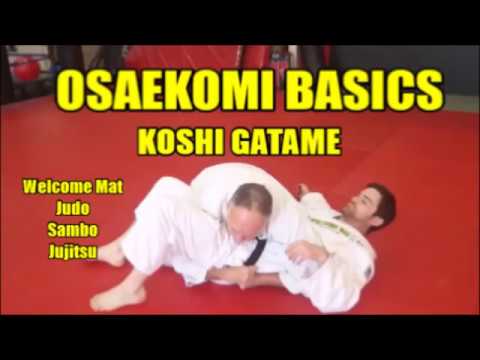
KOSHI GATAME BASICS
0
Ashi-Gatame·welcomematstevescott
Koshi Gatame (Hip Hold or Pin) is not a common pinning technique but is still a basic skill that should be mastered. Vie…
Перевод: leg hold
Ashi-gatame (足固め, 'leg hold') is an elbow lock where the attacker uses a leg to pin and isolate the opponent's arm against their own body, then applies hyperextension pressure to the elbow. [1],[2] The attacker typically drapes a leg across the opponent's chest or face while trapping the arm, using hip elevation to extend the elbow against the leg as a fulcrum. [1] Ashi-gatame is distinguished from the standard armbar by the specific use of the leg as both the pinning mechanism and the fulcrum rather than using both legs and hips. [1],[3]
Ashi-gatame is classified in Kodokan Judo's kansetsu-waza as a recognized elbow lock variation. [2],[3] The technique uses the leg as a controlling element, reflecting judo's systematic cataloging of different limb-locking configurations. [2] In BJJ, ashi-gatame principles appear in various armlock setups where the leg is used as a primary control and leverage point. [1]
Ashi-gatame (leg-assisted armlock) uses the leg across the opponent's body to apply breaking pressure to the elbow joint. [1]
Ashi-gatame is a classical judo armlock (kansetsu-waza) catalogued in the Kodokan system. [1]
Ashi-gatame and its variations are used in judo and BJJ competition. [1]
Изображений для этой техники пока нет.
Войдите, чтобы предложить изображение.
Koshi Gatame (Hip Hold or Pin) is not a common pinning technique but is still a basic skill that should be mastered. Vie…
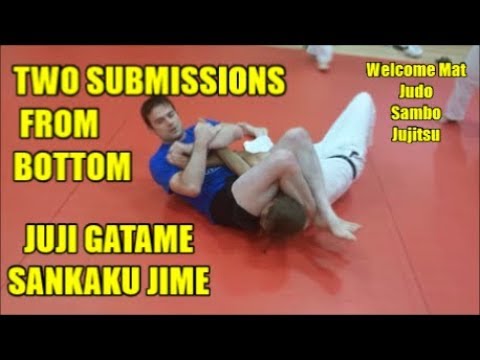
This video shows how to effectively work from the bottom position applying different variations of Juji Gatame and Sanka…
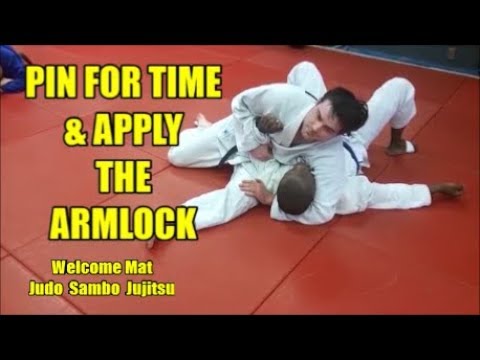
This video shows how to control an opponent with Osaekomi Waza (Pinning Techniques) and apply different submission techn…
Ashi-gatame, while not explicitly named in the transcripts as a standalone technique, is referenced within the broader context of pin-to-submission transitions taught by welcomematstevescott. The technique appears as a control mechanism during ground work, particularly from top positions where the practitioner uses leg placement—specifically knee positioning under the opponent's hips or buttocks—to immobilize and prevent bridge-out escapes. Stevescott emphasizes that in Sambo and freestyle judo contexts, the goal progresses from holding an opponent for time (earning points) to transitioning into submission techniques such as arm locks or chokes. The instructor demonstrates that effective control relies on precise knee placement and body pressure rather than hand grip alone, allowing the top player to maintain dominant positioning while setting up subsequent submissions. While the transcripts discuss related pinning concepts like koshi-gatame (hip hold) and kami-shiho-gatame (north-south position), the underlying principle of using leg positioning for immobilization—central to ashi-gatame—remains consistent across the demonstrated sequences. The technique functions primarily as a transitional control point rather than an end goal, valuable in submission grappling where pins alone cannot secure victory.
Сформировано на основе 3 инструкторов
Учебных курсов по этой технике пока нет.
Войдите, чтобы предложить курс.
Риск травмы для человека, к которому применяется техника
Ashi-gatame (leg-assisted armlock) uses the leg as a fulcrum against the elbow joint
Уровень мастерства, необходимый для надёжного выполнения техники
Разрешена ли техника по основным соревновательным правилам
Kodokan Judo — Official Katame-waza Classification
Kodokan — Ashi-gatame (足固め) classification
Standard Japanese martial arts terminology (kanji/hiragana)
Established Japanese martial arts naming convention — native Japanese term (和語/漢語)
Kodokan — Ashi-gatame (足固め) classification
hip flexibility, hip bridge power, leg clamping strength
long legs for controlling the opponent's torso
hip extensors (glutes), adductors, quadriceps, hamstrings
Каждое движение в любом боевом искусстве обладает рядом универсальных свойств. Комбинируйте параметры ниже, чтобы найти нужный инструмент или сравнить аналоги из разных стилей.
Ashi gatame (leg arm lock) is a Kodokan judo technique where the attacker uses their leg to press against the opponent's arm for an arm lock. The leg provides longer leverage than arm-on-arm techniques. (Kano, Kodokan Judo)
According to Steve Scott, positioning your inside knee up under the opponent's buttocks is the key thing that keeps them from turning. You then simply ride them out while maintaining this control.
Steve Scott explains that when executed properly with low positioning and good hip control, koshi-gatame takes away all of your opponent's mobility, making it very difficult for them to create space or transition out.
From koshi-gatame, Steve Scott notes you can transition to yokoshihogatami, knee on belly, and then into leg locks—a sequence commonly seen in Sambo where you can catch either leg with techniques like knee bars.
Ashi-gatame (足固め, 'leg hold') is an elbow lock where the attacker uses a leg to pin and isolate the opponent's arm against their own body, then applies hyperextension pressure to the elbow. The attacker typically drapes a leg across the opponent's chest or face while trapping the arm, using hip elevation to extend the elbow against the leg as a fulcrum.
Ashi-gatame is classified in Kodokan Judo's kansetsu-waza as a recognized elbow lock variation. The technique uses the leg as a controlling element, reflecting judo's systematic cataloging of different limb-locking configurations.
IBJJF: разрешён — Legal at all belt levels; IJF: запрещён — Only elbow joint locks (kansetsu-waza) permitted in judo — all other joint lo…; ADCC: разрешён — Legal — all submissions legal in ADCC; Unified MMA: разрешён — Legal submission technique; FIAS Sport Sambo: разрешён — Legal; FIAS Combat Sambo: разрешён — Legal
Оценка опасности 7/10. Ashi-gatame (leg-assisted armlock) uses the leg as a fulcrum against the elbow joint
Стандартная цепочка подготовки: Control the Arm → Position the Hips → Pinch Knees → Extend for the Finish.
Стандартные контрприёмы: Clasp Hands — grip own wrist to prevent arm extension / Stack — drive forward to compress the attacker and relieve elbow pressure / Hitchhiker Escape — rotate the thumb toward the mat and roll to extract the arm.
Распространённые варианты: Standard armbar (hips drive upward against the extended arm with legs clam…); Belly-down armbar (rolling to face the mat to prevent the opponent from stac…); S-mount armbar (transitioned from S-mount position for tighter control be…); Spinning armbar (rapid pivot from guard or side to catch the arm during tr…).
Ashi-gatame and its variations are used in judo and BJJ competition.
Основные ошибки, на которые стоит обратить внимание: Placing the leg too high on the upper arm — the shin must cross directly behind the elbow joint for the extension to … / Not securing the wrist — both hands must control the wrist; a free hand allows the opponent to bend the arm / Using the leg without pulling the wrist — the technique requires simultaneous leg pressure and wrist pull; one withou… / Abandoning top position for the lock — ashi-gatame's advantage is maintaining dominant position; don't sacrifice posi….
Ashi-Gatame также известен как Ashi-gatame, Leg Armlock, Foot-Pin Armbar, Leg Arm Lock.