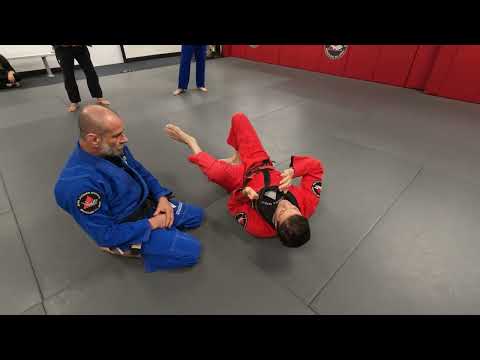
5 Fundamental Side Control Positions in BJJ You Should Know
0
Fundamental Side Control·Chewjitsu
In today's video I'll show you 5 BJJ side control positions and how I hold them and use them to setup other techniques. …
Перевод: fundamental side control
The Fundamental Side Control family covers the core side control variations and techniques for maintaining chest-to-chest control, attacking with submissions, and transitioning to more dominant positions — the most commonly reached dominant position after passing the guard. [1] This family includes standard side control (crossface and underhook), kesa gatame (scarf hold), reverse kesa gatame, and the submission attacks available from each variation (americana, kimura, arm triangle, baseball bat choke). [1],[2] Side control maintenance — keeping heavy, mobile pressure while the bottom player frames and hip escapes — is a critical skill that distinguishes advanced grapplers from beginners. [2],[3] The ability to flow between side control variations (standard → kesa → reverse kesa → north-south) in response to the bottom player's escape attempts is what creates an inescapable controlling platform. [3]
Изображений для этой техники пока нет.
Войдите, чтобы предложить изображение.
In today's video I'll show you 5 BJJ side control positions and how I hold them and use them to setup other techniques. …
#escapes #jeanjacquesmachado #bjj ----- One of the pioneers of the art of Brazilian Jiu-Jitsu and one of its greatest…
Учебных курсов по этой технике пока нет.
Войдите, чтобы предложить курс.
Риск травмы для человека, к которому применяется техника
Moderately high for the bottom player — enables submissions and ground-and-pound; less dominant than mount but harder to achieve escapes from than many think
Уровень мастерства, необходимый для надёжного выполнения техники
Разрешена ли техника по основным соревновательным правилам
Jiu-Jitsu University (Saulo Ribeiro, 2008)
Description sources — [1] Jiu-Jitsu University (Ribeiro, 2008) [2] Kodokan Judo (Kano, 1986) [3] BJJ competition evolution
Official Kodokan ground technique classification system
Description sources — [1] Jiu-Jitsu University (Ribeiro, 2008) [2] Kodokan Judo (Kano, 1986) [3] BJJ competition evolution
chest pressure ability, hip dexterity, crossface strength
heavy bodyweight, wide shoulders, strong forearms
chest/shoulders (pressure and crossface), core (hip switching), forearms (grip and crossface), hip flexors (pressure)
Каждое движение в любом боевом искусстве обладает рядом универсальных свойств. Комбинируйте параметры ниже, чтобы найти нужный инструмент или сравнить аналоги из разных стилей.
Side control appears in 816 passages across 27 books. The primary control position after passing the guard, scoring 3 points (guard pass) in IBJJF. From side control, the attacker can transition to mount, knee-on-belly, north-south, or attack with chokes and arm locks. (27 books; IBJJF Rules v6.0; Ribeiro, Jiu-Jitsu University)
Jean Jacques Machado emphasizes that your main goal is to make sure you can breathe—if your opponent is holding you so tight that you're trying to push them away, the strongest person will always have the advantage, so prioritize breathing and position over raw strength.
Jean Jacques Machado stresses keeping your leg touching his leg at all times—if his leg gets in front of yours, he can transition to mount, which is a much worse position for you.
Jean Jacques Machado explains that keeping your elbow connected to his body makes any control he tries to apply difficult because your body weight is distributed effectively, whereas if you keep your elbow out, he can get between your elbow and your body.
Chewjitsu teaches that you want to always have something connected to your opponent's hip—whether it's your hand, knee, or hip—which gives you a better platform to control them and set up submissions.
Chewjitsu advises that your chest should face wherever you want the pressure to go, allowing you to direct your weight and control effectively.
The Fundamental Side Control family covers the core side control variations and techniques for maintaining chest-to-chest control, attacking with submissions, and transitioning to more dominant positions — the most commonly reached dominant position after passing the guard. This family includes standard side control (crossface and underhook), kesa gatame (scarf hold), reverse kesa gatame, and the submission attacks available from each variation (americana, kimura, arm triangle, baseball bat choke).
Side control (yoko shiho gatame) is one of the five fundamental osaekomi positions in Kodokan judo, formalised by Jigoro Kano. BJJ evolved side control from a control position into a comprehensive attacking platform with elaborate submission chains.
IBJJF: разрешён — Legal; IJF: разрешён — Legal; ADCC: разрешён — Legal; Unified MMA: разрешён — Legal; UWW: разрешён — Legal; FIAS Sport Sambo: разрешён — Legal
Оценка опасности 6/10. Moderately high for the bottom player — enables submissions and ground-and-pound; less dominant than mount but harder to achieve escapes from than many think
Стандартная цепочка подготовки: Pass the Guard → Establish Side Control → Consolidate → Advance or Attack → Chain Attacks → Maintain.
Стандартные контрприёмы: Hip Escape (Shrimp) — create space and recover guard / Frame and Turn — forearm frames create escape space / Bridge and Roll — reverse the position / Underhook Escape — fight for underhook to come up.
Распространённые варианты: Standard side control (crossface and underhook with chest pressure; most fundame…); Kesa gatame (scarf hold) (head-and-arm control facing the opponent's head; judo's s…); Reverse kesa gatame (facing opponent's legs; strong control, fewer submissions); Modified side control (knee in) (inserting near-side knee against the hip; transitional to…); North-south (kami shiho gatame) (head-to-head position; enables north-south choke and kimura).
Side control is the most commonly reached dominant position in BJJ (3 points IBJJF). In judo, osaekomi from side control wins by ippon after 20 seconds.
Основные ошибки, на которые стоит обратить внимание: Lying flat without active pressure — effective side control requires active chest pressure with hips low and legs spr… / Losing the crossface — without crossface, the bottom player turns in and escapes / Chasing submissions without control — attempting attacks before consolidating loses the position / Not switching between variations — staying in one variation allows the opponent to develop a specific escape.
Fundamental Side Control также известен как Fandamentaru Saido Kontorōru, Side Control Technique, Side Control Variation, Side Mount Technique.