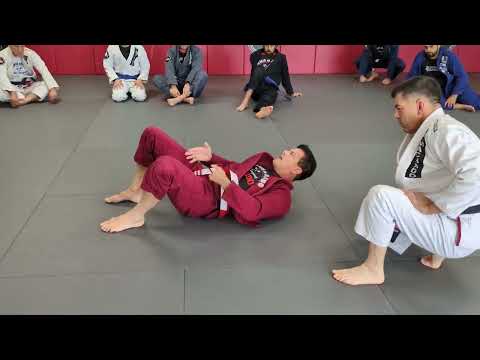
The Half Guard Masterclass
0
Half Guard·JeanJacquesMachado
#halfguard #jeanjacquesmachado #bjj ----- One of the pioneers of the art of Brazilian Jiu-Jitsu and one of its greate…
Перевод: Half guard
Half guard is a ground position where the bottom player controls ONE of the top player's legs between their own legs, creating a position that is half-way between full guard and being fully passed — once considered a last-ditch recovery position, it has been transformed into one of BJJ's most versatile and offensive guard systems. [1] Roberto 'Gordo' Correa revolutionised half guard in the 1990s after a knee injury forced him to rely on the position, developing an entire sweeping and attacking system that proved the position was far more than just a guard recovery step. [1],[2] Modern half guard encompasses multiple sub-systems — the underhook half guard (Gordo/Lucas Leite), deep half guard (Jeff Glover/Ryan Hall), Z-guard/knee shield (Bernardo Faria), Lockdown (10th Planet), and half butterfly — each with its own sweep, submission, and back-take pathways. [2],[3] Half guard is particularly valuable because it is reached naturally when guard recovery fails, making it the most commonly played guard in both gi and no-gi competition. [3]
Half guard was long considered a transitional or inferior position in BJJ — a step between having full guard and being fully passed. [1] Roberto 'Gordo' Correa transformed half guard in the 1990s after a severe knee injury limited his closed guard game, developing the underhook system and old school sweep that proved half guard could be a complete offensive position. [1],[2] Lucas Leite further refined the underhook half guard system, winning IBJJF World Championships with a half guard-dominant game. [2],[3] Deep half guard was popularised by Jeff Glover and Ryan Hall, while Eddie Bravo's Lockdown system added a no-gi dimension. [3]
Half guard is one of the most effective and practical guard positions because it is reached naturally during scrambles and guard recovery, making it the most commonly played guard in competition. [1] Lucas Leite won multiple IBJJF World Championship titles using predominantly half guard sweeps and back takes. [2] In MMA, half guard is the most commonly played bottom position because it is the natural recovery point when guard passes are attempted. [3]
Изображений для этой техники пока нет.
Войдите, чтобы предложить изображение.
#halfguard #jeanjacquesmachado #bjj ----- One of the pioneers of the art of Brazilian Jiu-Jitsu and one of its greate…
Учебных курсов по этой технике пока нет.
Войдите, чтобы предложить курс.
Риск травмы для человека, к которому применяется техника
Moderate — half guard is relatively safe for the bottom player; the primary risks are being crossfaced (opponent drives forearm across your face, turning your head away and flattening you), being smashed flat, or having the trapped leg freed; in MMA, the crossface from top half guard can enable ground-and-pound
Уровень мастерства, необходимый для надёжного выполнения техники
Разрешена ли техника по основным соревновательным правилам
Jiu-Jitsu University (Saulo Ribeiro, 2008)
Description sources — [1] Jiu-Jitsu University (Ribeiro, 2008) [2] Roberto Gordo competition record and instructional lineage [3] Lucas Leite, Jeff Glover, Eddie Bravo career records
History sources — [1] Roberto Gordo's knee injury and half guard development story [2] Lucas Leite IBJJF titles [3] Deep half and lockdown innovation
Description sources — [1] Jiu-Jitsu University (Ribeiro, 2008) [2] Roberto Gordo competition record and instructional lineage [3] Lucas Leite, Jeff Glover, Eddie Bravo career records
History sources — [1] Roberto Gordo's knee injury and half guard development story [2] Lucas Leite IBJJF titles [3] Deep half and lockdown innovation
hip mobility (creating angles from the bottom), upper body strength (winning the underhook battle), leg strength (maintaining the leg trap)
strong shoulders (underhook and whizzer battles), compact build (easier to get underneath for deep half), grip strength
shoulders (underhook), core (hip switching and coming to knees), hamstrings (trapping the leg), forearms (framing and grip fighting)
Каждое движение в любом боевом искусстве обладает рядом универсальных свойств. Комбинируйте параметры ниже, чтобы найти нужный инструмент или сравнить аналоги из разных стилей.
The half guard was traditionally considered a failed position until Roberto 'Gordo' Correa revolutionized it in the 1990s after a knee injury limited his full guard. Today it is one of the most sophisticated guard systems in BJJ. (Ribeiro, Jiu-Jitsu University)
Jean Jacques Machado teaches that your objective should be to get into a solid half-guard position itself, not to immediately pass. He emphasizes that by focusing on establishing and maintaining good half-guard control, you often end up passing the guard completely anyway, but with better positioning and safety.
Keep your shoulders always behind the opponent's belt line rather than ahead of it. Jean Jacques Machado stresses keeping your shoulders back and your arm under the opponent's shoulder while using the back of your hand on their leg rather than hugging it tightly.
Block the knee with your hip rather than just your leg. Jean Jacques Machado emphasizes positioning your leg in front of the opponent's knee and using hip pressure to block it, which prevents them from recovering guard or escaping easily.
No—Jean Jacques Machado warns against hugging too tightly, as this actually helps your opponent escape. Instead, maintain control through proper positioning and blocking with your knee and hip, and use your hands more for framing and directing movement rather than gripping pressure.
Half guard is a ground position where the bottom player controls ONE of the top player's legs between their own legs, creating a position that is half-way between full guard and being fully passed — once considered a last-ditch recovery position, it has been transformed into one of BJJ's most versatile and offensive guard systems. Roberto 'Gordo' Correa revolutionised half guard in the 1990s after a knee injury forced him to rely on the position, developing an entire sweeping and attacking system that proved the position was far more than just a guard recovery step.
Half guard was long considered a transitional or inferior position in BJJ — a step between having full guard and being fully passed. Roberto 'Gordo' Correa transformed half guard in the 1990s after a severe knee injury limited his closed guard game, developing the underhook system and old school sweep that proved half guard could be a complete offensive position.
IBJJF: разрешён — Legal — guard is fundamental to BJJ, sweeps from guard score 2 points; IJF: ограничен — Guard pulling penalized as non-combativity — groundwork from guard permitted …; ADCC: разрешён — Legal, guard pull penalized -1 point in points portion; Unified MMA: разрешён — Legal — no penalty for playing guard; FIAS Sport Sambo: разрешён — Legal
Оценка опасности 3/10. Low-moderate — half guard is relatively safe for the bottom player; the primary risks are being crossfaced (opponent drives forearm across your face, turning your head away and flattening you), being smashed flat, or having the trapped leg freed; in MMA, the crossface from top half guard can enable ground-and-pound
Стандартная цепочка подготовки: Recover Half Guard → Establish Knee Shield → Win the Underhook → Come to Knees → Sweep or Back Take → Follow Through.
Стандартные контрприёмы: Crossface — driving the forearm across the bottom player's face to flatten them and kill the underhook / Free the Leg — using hip movement and knee slicing to extract the trapped leg / Underhook Counter (Whizzer) — using an overhook with hip pressure to counter the bottom player's underhook / Flatten — driving chest pressure to flatten the half guard player on their back.
Распространённые варианты: Underhook half guard (securing an underhook on the near side to come to the kne…); Z-guard (knee shield) (placing the shin across the opponent's torso as a frame t…); Deep half guard (going deep underneath the opponent by sliding under their…); Lockdown (10th Planet system; crossing the feet in a figure-four ov…); Half butterfly (combining a butterfly hook with half guard control; hybri…); Coyote guard (a De La Riva-style hook from half guard position; creates…).
Half guard is the most commonly played guard in both IBJJF and ADCC competition. Lucas Leite won multiple World Championship titles from half guard.
Основные ошибки, на которые стоит обратить внимание: Lying flat in half guard without an underhook — flat half guard with no underhook is the worst-case scenario; the top… / Not fighting for the underhook — accepting bottom half guard without immediately fighting for the near-side underhook… / Knee shield too low — the shin frame should be across the opponent's chest/shoulder, not across the belly; a low knee… / Staying in half guard without attacking — half guard is a transitional position; staying in it passively allows the t….
Half Guard также известен как Hāfu Gādo, Half Guard, Meia Guarda, Half Guard Position.