Удар и защитаЗамкиБлижний бойБой против нескольких
Дистанция
БлижняяСредняяДальняя
Обзор
The Standard Mission Control establishes the base rubber guard by pulling the shin over the opponent's shoulder (typically the right shin over the left shoulder or vice versa) and controlling it with the opposite hand, keeping the opponent's posture broken. [1] The free hand is used for grip fighting, setting up submissions, or transitioning to the next position in the rubber guard sequence. [1],[2] Standard Mission Control requires hip flexibility to maintain the shin-over-shoulder position while keeping enough control to prevent the opponent from posturing. [2],[3]
Standard Mission Control is the entry point to Eddie Bravo's rubber guard system, the first position taught in the 10th Planet rubber guard curriculum. [1] It represents the fundamental concept of using the guard player's own leg as a posture control tool. [2],[3]
Страна происхождения· показано в случайном порядке
✓Standard mission control execution: from closed guard, break the opponent's posture, place the same-side foot on the opponent's hip, hip escape to create angle, swing the leg over the opponent's shoulder and place the shin across the back of their neck, then grab the ankle with the same-side hand (Eddie Bravo, Mastering the Rubber Guard, 2006)
✓Step 1: from closed guard, break the opponent's posture using legs and collar control
✓Step 2: uncross the legs and place one foot on the opponent's hip
✓Step 3: hip escape to the opposite side to create the angle needed for the leg swing
✓Step 4: swing the hip-foot leg over the opponent's shoulder — the shin crosses the back of their neck
✓Step 5: grab the ankle or shin with the same-side hand to lock the position — this is mission control
✓Step 6: use the free hand to push the head down or prepare for the chill dog transition
✓The hip escape is the critical step: without the angle, the leg cannot reach over the shoulder
✓Drill: from closed guard, establish mission control — 5 reps per side, focusing on smooth transitions
Типичные ошибки
!Swinging the leg without hip escaping first — the angle is essential for the leg to reach
!Not breaking posture before attempting — mission control is impossible against a postured opponent
!Grabbing the ankle with the wrong hand — same-side hand holds the ankle (right leg, right hand)
!Not maintaining the shin across the neck firmly — the shin must press down to control posture
!Rushing through the steps — each step must be completed before the next begins
!Straining the knee during the leg placement — if the flexibility isn't there, don't force it
!Not drilling both sides — mission control should be practised from both left and right angles
Effectiveness sources — [1] Mastering the Rubber Guard (Bravo, 2006)
Сообщество
Атлетизм
Requires
hip flexibility, active legs, grip management
Favours
long legs for distance control and guard retention
Key muscles
hip flexors, adductors, quadriceps, core, grip
Часто задаваемые вопросы
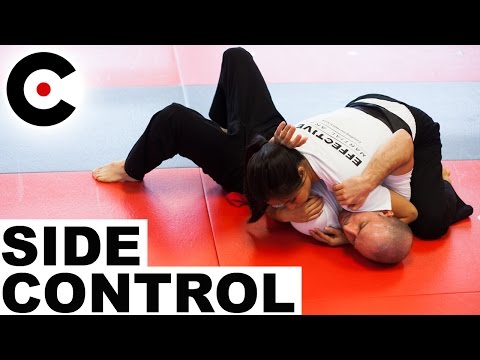
How do I establish a strong side control position on top?
Place one knee against your opponent's hips and the other level with their face, then pull them in tight by filling the gap with your elbow and hip. Apply pressure with your chest on their chest and your shoulder on their face to create solid control.
What are the main ways to escape from side control when I'm on the bottom?
Patrick Fulop teaches three primary escapes: the bridge and shrimp (get your elbow inside the hip and create space), the slip and flip (get your fingers in and use a neck hook to flip them over), and the sit-up escape (use your forearm under their neck to create distance, then post out and shrimp to escape).
What should I do if my opponent is too heavy to flip during the slip and flip escape?
Use the slip and slide variation instead: keep your hand grip on their back, straighten your legs, pull with your heels to slide out underneath them, then invert your legs to go to turtle position.
What offensive options do I have from the top of side control?
From side control you can transition to full mount position by sliding your knee across their belly, or you can attack with punches, hammer fists, or elbows to finish the fight—though direct strike opportunities are somewhat limited from this position.
Как работает Standard Mission Control?
The Standard Mission Control establishes the base rubber guard by pulling the shin over the opponent's shoulder (typically the right shin over the left shoulder or vice versa) and controlling it with the opposite hand, keeping the opponent's posture broken. The free hand is used for grip fighting, setting up submissions, or transitioning to the next position in the rubber guard sequence.
Откуда происходит Standard Mission Control?
Standard Mission Control is the entry point to Eddie Bravo's rubber guard system, the first position taught in the 10th Planet rubber guard curriculum. It represents the fundamental concept of using the guard player's own leg as a posture control tool.
Разрешён ли Standard Mission Control на соревнованиях?
IBJJF: разрешён — Legal — guard is fundamental to BJJ, sweeps from guard score 2 points; IJF: ограничен — Guard pulling penalized as non-combativity — groundwork from guard permitted …; ADCC: разрешён — Legal, guard pull penalized -1 point in points portion; Unified MMA: разрешён — Legal — no penalty for playing guard; FIAS Sport Sambo: разрешён — Legal
Насколько опасен Standard Mission Control?
Оценка опасности 2/10. Low — guard positions are defensive; injury risk comes from transitions, not the position itself
Стандартные контрприёмы: Guard Pass — systematically work to clear the legs and establish a dominant position / Leg Pin — control one or both legs to neutralize guard retention / Pressure Passing — use heavy chest pressure to flatten and immobilize the guard player.
Какие есть варианты Standard Mission Control?
Распространённые варианты: Standard guard (primary leg and grip configuration for control and attack…); Offensive guard (configured for sweeps and submissions); Defensive guard (prioritising distance management and preventing passes); Transition guard (moving between guard types to adjust to the opponent's pa…).
Насколько эффективен Standard Mission Control на соревнованиях?
Mission control is used in no-gi competition by rubber guard practitioners.
Какие типичные ошибки при выполнении Standard Mission Control?
Основные ошибки, на которые стоит обратить внимание: Swinging the leg without hip escaping first — the angle is essential for the leg to reach / Not breaking posture before attempting — mission control is impossible against a postured opponent / Grabbing the ankle with the wrong hand — same-side hand holds the ankle (right leg, right hand) / Not maintaining the shin across the neck firmly — the shin must press down to control posture.
Какие ещё названия есть у Standard Mission Control?
Standard Mission Control также известен как Sutandādo Misshon Kontorōru, Basic Mission Control, Classic Mission Control.