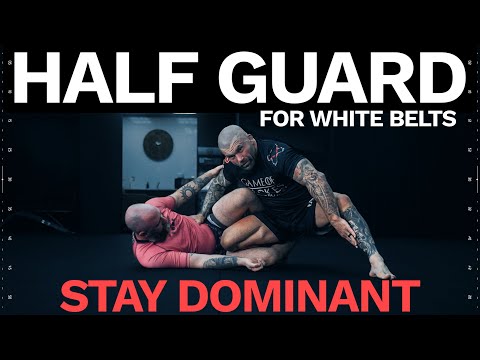
BEGINNERS GUIDE: HALF GUARD
0
Standard Half Guard·Will Brooks Official
Today we're covering a position that many white belts struggle with...half guard. It's an information rich position with…
Перевод: standard half guard
The Standard Half Guard subfamily covers the basic half guard configurations where the guard player controls one of the opponent's legs between theirs from a side-lying or flat-on-back position. [1] The standard half guard is the starting point for all half guard play, with variations defined by the upper body control (underhook, overhook, frame) and leg positioning (knee shield, lockdown, flat). [1],[2] Standard half guard positions include the underhook half guard (the most offensively oriented), the knee shield half guard (the most defensively oriented), and the lockdown (the most control-oriented). [2],[3]
Half guard is one of the most commonly played guards in BJJ competition at all belt levels. [1]
Изображений для этой техники пока нет.
Войдите, чтобы предложить изображение.
Today we're covering a position that many white belts struggle with...half guard. It's an information rich position with…
Учебных курсов по этой технике пока нет.
Войдите, чтобы предложить курс.
Риск травмы для человека, к которому применяется техника
Guard positions are defensive; injury risk comes from transitions, not the position itself
Уровень мастерства, необходимый для надёжного выполнения техники
Разрешена ли техника по основным соревновательным правилам
Jiu-Jitsu University (Saulo Ribeiro, 2008)
Alias sources — [1] IBJJF Rules (2024) [2] Jiu-Jitsu University (Ribeiro, 2008) [3] The Guard (Moreira & Beneville, 2003)
Effectiveness sources — [1] Mastering Jujitsu (Gracie & Danaher, 2003) [2] Jiu-Jitsu University (Ribeiro, 2008)
Standard katakana transliteration of Western martial arts terminology (外来語) — used in Japanese MMA, boxing, and BJJ communities
Alias sources — [1] IBJJF Rules (2024) [2] Jiu-Jitsu University (Ribeiro, 2008) [3] The Guard (Moreira & Beneville, 2003)
Effectiveness sources — [1] Mastering Jujitsu (Gracie & Danaher, 2003) [2] Jiu-Jitsu University (Ribeiro, 2008)
hip flexibility, active legs, grip management
long legs for distance control and guard retention
hip flexors, adductors, quadriceps, core, grip
Каждое движение в любом боевом искусстве обладает рядом универсальных свойств. Комбинируйте параметры ниже, чтобы найти нужный инструмент или сравнить аналоги из разных стилей.
The Knee Shield Half Guard positions the guard player's top knee across the opponent's chest or midsection as a frame while maintaining half guard leg control on the bottom. [1] The knee shield creates powerful distance management, keeping the top fighter from closing distance and applying pressure. [1,2] The knee shield half guard is one of the most versatile half guard configurations, allowing transitions to X-guard, De La Riva guard, and full guard while providing a stable defensive frame. [2,3]
The Lockdown Half Guard uses a double-leg interlock (lockdown) on the opponent's trapped leg — both of the guard player's legs wrap around the opponent's leg in a figure-four configuration. [1] The lockdown provides extremely strong leg control that prevents the opponent from posturing or pulling the leg free, creating a platform for the electric chair sweep and whip-up attacks. [1,2] The lockdown half guard is the signature position of Eddie Bravo's 10th Planet Jiu-Jitsu system. [2,3]
The Underhook Half Guard positions the guard player with a deep underhook on the opponent's far arm while maintaining half guard leg control, creating the most offensively oriented half guard configuration. [1] The underhook provides strong upper body control and hip access, enabling the classic old school sweep, dog fight transitions, and back takes. [1,2] Getting the underhook from half guard is considered the primary offensive objective of half guard play, as it immediately creates sweep and transition opportunities. [2,3]
No. Will Brooks emphasizes that half guard is not a good position for self-defense or street fighting because there is limited protection from being punched. While it's a very offensive position in sport jiu-jitsu with many available submissions, it lacks the practical applicability needed outside the training room.
The best time to counter a technique is at its genesis, before it fully develops. Will Brooks recommends initiating your pass before your opponent has a chance to hunt the underhook by pinning their bottom leg with your outside hand on the knee and placing your top hand on their upper hip and oblique area.
Focus on foundational positioning and passing before attempting submissions and sweeps. Will Brooks notes that half guard is a tricky position for most practitioners, and mastering the basics first will give you a better foundation to build submissions and sweeps on later.
If you post your leg too close to your opponent, they will underhook it, which allows them to progress the position against you. Will Brooks recommends taking a very wide base stance with your leg post to prevent this.
The Standard Half Guard subfamily covers the basic half guard configurations where the guard player controls one of the opponent's legs between theirs from a side-lying or flat-on-back position. The standard half guard is the starting point for all half guard play, with variations defined by the upper body control (underhook, overhook, frame) and leg positioning (knee shield, lockdown, flat).
The standard half guard was developed into a complete fighting system by Roberto 'Gordo' Correa, who transformed it from a stalling position into one of the most popular and effective guards in BJJ. It is now one of the most commonly played guard positions at all levels of competition.
IBJJF: разрешён — Legal — guard is fundamental to BJJ, sweeps from guard score 2 points; IJF: ограничен — Guard pulling penalized as non-combativity — groundwork from guard permitted …; ADCC: разрешён — Legal, guard pull penalized -1 point in points portion; Unified MMA: разрешён — Legal — no penalty for playing guard; FIAS Sport Sambo: разрешён — Legal
Оценка опасности 2/10. Low — guard positions are defensive; injury risk comes from transitions, not the position itself
Стандартная цепочка подготовки: Achieve Guard Contact → Control Grips → Manage Distance → Threaten Submissions/Sweeps.
Стандартные контрприёмы: Guard Pass — systematically work to clear the legs and establish a dominant position / Leg Pin — control one or both legs to neutralize guard retention / Pressure Passing — use heavy chest pressure to flatten and immobilize the guard player.
Распространённые варианты: Standard half guard (one leg trapped between both legs with an underhook); Deep half guard (fully under the opponent with the leg fully entangled); Lockdown half guard (figure-four leg lock on the trapped leg (10th Planet)); Z-guard (knee shield) (knee across the opponent's chest creating a frame).
Half guard is one of the most commonly played guards in BJJ competition at all belt levels.
Основные ошибки, на которые стоит обратить внимание: Lying flat on the back in half guard — get on the hip and fight for the underhook / Allowing the crossface without resistance — frame against the crossface immediately / Not controlling the trapped leg with active legs — a loose half guard lock is easily cleared / Playing half guard without the underhook — the underhook is non-negotiable for offensive half guard.
Standard Half Guard также известен как Sutandādo Hāfu Gādo, Basic Half Guard, Traditional Half Guard, Standard Meia Guarda.