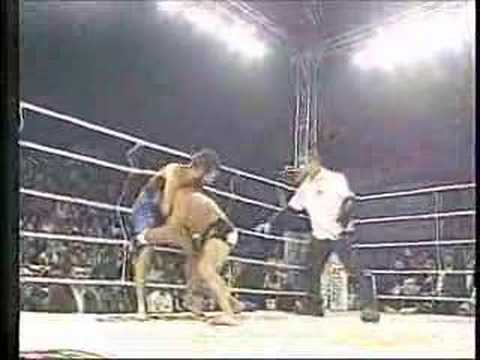
Luis Azeredo vs Tony DeSouza
0
DeSouza Special·amtuncurich
Luis Azeredo(Brasil) contra Tony DeSouza(PERU), en el MECA 11. www.tonydesouza.com www.cholitzu.com
Перевод: DeSouza Special — named after a Brazilian fighter who popularised this specific takedown-to-pass transition, where a defended double-leg attempt converts directly into a guard pass
The DeSouza Special is an MMA-specific technique that converts a defended double-leg takedown attempt directly into a guard pass, bypassing the intermediate step of landing in the opponent's guard. [1] In standard MMA grappling, when a double-leg takedown is defended (the opponent sprawls or posts), the attacker typically either backs out and resets to striking range or continues wrestling from the front headlock/scramble position. [1] The DeSouza Special offers a third option: instead of abandoning the failed shot, the attacker drives through the opponent's defence, threading past the legs directly into a guard pass — arriving in side control or mount without ever entering the opponent's closed guard. [1] BJ Penn documented the technique in The Book of Knowledge (2007) as one of several 'failed shot' recovery options, noting that the transition from the double-leg position to the guard pass uses the opponent's sprawl as an anchor point — the opponent's hips are lowered from the sprawl, and the attacker uses this lowered hip position to drive over or around the legs rather than fighting to complete the original double-leg. [1] The tactical brilliance of the DeSouza Special is that it turns a defensive failure (the shot was stopped) into an offensive success (direct pass to dominant position) — the opponent, having successfully defended the takedown, believes the danger has passed, and the immediate transition to the guard pass catches them mentally unprepared. [1] The technique requires excellent mat awareness: the attacker must recognise in real-time that the double-leg has been defended and IMMEDIATELY convert to the pass rather than continuing to fight for the original takedown. [1]
The DeSouza Special was named after a Brazilian fighter who demonstrated the takedown-to-pass transition in MMA competition, showing that a defended double-leg need not result in a reset to striking range. [1] BJ Penn documented the technique in Mixed Martial Arts: The Book of Knowledge (2007) as part of his comprehensive MMA technical system. [1] The concept of converting defensive scrambles into passing opportunities has roots in wrestling (where chain wrestling from failed takedowns is fundamental) and BJJ (where guard passing from standing is a standard transition), but the specific DeSouza Special — converting the double-leg defence directly to a side-control pass — was codified as a named technique in MMA. [1] The technique reflects MMA's unique tactical environment: unlike pure wrestling (where the takedown is the goal) or pure BJJ (where guard play is acceptable), MMA rewards bypassing the guard entirely (avoiding ground-and-pound from bottom guard), making the DeSouza's direct-to-side-control transition particularly valuable. [1]
The DeSouza Special is effective because it exploits a cognitive gap: after successfully defending a takedown (sprawling), the opponent mentally shifts from 'defending' to 'recovering' — the DeSouza arrives during this mental transition, before the opponent has re-engaged their defensive processing. [1] The technique also eliminates the need to pass the guard entirely: standard MMA grappling often follows the sequence takedown → land in guard → fight to pass → achieve side control. The DeSouza eliminates the 'land in guard' and 'fight to pass' stages, jumping directly from the takedown attempt to side control. [1] In UFC competition, wrestlers and MMA grapplers who develop the ability to chain from takedown attempts to guard passes have a significant advantage because their opponents can never 'relax' after a successful takedown defence. [1]
Brazilian MMA fighter (DeSouza) → demonstrated in competition → documented by BJ Penn in The Book of Knowledge (2007) → standard MMA wrestling-to-passing transition technique. [1]
The takedown-to-pass transition concept is used extensively in UFC and MMA competition by wrestlers who chain takedown attempts with guard passes. Fighters like Khabib Nurmagomedov, Colby Covington, and Daniel Cormier have demonstrated similar transitions where defended takedowns immediately convert to passing attempts without resetting to striking.
Изображений для этой техники пока нет.
Войдите, чтобы предложить изображение.
Luis Azeredo(Brasil) contra Tony DeSouza(PERU), en el MECA 11. www.tonydesouza.com www.cholitzu.com
Учебных курсов по этой технике пока нет.
Войдите, чтобы предложить курс.
Риск травмы для человека, к которому применяется техника
The DeSouza Special is a positional transition with minimal injury risk. The technique achieves a dominant position (side control or mount) without striking or joint-locking.
Уровень мастерства, необходимый для надёжного выполнения техники
Разрешена ли техника по основным соревновательным правилам
Mixed Martial Arts: The Book of Knowledge (Penn, Cordoza & Krauss, 2007)
description: [1] Penn 2007 Failed Shot section
Standard katakana transliteration of Western martial arts terminology (外来語) — used in Japanese MMA, boxing, and BJJ communities
description: [1] Penn 2007 Failed Shot section
Requires good wrestling base (the double-leg attempt must be competent)
Quick decision-making (recognising the defended shot in real-time)
Mat awareness for the lateral transition
Shoulder strength for maintaining hip pressure during the pass
Standard MMA grappling athleticism
The DeSouza Special is an MMA-specific technique that converts a defended double-leg takedown attempt directly into a guard pass, bypassing the intermediate step of landing in the opponent's guard. In standard MMA grappling, when a double-leg takedown is defended (the opponent sprawls or posts), the attacker typically either backs out and resets to striking range or continues wrestling from the front headlock/scramble position.
The DeSouza Special was named after a Brazilian fighter who demonstrated the takedown-to-pass transition in MMA competition, showing that a defended double-leg need not result in a reset to striking range. BJ Penn documented the technique in Mixed Martial Arts: The Book of Knowledge (2007) as part of his comprehensive MMA technical system.
IBJJF: разрешён — Legal, guard pass scores 3 points; IJF: разрешён — Legal — transitioning past opponent's legs is part of newaza; ADCC: разрешён — Legal, guard pass scores 3 points; Unified MMA: разрешён — Legal; FIAS Sport Sambo: разрешён — Legal
Оценка опасности 2/10. The DeSouza Special is a positional transition with minimal injury risk. The technique achieves a dominant position (side control or mount) without striking or joint-locking.
Стандартная цепочка подготовки: Striking range → Level change → Penetration step → Double-leg attempt → IF COMPLETED: takedown to dominant position → IF DEFENDED (opponent sprawls): Recognise the defence in real-time (0.5-1.0 second window) → Redirect from forward drive to lateral thread → Maintain shoulder pressure on opponent's hip → Thread past the opponent's legs laterally → Arrive in side control without entering guard → Consolidate dominant position → IF DeSouza is also defended → transition to single-leg, or back out to striking.
Стандартные контрприёмы: Strong sprawl with immediate disengagement — if the defender sprawls AND backs away quickly, the DeSouza window closes / Hip escape during the transition — if the defender hip escapes during the lateral thread, they can recompose guard / Guillotine attempt — reaching for a guillotine choke during the transition can halt the pass / Turtle and defend — if the defender turtles (knees and elbows on the mat) during the transition, the attacker cannot ….
Распространённые варианты: Standard DeSouza (from defended double-leg, thread laterally to side control); DeSouza to mount (continuing the transition past side control directly to m…); DeSouza to back (if the opponent turtles during the transition, taking the…); DeSouza from single-leg (the same transition principle applied from a defended sin…); Cage DeSouza (using the cage wall as an anchor during the transition (M…); DeSouza to guillotine (if the opponent reaches for a guillotine during the trans…).
The takedown-to-pass transition concept is used extensively in UFC and MMA competition by wrestlers who chain takedown attempts with guard passes. Fighters like Khabib Nurmagomedov, Colby Covington, and Daniel Cormier have demonstrated similar transitions where defended takedowns immediately convert to passing attempts without resetting to striking.
Основные ошибки, на которые стоит обратить внимание: Continuing to fight for the double-leg when it's clearly defended — the most common error: the attacker stubbornly dr… / Converting too slowly — the DeSouza window is approximately 0.5-1.0 seconds; a slow transition gives the opponent tim… / Losing shoulder pressure during the transition — the near shoulder must maintain contact with the opponent's hip thro… / Not controlling the near leg — during the lateral transition, the opponent's near leg can hook the attacker's body if….
DeSouza Special также известен как Desouza Supesharu, DeSouza Takedown, DeSouza Pass, Failed Shot Recovery, Sprawl-to-Pass.