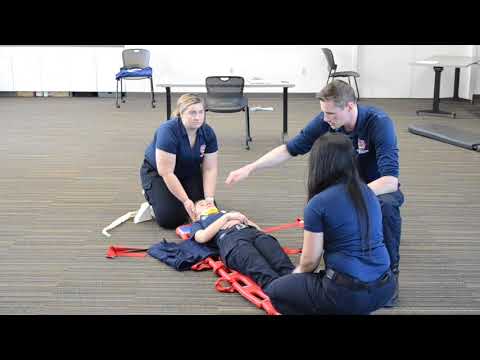
Spinal Immobilization: Supine Patient
0
Supine Rear Mount·San Diego Miramar EMT Program
Demonstration of the Spinal Immobilization for the Supine Patient Skill. This is a testable skill for the San Diego Coun…
Перевод: supine rear mount
The Supine Rear Mount subfamily covers the rear mount position where the controlling fighter is lying on their back with the opponent on top of them, face up, with hooks or body triangle maintaining control. [1] The supine rear mount is the more common rear mount configuration in competition because escaping fighters often roll to put the controlling fighter on their back, and skilled back takers maintain the position from supine. [1],[2] Despite being on the bottom, the supine rear mount is still considered a dominant position because the controlling fighter maintains full back control and attacking capability. [2],[3]
The supine rear mount is the most common back control configuration in competitive grappling and MMA, as opponents frequently attempt to escape back control by rolling, resulting in the controlling fighter ending up on their back. [1] The position's dominance despite being on the bottom demonstrates the primacy of back control in the positional hierarchy. [2],[3]
The supine rear mount is the classical back control position in BJJ and judo ne-waza. [1]
The supine rear mount is the standard back control finishing position in MMA and BJJ competition. [1]
Изображений для этой техники пока нет.
Войдите, чтобы предложить изображение.
Demonstration of the Spinal Immobilization for the Supine Patient Skill. This is a testable skill for the San Diego Coun…
Учебных курсов по этой технике пока нет.
Войдите, чтобы предложить курс.
Риск травмы для человека, к которому применяется техника
Back control is dominant position; enables rear chokes (Danaher 2021)
Уровень мастерства, необходимый для надёжного выполнения техники
Разрешена ли техника по основным соревновательным правилам
Mastering Jujitsu (Renzo Gracie & John Danaher, 2003)
Alias sources — [1] IBJJF Rules (2024) [2] Jiu-Jitsu University (Ribeiro, 2008) [3] Mastering Jujitsu (Gracie & Danaher, 2003)
Effectiveness sources — [1] Mastering Jujitsu (Gracie & Danaher, 2003) [2] Jiu-Jitsu University (Ribeiro, 2008)
Standard Japanese martial arts terminology (kanji/hiragana)
Established Japanese martial arts naming convention — native Japanese term (和語/漢語)
Alias sources — [1] IBJJF Rules (2024) [2] Jiu-Jitsu University (Ribeiro, 2008) [3] Mastering Jujitsu (Gracie & Danaher, 2003)
Effectiveness sources — [1] Mastering Jujitsu (Gracie & Danaher, 2003) [2] Jiu-Jitsu University (Ribeiro, 2008)
base stability, heavy hips, ride ability
heavier build with strong hips for pressure
hip adductors, core, glutes, quadriceps
Каждое движение в любом боевом искусстве обладает рядом универсальных свойств. Комбинируйте параметры ниже, чтобы найти нужный инструмент или сравнить аналоги из разных стилей.
Check all straps to ensure they are secure, and tighten them as needed. Make sure you have an even number of straps on each side of the patient for balanced immobilization.
Do not pull on stuck straps; instead, address them as needed once the patient is properly positioned on the board.
Secure the torso and body first with straps, then move to securing the patient's head to the board as the final step of immobilization.
The Supine Rear Mount subfamily covers the rear mount position where the controlling fighter is lying on their back with the opponent on top of them, face up, with hooks or body triangle maintaining control. The supine rear mount is the more common rear mount configuration in competition because escaping fighters often roll to put the controlling fighter on their back, and skilled back takers maintain the position from supine.
The supine rear mount is the most common back control configuration in competitive grappling and MMA, as opponents frequently attempt to escape back control by rolling, resulting in the controlling fighter ending up on their back. The position's dominance despite being on the bottom demonstrates the primacy of back control in the positional hierarchy.
IBJJF: разрешён — Legal, mount scores 4 points — highest-scoring position; IJF: разрешён — Legal, osaekomi (pin) — 10-19 seconds scores waza-ari, 20 seconds scores ippon; ADCC: разрешён — Legal, mount scores 2 points; Unified MMA: разрешён — Legal dominant position; UWW: разрешён — Legal, back exposure scores points, pin ends match by fall; FIAS Sport Sambo: разрешён — Legal, pin scores points
Оценка опасности 4/10. Moderate — back control is dominant position; enables rear chokes (Danaher 2021)
Стандартная цепочка подготовки: Pass the Guard → Settle Weight → Control Arms → Threaten Submissions.
Стандартные контрприёмы: Bridge (Upa) — explosive hip elevation to off-balance the top player / Elbow-Knee Escape (Shrimp) — create space by driving elbow to knee and hip-escaping / Frame — establish forearm frames to prevent the top player from settling weight.
Распространённые варианты: Low mount (hips heavy on the opponent's belly, grapevines in for sta…); High mount (knees under the armpits, arms isolated for submissions); S-mount (one knee high under the armpit, other leg across for arm …); Technical mount (one leg hooked, one knee posted, modified for back-take t…).
The supine rear mount is the standard back control finishing position in MMA and BJJ competition.
Основные ошибки, на которые стоит обратить внимание: Not falling to the strong seatbelt side — always transition to the side that favours the choke / Allowing the opponent to turn to their side — prevent the turn with hooks and seatbelt / Not using gravity to your advantage — in the supine position, the opponent must work against gravity to escape / Keeping the opponent too far above you — keep them low; if they slide up, your choke access improves.
Supine Rear Mount также известен как Aomuke Ushiro Kijōi, Flat Back Mount, Supine Back Control, Prone Rear Mount.