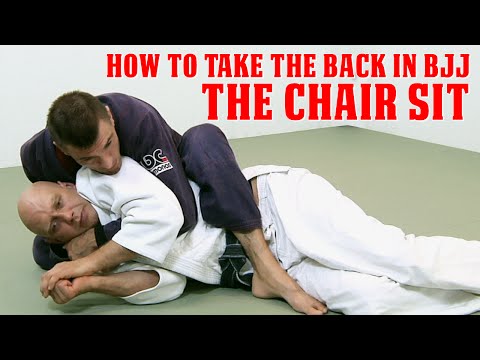
How to Take the Back in BJJ 1: The Chair Sit
0
Chair Sit·Stephan Kesting
Take the back and get rearmount with the Chair Sit technique. Rob Biernacki and Stephan Kesting show you how to get to …
Перевод: chair sit
The Chair Sit family covers the back control position where the controlling fighter sits behind the opponent with both fighters' hips on the mat, the controlling fighter's legs wrapped around the opponent's waist. [1] The chair sit is a transitional back position that provides control while the controlling fighter works to establish full back control with hooks or a body triangle. [1],[2] It is named for the seated posture resembling sitting in a chair behind the opponent. [2],[3]
The chair sit is a back control variation where the attacker sits upright with legs wrapped around the seated or kneeling opponent, providing a stable base for choke entries. [1]
The chair sit was developed in modern BJJ as a specialised back control variant. [1]
The chair sit is used in BJJ and MMA competition as a back control position. [1]
Изображений для этой техники пока нет.
Войдите, чтобы предложить изображение.
Take the back and get rearmount with the Chair Sit technique. Rob Biernacki and Stephan Kesting show you how to get to …
Учебных курсов по этой технике пока нет.
Войдите, чтобы предложить курс.
Риск травмы для человека, к которому применяется техника
Back control is dominant position; enables rear chokes (Danaher 2021)
Уровень мастерства, необходимый для надёжного выполнения техники
Разрешена ли техника по основным соревновательным правилам
Advanced Brazilian Jiu-Jitsu Techniques (Marcelo Garcia, 2011)
Alias sources — [1] Enter the System (Danaher, 2018) [2] Enter the System (Danaher, 2018) [3] Enter the System (Danaher, 2018)
Effectiveness sources — [1] Jiu-Jitsu University (Ribeiro, 2008)
Standard katakana transliteration of Western martial arts terminology (外来語) — used in Japanese MMA, boxing, and BJJ communities
Alias sources — [1] Enter the System (Danaher, 2018) [2] Enter the System (Danaher, 2018) [3] Enter the System (Danaher, 2018)
Effectiveness sources — [1] Jiu-Jitsu University (Ribeiro, 2008)
hook control, seatbelt grip endurance, hip connection
long legs for deep hooks, strong grip for seatbelt
hip adductors, biceps, forearms, core
Каждое движение в любом боевом искусстве обладает рядом универсальных свойств. Комбинируйте параметры ниже, чтобы найти нужный инструмент или сравнить аналоги из разных стилей.
The chair sit (seated back control) is an alternative to traditional back control with hooks — the attacker sits behind the opponent with their legs in front rather than hooks in. Used when the opponent defends hook insertion. (BJJ instructionals; competition records)
According to Stephan Kesting, a common error is going directly to a hook without first controlling the bottom side of your opponent's hip with your leg. This allows them to scoot their hip away and escape to half guard. Instead, place your leg against their hip first to prevent them from walking their hip away before establishing hooks.
Stephan Kesting emphasizes maintaining chest-to-back connection and keeping your elbows flush throughout the rotation. Don't detach or create space during the movement—use your leg and arm to push off and elevate your opponent while rotating, and maintain tension with your foot as you rotate them to the other side.
Stephan Kesting explains that if you immediately let go and try to establish hooks right away, there's a split second where your opponent's hips are free to escape. Instead, establish the position first and wait to see if they react before committing to hooks, which keeps the position tight.
Stephan Kesting stresses that you should slide your chest behind your opponent so your chin rests on their shoulder and your sternum is behind their scapula. This positioning dramatically increases control and prevents them from turning back in. As they turn, drop and place your chest behind while coming up off your knees to keep rotating them forward.
The Chair Sit family covers the back control position where the controlling fighter sits behind the opponent with both fighters' hips on the mat, the controlling fighter's legs wrapped around the opponent's waist. The chair sit is a transitional back position that provides control while the controlling fighter works to establish full back control with hooks or a body triangle.
The chair sit position was developed in BJJ and wrestling as a transitional back control position, used when taking the back from standing or during scrambles where full hooks have not yet been established. It is recognised as an intermediate position in the back-taking sequence.
IBJJF: разрешён — Legal, back control with hooks or body triangle scores 4 points; IJF: разрешён — Legal — back control leads to pin or submission opportunities; ADCC: разрешён — Legal, back mount scores 3 points (4 from sweep); Unified MMA: разрешён — Legal — dominant position for ground-and-pound and rear naked choke; UWW: разрешён — Legal — back exposure is the primary scoring mechanism in wrestling; FIAS Sport Sambo: разрешён — Legal
Оценка опасности 4/10. Moderate — back control is dominant position; enables rear chokes (Danaher 2021)
Стандартная цепочка подготовки: Achieve Position → Stabilize → Maintain → Attack.
Стандартные контрприёмы: Hand Fight — grip-fight the choking hand to prevent the rear naked choke / Shoulder Walk — walk shoulders to the mat to escape back control / Turn into Guard — rotate to face the attacker and recover guard position.
Распространённые варианты: Back control with hooks (both feet hooked inside the opponent's thighs); Body triangle back control (legs locked in a figure-four around the torso); Rear mount (mounted on the back with both hooks, opponent face-down); Chair sit back control (sitting behind the opponent with hooks, upright position).
The chair sit is used in BJJ and MMA competition as a back control position.
Основные ошибки, на которые стоит обратить внимание: Sitting too upright without hook pressure — the hooks must actively control the opponent's thighs / Not transitioning to flat back control when appropriate — the chair sit is often transitional / Losing the seatbelt in the chair sit — maintain the seatbelt grip at all times / Allowing the opponent to posture up and create distance — use the hooks to keep them close.
Chair Sit также известен как Chea Shitto, Chair Position, Backpack Sit, Hip Clamp.