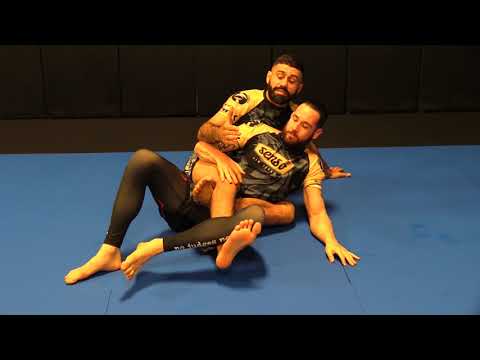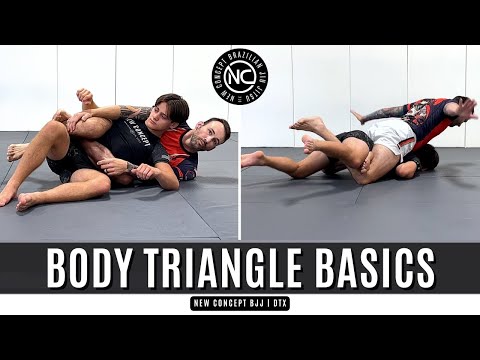
New Concept BJJ | Body Triangle Basics | NoGi Coach Caleb Flippin
0
Over Body Triangle·New Concept BJJ
Body Triangle Basics with NoGi Coach Caleb Flippin @NewConceptBJJ Dallas, TX #grappling #bjj #jiujitsu #newconcept…
Перевод: over body triangle
The Over Body Triangle positions the locking leg (the leg that crosses over to complete the figure-four) on top of the opponent's body, typically across the abdomen. [1] The over configuration creates downward compression on the opponent's midsection and allows the controlling fighter to squeeze the diaphragm, adding a physical discomfort element to the positional control. [1],[2] The over body triangle is the more commonly used configuration because it provides both control and compression. [2],[3]
The over body triangle was refined in modern competitive BJJ as practitioners developed systematic back-attack methodologies. [1]
The body triangle is a dominant control position in ADCC and IBJJF competition, used by athletes like Gordon Ryan. [1]
Изображений для этой техники пока нет.
Войдите, чтобы предложить изображение.
Body Triangle Basics with NoGi Coach Caleb Flippin @NewConceptBJJ Dallas, TX #grappling #bjj #jiujitsu #newconcept…
Vagner Rocha's Savage Back Attacks gives you the ability to control and submit even the toughest and most skilled from t…
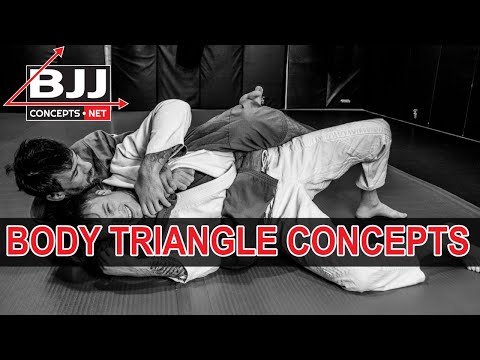
Here Rob and I talk about Body Triangle concepts from Back Control. This is a video from one of our Pedagogy membership…
The over body triangle is a back control position where the attacking grappler locks their legs around the opponent's torso with one leg triangled underneath and the other leg crossed over top, creating a dual-leg compression system. All three instructors—RVV BJJ, New Concept BJJ, and Digitsu—agree this represents the superior form of back control for maintaining position, superior to hooks alone. RVV BJJ emphasizes the conceptual distinction between holding and maneuvering, explaining that the body triangle excels at direct control through chest-to-back and hip-to-hip connections but limits offensive transitions compared to a single leg across the body. New Concept BJJ stresses proper foot placement positioning the lock high on the ribcage while keeping underhooks low, and warns against going belly-down under the opponent's weight. Digitsu (Vagner Rocha) provides detailed technical specifications: maintaining "jiu-jitsu feet" (toes up rather than pointed) to prevent ankle vulnerability, locking the foot underneath the opponent's buttocks rather than leaving it exposed, and positioning the lock high enough to maximize tightness while preventing bridge escapes. All three instructors discuss switching the body triangle when the opponent rotates, though RVV BJJ notes this presents a potential knee injury vulnerability for inflexible practitioners—a theoretical concern never seen at elite competitive levels. Digitsu emphasizes squeezing the ribs and middle body rather than merely cranking, and highlights how the freed hands in body triangle allow greater submission setup flexibility compared to hook-based control.
Сформировано на основе 3 инструкторов
Учебных курсов по этой технике пока нет.
Войдите, чтобы предложить курс.
Риск травмы для человека, к которому применяется техника
Back control is dominant position; enables rear chokes (Danaher 2021)
Уровень мастерства, необходимый для надёжного выполнения техники
Разрешена ли техника по основным соревновательным правилам
Advanced Brazilian Jiu-Jitsu Techniques (Marcelo Garcia, 2011)
Alias sources — [1] Jiu-Jitsu University (Ribeiro, 2008) [2] Mastering Jujitsu (Gracie & Danaher, 2003)
Effectiveness sources — [1] Jiu-Jitsu University (Ribeiro, 2008) [2] Mastering Jujitsu (Gracie & Danaher, 2003)
Standard katakana transliteration of Western martial arts terminology (外来語) — used in Japanese MMA, boxing, and BJJ communities
Alias sources — [1] Jiu-Jitsu University (Ribeiro, 2008) [2] Mastering Jujitsu (Gracie & Danaher, 2003)
Effectiveness sources — [1] Jiu-Jitsu University (Ribeiro, 2008) [2] Mastering Jujitsu (Gracie & Danaher, 2003)
hook control, seatbelt grip endurance, hip connection
long legs for deep hooks, strong grip for seatbelt
hip adductors, biceps, forearms, core
No, according to Coach Caleb Flippin, cranking doesn't work. Instead, lightly lock your legs and then pinch your knees together to constrict the diaphragm. This approach conserves energy and can be held for at least five minutes.
Coach Caleb Flippin emphasizes keeping your foot high enough that the opponent can't step over it and roll you to the other side. If your foot is too low, they can drive their hip through and potentially blow out your ankle.
According to Coach Caleb Flippin, avoid going belly-down, as this makes you vulnerable. Instead, use your hands and legs together—you can pop backwards using the tight hand position and drive through to escape.
RVV BJJ explains that you need to switch your body triangle to the other side and lace your foot behind their knee to maintain the lever-based control. Time your switch so that your foot stays controlling their leg as they rotate, preventing them from unwinding the position.
RVV BJJ distinguishes that the body triangle provides direct control with chest-to-back and hip-to-hip connection, but when you want to move and generate offense, you transition to using your leg across for lever-based control rather than the full triangle lock.
The Over Body Triangle positions the locking leg (the leg that crosses over to complete the figure-four) on top of the opponent's body, typically across the abdomen. The over configuration creates downward compression on the opponent's midsection and allows the controlling fighter to squeeze the diaphragm, adding a physical discomfort element to the positional control.
The over body triangle became the standard body triangle configuration as fighters discovered that the top-lock position provided superior compression and control compared to the under-lock variant. It is the most commonly taught body triangle position in both BJJ and MMA.
IBJJF: разрешён — Legal, back control with hooks or body triangle scores 4 points; IJF: разрешён — Legal — back control leads to pin or submission opportunities; ADCC: разрешён — Legal, back mount scores 3 points (4 from sweep); Unified MMA: разрешён — Legal — dominant position for ground-and-pound and rear naked choke; UWW: разрешён — Legal — back exposure is the primary scoring mechanism in wrestling; FIAS Sport Sambo: разрешён — Legal
Оценка опасности 4/10. Moderate — back control is dominant position; enables rear chokes (Danaher 2021)
Стандартная цепочка подготовки: Achieve Position → Stabilize → Maintain → Attack.
Стандартные контрприёмы: Posture Control — maintain strong posture to limit the opponent's offensive options / Escape to Neutral — work back to standing or a neutral position.
Распространённые варианты: Back control with hooks (both feet hooked inside the opponent's thighs); Body triangle back control (legs locked in a figure-four around the torso); Rear mount (mounted on the back with both hooks, opponent face-down); Chair sit back control (sitting behind the opponent with hooks, upright position).
The body triangle is a dominant control position in ADCC and IBJJF competition, used by athletes like Gordon Ryan.
Основные ошибки, на которые стоит обратить внимание: Not applying enough squeeze — the body triangle must actively compress; passive locking loses effectiveness / Positioning the cross too high (on the chest) — the ribs and stomach are the target area / Not maintaining the seatbelt with the body triangle — both controls are needed for full back control / Allowing the opponent to turn toward the locking ankle — this creates the escape angle; prevent the turn.
Over Body Triangle также известен как Ōbā Bodi Toraianguru, Top Lock Body Triangle, Over-Under Body Triangle.