Standard Kiss Of The Dragon

Род

Перевод: standard kiss of the dragon

Дистанция и классификация

Категория
Удар и защитаЗамкиБлижний бойБой против нескольких
Дистанция
БлижняяСредняяДальняя

Обзор

The Standard Kiss Of The Dragon executes the fundamental version of this technique by establishing reverse De La Riva guard, inverting between the opponent's legs, and threading the head and shoulders through to emerge behind the opponent with back control. [1] The guard player hooks the reverse DLR, inverts by pulling the hips over the shoulders, and slides between the opponent's legs, using the hooking leg to maintain connection throughout the transition. [1],[2] As the player emerges behind the opponent, they immediately secure seat-belt control and establish hooks for full back control. [2],[3]

Также известна как
Basic Kiss Of The Dragon[1]Standard KOTD[2]
Используется в

История и происхождение

The standard Kiss of the Dragon represents the base version of this advanced berimbolo variation, developed within the broader inverted guard system that dominated lightweight BJJ competition. [1] It remains a high-level technique primarily used by advanced competitors. [2],[3]

Страна происхождения· показано в случайном порядке

  • БразилияБразильское джиу-джитсу
  • ЯпонияБразильское джиу-джитсу

Эффективность

The Kiss of the Dragon is a highly effective back-take variation from the berimbolo family, using an inversion through the opponent's legs to emerge behind them and take the back. [1] It requires significant flexibility and timing but is effective in gi competition. [1],[2]

Родословная

A modern BJJ back-take technique from DLR guard. [1]

Соревновательные результаты

Used in IBJJF competition. [1]

Изображения

Изображений для этой техники пока нет.

Войдите, чтобы предложить изображение.

Биомеханический механизм

Primary ActionBreaking the opponent's leg control to advance to a more dominant position
Joints InvolvedHips (posture and pressure), knees (opening the guard with knee-in or standing), hands (grip fighting)
Force VectorForward pressure (stack/smash) or backward posture (stand-up break) to open the closed guard
Passing MechanicOnce the guard is opened, speed passing, pressure passing, or toreando passing advances the position

Позиция и вход

From bottom (opponent has back control)Fight the hands to prevent the choke, slide hips to the mat on the choking side, escape the hooks and turn into the opponent
From standing (opponent has back clinch)Drop the hips, peel the hands, turn and face the opponent
From body triangleAddress the body triangle first by positioning the trapped leg to pry it open, then escape the hooks

Варианты

Slide to side (choking-arm side)fighting hands and sliding hips to the mat on the choking side
Peel-and-turnstripping the seatbelt grip and turning into the opponent
Trap-arm escapetrapping one arm and rolling to pin the opponent's back
Body triangle escapeaddressing the body triangle lock before escaping the hooks

Видео

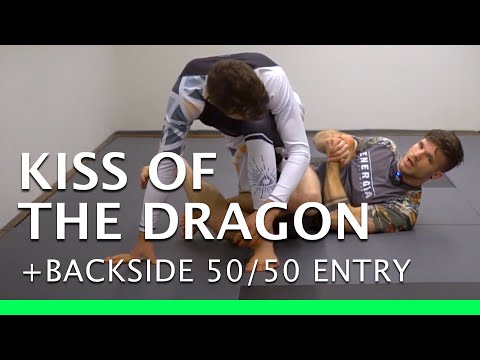
Kiss of the Dragon

0
Standard Kiss Of The Dragon·Energia Martial Arts·Added by Admin

Kiss of the Dragon In this video we cover the entry from reverse de la Riva to the kiss of the dragon back take. We also

1 video

Изучить технику

Учебных курсов по этой технике пока нет.

Войдите, чтобы предложить курс.

Оценки

Уровень опасности

Риск травмы для человека, к которому применяется техника

3
Умеренный3/10

Sweeps reverse position from bottom; moderate impact on landing for top player

Сложность

Уровень мастерства, необходимый для надёжного выполнения техники

Средний
Допустимость на соревнованиях

Разрешена ли техника по основным соревновательным правилам

Заметки по тренировке

Standard Kiss of the Dragon: from DLR guard with the opponent attempting a knee slice, maintain the deep DLR hook, grip the far belt or ankle, invert underneath their passing leg, and spin to the back (Mendes Brothers, Art of Jiu-Jitsu, 2010s)
Step 1: from DLR guard, feel the opponent begin a knee slice or leg drag pass
Step 2: maintain the DLR hook deeply — the hook must stay connected during their passing attempt
Step 3: grip the far belt, ankle, or pant leg with the bottom hand
Step 4: as the opponent commits to the pass, invert underneath their passing knee
Step 5: spin through, using the DLR hook as a pivot, to emerge behind the opponent
Step 6: immediately establish back control — hooks and seatbelt
The timing is critical: invert as the opponent commits their weight to the pass — too early or too late fails
The inversion goes under the opponent's passing knee — you thread through the narrowest gap
This is a counter-attack technique: wait for the pass attempt, then convert it

Типичные ошибки

!Inverting before the opponent commits to the pass — you need their weight commitment for the spin to work
!Losing the DLR hook during the inversion — the hook must stay deep throughout
!Not gripping the far belt or ankle — the grip prevents the opponent from adjusting during your spin
!Inverting to the wrong side — always invert under the passing knee, not away from it
!Not completing the back take — finishing behind the opponent with hooks is the goal
!Attempting against a standing opponent — the Kiss of the Dragon works against kneeling/passing opponents
!Over-relying on inversion without developing the timing — timing training with live partners is essential

Связанные техники

Контрприёмы

Цепочка подготовки

1Create Spaceuse frames, hip movement, or leverage to generate room to move
2Disrupt Controlbreak or weaken the opponent's grips and weight placement
3Execute Escapeapply the specific escape mechanic with timing and commitment
4Recover Positionestablish a safe position (guard, standing, or top)

Источники и ссылки

Основной источник

Advanced Brazilian Jiu-Jitsu Techniques (Marcelo Garcia, 2011)

1КнигаThe Guard (Moreira & Beneville, 2008)

Alias sources — [1] Popularised by Leandro Lo and Mendes Brothers [2] Modern competition BJJ terminology

2КнигаJiu-Jitsu University (Ribeiro, 2008)

Effectiveness sources — [1] Art of Jiu-Jitsu Academy (Mendes Brothers) competition methodology [2] IBJJF competition analysis

3ДругоеJapanese Combat Sports Katakana Convention

Standard katakana transliteration of Western martial arts terminology (外来語) — used in Japanese MMA, boxing, and BJJ communities

4ЦитатаThe Guard (Moreira & Beneville, 2008)

Alias sources — [1] Popularised by Leandro Lo and Mendes Brothers [2] Modern competition BJJ terminology

5ЦитатаJiu-Jitsu University (Ribeiro, 2008)

Effectiveness sources — [1] Art of Jiu-Jitsu Academy (Mendes Brothers) competition methodology [2] IBJJF competition analysis

Сообщество

Атлетизм

Requires

grip fighting ability, hip mobility for sliding to the mat, chin defence

Favours

strong hands for grip fighting, flexible hips

Key muscles

forearms (grip fighting), core, hip flexors, neck

Часто задаваемые вопросы

What position do I start from to perform the Kiss of the Dragon?

You start from a reverse Dela Jiva position. Energia Martial Arts recommends checking out their basic reverse Dela Jiva video first to understand the foundational position.

How do I grip during the inversion part of the Kiss of the Dragon?

Initially grip the opponent's heel from behind, then switch your grip to the inside backside of your hand and wrist as you invert. You'll push off with the backside of your hand and wrist against their ankle and shin to help you spin between their legs.

What should I do with my shoulders once I'm underneath my opponent?

Shove your shoulders back slightly to prevent the opponent from falling on your face and chest, which helps them fall into your lap for the back take instead.

What submission can I go for after the Kiss of the Dragon besides the back take?

You can attack the opponent's leg with a backside 50/50 heel entry using a gable grip or reverse butterfly grip, keeping pressure with your hamstring to maintain control.

Как работает Standard Kiss Of The Dragon?

The Standard Kiss Of The Dragon executes the fundamental version of this technique by establishing reverse De La Riva guard, inverting between the opponent's legs, and threading the head and shoulders through to emerge behind the opponent with back control. The guard player hooks the reverse DLR, inverts by pulling the hips over the shoulders, and slides between the opponent's legs, using the hooking leg to maintain connection throughout the transition.

Откуда происходит Standard Kiss Of The Dragon?

The standard Kiss of the Dragon represents the base version of this advanced berimbolo variation, developed within the broader inverted guard system that dominated lightweight BJJ competition. It remains a high-level technique primarily used by advanced competitors.

Разрешён ли Standard Kiss Of The Dragon на соревнованиях?

Unified MMA: разрешён — Legal defensive/transitional technique; IBJJF: разрешён — Legal; IJF: разрешён — Legal; ADCC: разрешён — Legal; UWW: разрешён — Legal; FIAS Sport Sambo: разрешён — Legal

Насколько опасен Standard Kiss Of The Dragon?

Оценка опасности 3/10. Moderate — sweeps reverse position from bottom; moderate impact on landing for top player

Как подготовить Standard Kiss Of The Dragon?

Стандартная цепочка подготовки: Create Space → Disrupt Control → Execute Escape → Recover Position.

Как защититься от Standard Kiss Of The Dragon?

Стандартные контрприёмы: Maintain Pressure — keep consistent weight distribution to limit escape space / Anticipate Direction — read escape attempt direction and block early / Transition — flow to a new position when the current one is threatened.

Какие есть варианты Standard Kiss Of The Dragon?

Распространённые варианты: Slide to side (choking-arm side) (fighting hands and sliding hips to the mat on the choking…); Peel-and-turn (stripping the seatbelt grip and turning into the opponent); Trap-arm escape (trapping one arm and rolling to pin the opponent's back); Body triangle escape (addressing the body triangle lock before escaping the hooks).

Насколько эффективен Standard Kiss Of The Dragon на соревнованиях?

Used in IBJJF competition.

Какие типичные ошибки при выполнении Standard Kiss Of The Dragon?

Основные ошибки, на которые стоит обратить внимание: Inverting before the opponent commits to the pass — you need their weight commitment for the spin to work / Losing the DLR hook during the inversion — the hook must stay deep throughout / Not gripping the far belt or ankle — the grip prevents the opponent from adjusting during your spin / Inverting to the wrong side — always invert under the passing knee, not away from it.

Какие ещё названия есть у Standard Kiss Of The Dragon?

Standard Kiss Of The Dragon также известен как Sutandādo Kisu Obu Za Doragon, Basic Kiss Of The Dragon, Standard KOTD.