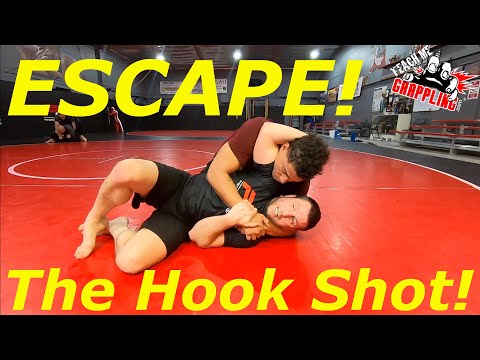
ESCAPE the Seatbelt..."The HOOK SHOT!"
0
Seatbelt Escape·TeachMeGrappling Coach Brian
PLEASE Click this link to SUPPORT the TeachMeGrappling Channel!!! https://www.patreon.com/TeachMeGrappling or https:/…
Not yet documented
The Seatbelt Escape family covers techniques for breaking the seatbelt grip (over-under arm control from behind) — the most critical first step in any back escape, because the seatbelt grip enables the rear naked choke, bow and arrow, and all other back attacks. [1] The seatbelt is the opponent's primary control tool from back mount: one arm goes over the shoulder (choking arm) and one under the armpit (control arm), with hands clasped on the chest. [1],[2] Escaping the seatbelt involves hand fighting to strip the choking-side grip, turning toward the underhook side, and sliding the hips to the mat — a precise sequence that must be executed before the opponent can transition from seatbelt control to a choking grip. [2],[3] Every back escape begins with addressing the seatbelt; if the seatbelt remains intact, no positional escape is possible. [3]
Seatbelt escapes are performed constantly at the highest levels of BJJ and MMA competition. [1]
Изображений для этой техники пока нет.
Войдите, чтобы предложить изображение.
PLEASE Click this link to SUPPORT the TeachMeGrappling Channel!!! https://www.patreon.com/TeachMeGrappling or https:/…
Учебных курсов по этой технике пока нет.
Войдите, чтобы предложить курс.
Риск травмы для человека, к которому применяется техника
The seatbelt position is one step away from the rear naked choke; failing to escape the seatbelt often leads to being choked; in MMA, ground-and-pound from back control with seatbelt is devastating
Уровень мастерства, необходимый для надёжного выполнения техники
Разрешена ли техника по основным соревновательным правилам
Jiu-Jitsu University (Saulo Ribeiro, 2008)
Description sources — [1] Jiu-Jitsu University (Ribeiro, 2008) [2] Modern back escape methodology
Standard katakana transliteration of Western martial arts terminology (外来語) — used in Japanese MMA, boxing, and BJJ communities
Description sources — [1] Jiu-Jitsu University (Ribeiro, 2008) [2] Modern back escape methodology
grip fighting ability, chin tuck discipline, hip mobility
strong hands (grip stripping), flexible hips (sliding to mat), mental composure
forearms (grip fighting), neck (chin tuck), hip flexors (sliding), core (turning)
Каждое движение в любом боевом искусстве обладает рядом универсальных свойств. Комбинируйте параметры ниже, чтобы найти нужный инструмент или сравнить аналоги из разных стилей.
Coach Brian emphasizes that poking your head out too far is a critical error—you need to keep your head hidden and protected. Letting your head peek out gives your opponent opportunities to attack and makes the escape much harder.
Once you protect your neck and get into a tight ball, look for your opponent's head to lift or hang out. When it does, pick up their near leg (ankle or thigh) and rotate toward your knees while turning to face them, which flips them and gets you out of the bottom position.
Be careful of back takes—if your head rises too high during the escape and your opponent grips it, they can take your back. Also avoid getting your leg caught in half guard as you rotate; keep tight control of your leg positioning throughout the escape.
The Seatbelt Escape family covers techniques for breaking the seatbelt grip (over-under arm control from behind) — the most critical first step in any back escape, because the seatbelt grip enables the rear naked choke, bow and arrow, and all other back attacks. The seatbelt is the opponent's primary control tool from back mount: one arm goes over the shoulder (choking arm) and one under the armpit (control arm), with hands clasped on the chest.
Seatbelt escape techniques developed as back control and choking systems became more sophisticated in modern BJJ and MMA competition. As fighters like Marcelo Garcia and the Danaher Death Squad developed comprehensive back attack systems, the need for systematic seatbelt escapes grew.
Unified MMA: разрешён — Legal defensive/transitional technique; IBJJF: разрешён — Legal; IJF: разрешён — Legal; ADCC: разрешён — Legal; UWW: разрешён — Legal; FIAS Sport Sambo: разрешён — Legal
Оценка опасности 8/10. Very high — the seatbelt position is one step away from the rear naked choke; failing to escape the seatbelt often leads to being choked; in MMA, ground-and-pound from back control with seatbelt is devastating
Стандартная цепочка подготовки: Protect Neck → Fight Choking Hand → Strip Grip → Slide Hips → Turn → Recover Guard.
Стандартные контрприёмы: When attacking from back: re-clasp the hands when stripped / Transition to choke immediately when the seatbelt starts breaking / Switch to body triangle to maintain control even if seatbelt is stripped / Maintain hooks to prevent the hip slide.
Распространённые варианты: Two-on-one strip (using both hands to peel the choking hand [1]); Slide to choking-arm side (dropping the hips to the mat on the choking side); Turn to underhook side (rotating to face the opponent after breaking the grip); Hitchhiker escape (rotating the body to relieve the grip angle); Posture and grip fight (using posture to create space before stripping [2]).
Seatbelt escapes are performed constantly at the highest levels of BJJ and MMA competition.
Основные ошибки, на которые стоит обратить внимание: Fighting the control arm instead of the choking arm — the under-armpit arm is annoying but the over-shoulder arm kill… / Pulling the choking hand up (toward your face) — pull it DOWN below the chin; pulling up gives the opponent better ch… / Turning toward the choking arm — turn toward the underhook/control arm side; turning toward the choking arm tightens … / Not sliding the hips — fighting hands without moving the hips keeps you in the choke zone.
Seatbelt Escape также известен как Seatbelt Defence, Back Escape from Seatbelt, Over-Under Escape.