How to Escape the Body Triangle
0
Standard Body Triangle Escape·Shawn Williams BJJ
How to escape the body triangle. This video demonstrates how to get out of the body triangle when your opponent has you…
Перевод: standard body triangle escape
The Standard Body Triangle Escape addresses the body triangle lock by turning into the locked side (toward the leg on top of the triangle), then using hip pressure and leg positioning to pry the triangle open and clear the legs. [1] The key mechanical insight is that turning toward the top leg changes the angle of the triangle, making it easier to slide the hips free. [1],[2] Once the triangle is cleared, the escape proceeds as a standard back escape — clearing the hooks and turning to face the opponent. [2],[3]
The standard body triangle escape uses hip movement and knee insertion to break the triangle configuration. [1]
A fundamental BJJ escape technique. [1]
Used in BJJ competition. [1]
Изображений для этой техники пока нет.
Войдите, чтобы предложить изображение.
How to escape the body triangle. This video demonstrates how to get out of the body triangle when your opponent has you…
Gordon Ryan taught me one of the greatest techniques I've ever seen. It's remarkable how much information he has about e…
Join My Online Academy to Improve Your Jiu Jitsu FAST!!! https://academy.mattarroyo.com/ Get my FREE Side Control Esca…
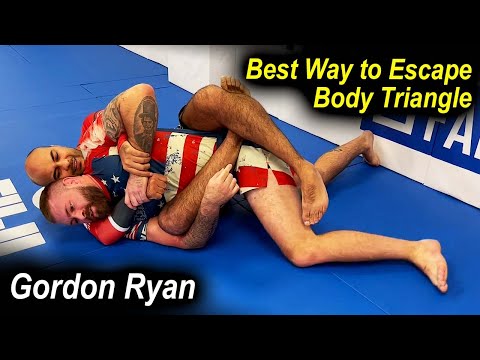
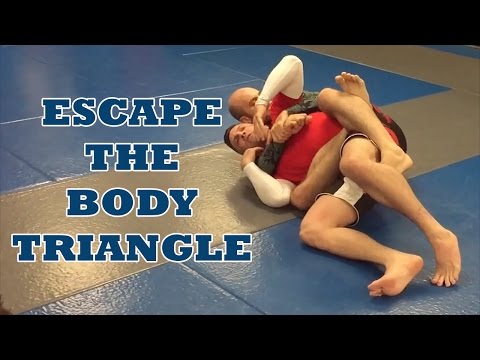
The standard body triangle escape relies on a fundamental principle articulated by all three instructors: displacing the opponent's heel past the escaper's hip to break the geometric lock. Shawn Williams BJJ emphasizes the core mechanic—the opponent's shin creates a bar across the hip that controls body position, and moving the hip past this heel compromises the angle and opens escape routes. Gordon Ryan (Bernardo Faria BJJ Fanatics) systematizes escapes by position (overhook/underhook, top/bottom side triangles) and introduces a critical hand-assist method: using the secondary hand's elbow underneath the opponent's knee to create ankle exposure, allowing the legs to scissor and trap the foot while the primary hand maintains neck defense via inside thumb position on the opponent's wrist. Matt Arroyo Jiu Jitsu adds prevention (locking the opponent's foot between the knees before the triangle sets) and emphasizes three sequential strategies: attempting a footlock submission first, then using scissor mechanics to move the foot to the outside and control it via the toe/pinky toe, and finally using hip displacement to escape the back position. All instructors stress continuous neck defense throughout. Where they differ: Williams focuses on basic hip displacement; Ryan systematizes hand-assist positioning based on configuration; Arroyo prioritizes submission attempts before escape and presents a roll-over-shoulder variation for difficult cases. All agree the escape is mechanically sound across skill levels despite subjective difficulty increases with longer-limbed opponents.
Сформировано на основе 3 инструкторов
Учебных курсов по этой технике пока нет.
Войдите, чтобы предложить курс.
Риск травмы для человека, к которому применяется техника
Back escapes must address choke threat while escaping; urgency increases injury risk
Уровень мастерства, необходимый для надёжного выполнения техники
Разрешена ли техника по основным соревновательным правилам
Jiu-Jitsu University (Saulo Ribeiro, 2008)
Alias sources — [1] Back Attacks: Enter the System (John Danaher, 2018) [2] Jiu-Jitsu University (Saulo Ribeiro, 2008)
Effectiveness sources — [1] Jiu-Jitsu University (Ribeiro, 2008)
Standard katakana transliteration of Western martial arts terminology (外来語) — used in Japanese MMA, boxing, and BJJ communities
Alias sources — [1] Back Attacks: Enter the System (John Danaher, 2018) [2] Jiu-Jitsu University (Saulo Ribeiro, 2008)
Effectiveness sources — [1] Jiu-Jitsu University (Ribeiro, 2008)
explosive hip bridge power, shrimping ability, timing
strong glutes and hip extensors for powerful bridges
glutes, hip extensors, core, quadriceps
According to Matt Arroyo, the second your back is taken, watch for your opponent to place his foot on your hip and bring the other foot up across your body. Push that foot between your legs to protect your neck before the triangle locks, then execute whatever back escape you prefer from that position.
Matt Arroyo recommends trying to submit your opponent with his own body triangle lock first, since a successful submission ends the match immediately. If the submission attempt fails, then proceed with escape techniques, which otherwise require you to pass guard and work for position before attempting any submission.
Matt Arroyo explains that you cannot simply open a tight body triangle by pushing outward since the opponent's legs are the strongest part of their body. Instead, manipulate the foot position by sliding your opponent's foot up their shin toward the knee, which weakens the lock and allows you to work your hips free from the hook.
Matt Arroyo teaches a timing-based escape: when your opponent releases their grip to attempt a choke, insert your hand to create a double-under grip. Your opponent will lock their hands for control, and when they release to return to a seat belt grip, that's when you escape your back from their chest with separation.
The Standard Body Triangle Escape addresses the body triangle lock by turning into the locked side (toward the leg on top of the triangle), then using hip pressure and leg positioning to pry the triangle open and clear the legs. The key mechanical insight is that turning toward the top leg changes the angle of the triangle, making it easier to slide the hips free.
The standard body triangle escape was developed through competitive grappling and MMA, where the body triangle became an increasingly common back control method that required specific defensive solutions. It is now taught as the primary body triangle escape in most grappling programmes.
Unified MMA: разрешён — Legal defensive/transitional technique; IBJJF: разрешён — Legal; IJF: разрешён — Legal; ADCC: разрешён — Legal; UWW: разрешён — Legal; FIAS Sport Sambo: разрешён — Legal
Оценка опасности 4/10. Moderate — back escapes must address choke threat while escaping; urgency increases injury risk
Стандартная цепочка подготовки: Create Space → Disrupt Control → Execute Escape → Recover Position.
Стандартные контрприёмы: Maintain Pressure — keep consistent weight distribution to limit escape space / Anticipate Direction — read escape attempt direction and block early / Transition — flow to a new position when the current one is threatened.
Распространённые варианты: Bridge and roll (upa) (explosive bridge trapping arm and leg to reverse position); Elbow-knee escape (framing and shrimping to recover guard); Foot drag escape (dragging the opponent's foot with the heel to create spac…); Combination escape (bridging to force a reaction, then shrimping when the opp…).
Used in BJJ competition.
Основные ошибки, на которые стоит обратить внимание: Turning away from the locking ankle — you must turn toward it to create the correct angle for the push / Pushing the ankle with one hand — use both hands for maximum force against the lock / Not trapping the freed leg immediately — the opponent will re-lock the body triangle within seconds / Trying to open the triangle by pulling the legs apart — the figure-four is designed to resist pulling; attack the ank….
Standard Body Triangle Escape также известен как Sutandādo Bodi Toraianguru Esukēpu, Body Triangle Turn Escape, Hip Switch Body Triangle Escape.