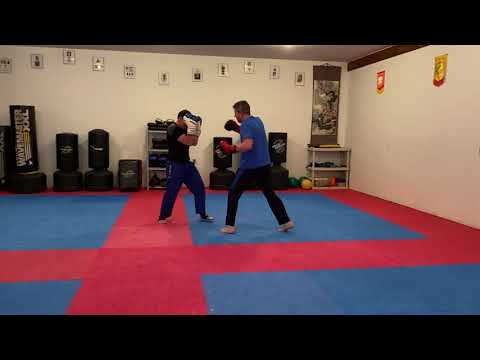
Shell Guard Defense - Self-Defense and Sparring - Lesson 5
0
Standard Shell·Martial Arts Concepts and Philosophy·Added by Admin
Ways to defend basic strikes using shell guard as a backup plan. The positives and negatives of this defense are also d…
Перевод: standard shell
The Standard Shell covers the head by placing both hands over the ears and temples, tucking the chin to the chest, and bringing the elbows together in front of the face, creating a compact protective structure. [1] The shoulders are raised to protect the sides of the jaw, and the body is turned slightly to present a smaller target. [1],[2] In the ground position, the standard shell also includes bringing the knees up to protect the body and create space for guard recovery. [2],[3]
The shell defence has been part of boxing's defensive repertoire since the introduction of gloved boxing under the Marquess of Queensberry rules (1867), as gloves enabled fighters to absorb punches behind a tight guard. [1]
George Foreman employed a tight shell guard during his remarkable comeback career in the 1990s, using it to absorb punishment before countering with power shots, culminating in his heavyweight title win over Michael Moorer in 1994 at age 45. [1]
Изображений для этой техники пока нет.
Войдите, чтобы предложить изображение.
Ways to defend basic strikes using shell guard as a backup plan. The positives and negatives of this defense are also d…
Учебных курсов по этой технике пока нет.
Войдите, чтобы предложить курс.
Риск травмы для человека, к которому применяется техника
Blocking and parrying absorb strike force; hand/forearm injury from repeated blocking
Уровень мастерства, необходимый для надёжного выполнения техники
Разрешена ли техника по основным соревновательным правилам
Boxing (Edwin Haislet, 1940)
Alias sources — [1] Championship Fighting (Dempsey, 1950) [2] Boxing Mastery (Hatmaker, 2004) [3] Fighter's Fact Book (Christensen, 2000)
Effectiveness sources — [1] Championship Fighting (Dempsey, 1950) [2] Boxing Mastery (Hatmaker, 2004)
Standard katakana transliteration of Western martial arts terminology (外来語) — used in Japanese MMA, boxing, and BJJ communities
Alias sources — [1] Championship Fighting (Dempsey, 1950) [2] Boxing Mastery (Hatmaker, 2004) [3] Fighter's Fact Book (Christensen, 2000)
Effectiveness sources — [1] Championship Fighting (Dempsey, 1950) [2] Boxing Mastery (Hatmaker, 2004)
reaction speed, structural body mechanics, defensive awareness
quick reflexes and conditioned defensive surfaces
varies — forearms (blocking), legs (movement), core (stability)
The shell guard is a last resort defensive technique, used when you can't employ head movement or other primary defenses. It's most practical in sport contexts where punches are typically above the belt.
Place your gloves in front of your head to protect it from jabs and crosses, and arch your body slightly inward so that when struck, you absorb the impact without getting knocked backward.
The shell guard uses both hands for better support and protection, particularly against kicks, whereas a carriage block relies on a single hand for defense.
When struck, you can 'ride along' with the punch by moving with the impact rather than meeting it statically, which helps dissipate the force and reduces the damage you absorb.
The Standard Shell covers the head by placing both hands over the ears and temples, tucking the chin to the chest, and bringing the elbows together in front of the face, creating a compact protective structure. The shoulders are raised to protect the sides of the jaw, and the body is turned slightly to present a smaller target.
The standard shell cover is a universal defensive position used across all combat sports, refined through boxing's long history and adapted for MMA's ground-and-pound scenarios. It is taught as an emergency defensive option when all other defences have been compromised.
Unified MMA: разрешён — Legal defensive technique; WBC/Boxing: разрешён — Legal — blocking and evasion are core boxing skills; WKF: разрешён — Legal — blocking is a fundamental karate skill; Kyokushin: разрешён — Legal; WT: разрешён — Legal; WAKO: разрешён — Legal; K: разрешён — 1/GLORY — Legal; IFMA: разрешён — Legal
Оценка опасности 3/10. Moderate — blocking and parrying absorb strike force; hand/forearm injury from repeated blocking
Стандартная цепочка подготовки: Anticipate the Attack → Execute Defence → Recover Stance → Counter or Disengage.
Стандартные контрприёмы: Timing — attack when the defence is recovering or between movements / Feint — use deception to create openings in the defensive structure / Angle Change — attack from an unexpected angle that the defence does not cover.
Распространённые варианты: Standard defence (primary defensive technique from the most common position); Reactive defence (triggered by the opponent's attack, minimal movement for …); Proactive defence (anticipating the attack and positioning to neutralise it …); Counter defence (using the defensive movement to create an immediate count…).
George Foreman employed a tight shell guard during his remarkable comeback career in the 1990s, using it to absorb punishment before countering with power shots, culminating in his heavyweight title win over Michael Moorer in 1994 at age 45.
Основные ошибки, на которые стоит обратить внимание: Chin not tucked behind the lead shoulder — the chin MUST be hidden / Rear hand away from the chin — it stays glued to the jaw / Lead arm protecting nothing — the forearm should cover the ribs and liver / Using the shell against body kicks — the shell protects against punches primarily; kicks require shin checks.
Standard Shell также известен как Sutandādo Sheru, Basic Shell Cover, Standard Shell Guard, Tight Shell.