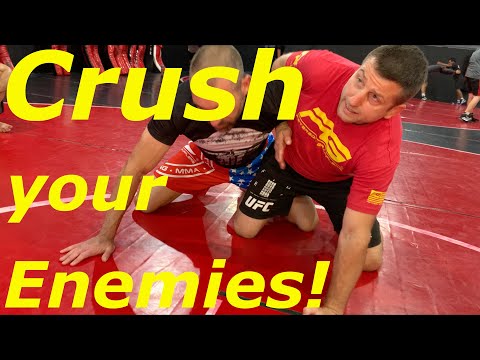
PRESSURE with the Whizzer!!
0
Whizzer·TeachMeGrappling Coach Brian
This video I teach a little about putting pressure before you attack the jumping triangle. Check out the details and yo…
Перевод: whizzer
The Whizzer subfamily covers the active overhook variant where the attacker combines the arm wrap with aggressive hip pressure, driving the hip into the opponent's body on the overhook side to create a powerful defensive and counter-offensive tool. [1] The whizzer is distinguished from the standard overhook by its dynamic hip engagement — the attacker doesn't just trap the arm but actively drives the hip forward and downward, using the overhook as a lever to redirect or stop the opponent's movement. [1],[2] The whizzer is the primary defence against single-leg takedowns and underhook drives in wrestling. [2],[3]
The whizzer is a distinctly American wrestling contribution, developed and named within the folkstyle wrestling tradition where the active overhook with hip pressure became a primary defensive technique against single-leg takedowns. [1] The term 'whizzer' has been part of American wrestling vocabulary since at least the mid-20th century. [2],[3]
The whizzer (defensive overhook) is the primary takedown defence technique in the clinch, used to counter single-leg and double-leg takedown attempts by hooking over the attacker's arm and driving the hip. [1] Welker describes the whizzer as 'the most important single defence against leg attacks' in wrestling. [1] Its effectiveness depends on hip pressure — the defender must drive their hip into the attacker to prevent them from finishing the takedown. [2]
The whizzer is a wrestling term for the defensive overhook used to counter underhook attacks and single-leg takedowns. [1]
The whizzer is one of the most commonly used defensive techniques in wrestling competition. [1]
Изображений для этой техники пока нет.
Войдите, чтобы предложить изображение.
This video I teach a little about putting pressure before you attack the jumping triangle. Check out the details and yo…
Учебных курсов по этой технике пока нет.
Войдите, чтобы предложить курс.
Риск травмы для человека, к которому применяется техника
Upper body clinch positions for control and transitions
Уровень мастерства, необходимый для надёжного выполнения техники
Разрешена ли техника по основным соревновательным правилам
Freestyle Wrestling: A Complete Guide for Coaches and Wrestlers (Petrov, 1977)
Alias sources — [1] Wrestling Physical Conditioning Encyclopedia (Welker, 2010) [2] NCAA Wrestling Rules and Interpretations (NCAA, 2020) [3] Freestyle Wrestling: A Complete Guide (Petrov, 2005)
Effectiveness sources — [1] Wrestling Physical Conditioning Encyclopedia (Welker, 2010) [2] Freestyle Wrestling: A Complete Guide (Petrov, 2005)
Official Kodokan ground technique classification system
Standard katakana transliteration of Western martial arts terminology (外来語) — used in Japanese MMA, boxing, and BJJ communities
Alias sources — [1] Wrestling Physical Conditioning Encyclopedia (Welker, 2010) [2] NCAA Wrestling Rules and Interpretations (NCAA, 2020) [3] Freestyle Wrestling: A Complete Guide (Petrov, 2005)
Effectiveness sources — [1] Wrestling Physical Conditioning Encyclopedia (Welker, 2010) [2] Freestyle Wrestling: A Complete Guide (Petrov, 2005)
swimming speed for inside position, shoulder drive, hip pressure
strong shoulders and low centre of gravity
deltoids, pectorals, core, quadriceps
Каждое движение в любом боевом искусстве обладает рядом универсальных свойств. Комбинируйте параметры ниже, чтобы найти нужный инструмент или сравнить аналоги из разных стилей.
The Defensive Whizzer applies the overhook with hip pressure specifically as a defensive reaction to the opponent's takedown attempt, typically against a single-leg or underhook drive. [1] When the opponent secures an underhook and drives forward, the defender hooks the overhook deep, drives the near hip forward into the attacker's body, and uses the combined arm-and-hip pressure to halt the forward drive and redirect the opponent's energy. [1,2] The defensive whizzer is the most commonly used whizzer application and is considered one of the fundamental takedown defence techniques in wrestling. [2,3]
The Offensive Whizzer uses the overhook with hip pressure as an attacking tool rather than purely defensive, leveraging the whizzer position to initiate throws, trips, and go-behind transitions. [1] The offensive whizzer drives the hip aggressively through the opponent while using the overhook to control their posture, creating off-balancing forces that set up hip throws (like harai-goshi), inside trips, or snap-and-spin-behind transitions. [1,2] The offensive whizzer transforms a traditionally defensive position into an attack platform by increasing the aggression and directional commitment of the hip drive. [2,3]
Coach Brian emphasizes turning your hip and having your opponent give back a little bit of energy before you attempt the lift—this hip turn is essential for generating proper pressure.
If your leg is still untangled and you're not in position to shoot the triangle, Coach Brian recommends punishing your opponent with a throw when they refuse to release your entangled leg.
Stay on your toes and keep your toes off the ground to maintain proper positioning and mobility during the technique.
The Whizzer subfamily covers the active overhook variant where the attacker combines the arm wrap with aggressive hip pressure, driving the hip into the opponent's body on the overhook side to create a powerful defensive and counter-offensive tool. The whizzer is distinguished from the standard overhook by its dynamic hip engagement — the attacker doesn't just trap the arm but actively drives the hip forward and downward, using the overhook as a lever to redirect or stop the opponent's movement.
The whizzer is a distinctly American wrestling contribution, developed and named within the folkstyle wrestling tradition where the active overhook with hip pressure became a primary defensive technique against single-leg takedowns. The term 'whizzer' has been part of American wrestling vocabulary since at least the mid-20th century.
Unified MMA: разрешён — Legal — clinching is integral to MMA; IJF: разрешён — Legal — kumi-kata (grip fighting) is fundamental to judo; IBJJF: разрешён — Legal — standing grip fighting and clinch work permitted; IFMA: разрешён — Legal — the clinch is a core element of Muay Thai, clinch dominance is highly…; WBC/Boxing: ограничен — Holding is technically a foul — referee breaks clinch, excessive holding resu…; K: ограничен — 1/GLORY — One attack from clinch allowed, then referee breaks; WAKO: ограничен — Clinch generally broken by referee — limited or no clinch fighting in most fo…; UWW: разрешён — Legal — clinch is fundamental to wrestling, the primary position in Greco-Roman
Оценка опасности 4/10. Moderate — upper body clinch positions for control and transitions
Стандартная цепочка подготовки: Close Distance → Establish Primary Grip → Position the Hips → Apply Pressure.
Стандартные контрприёмы: Pummeling — fight for inside position by swimming arms under opponent's grips / Frame and Push — create distance using forearm frames against the chest or neck / Grip Break — systematically strip the opponent's controlling grips / Posture Up — straighten the spine and drive the hips forward to break clinch control.
Распространённые варианты: Single underhook (one arm inside for angle and control); Double underhooks (both arms inside for maximum inside position); Underhook with collar tie (combining the underhook with head control).
The whizzer is one of the most commonly used defensive techniques in wrestling competition.
Основные ошибки, на которые стоит обратить внимание: Whizzering without hip pressure — the hip drive is what makes the whizzer effective; without it, the opponent drives … / Keeping the elbow high — drive the elbow down toward the mat to trap the opponent's arm / Using the whizzer passively — it's a temporary counter; transition to underhook or attack from the whizzer / Not using the free hand — the non-whizzer hand should be fighting for control.
Whizzer также известен как Wizā, Wizzer, Hip Whizzer, Overhook Defence.