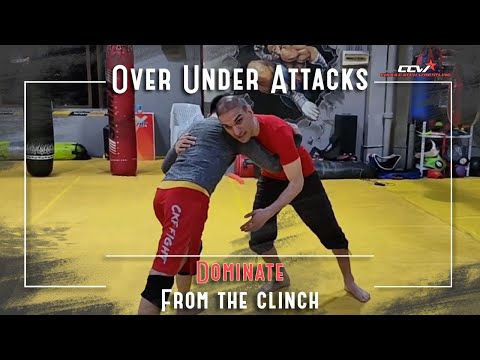
Over-Under Attacks - Dominate from the clinch
0
Over-Under Clinch·China Catch Wrestling
The Over-Under clinch is one of the most common positions you'll find yourself while wrestling — especially in Catch and…
Перевод: over-under clinch
The Over-Under Clinch family covers the clinch configuration where one arm has an underhook and the opposite arm has an overhook, creating a neutral or contested clinch position. [1] The over-under position is the most common clinch configuration in wrestling because it occurs naturally when both fighters simultaneously compete for underhooks and each succeeds on one side. [1],[2] The fighter with the stronger underhook side typically has a slight advantage, but the over-under position is fundamentally a battle of positioning where both fighters have offensive options. [2],[3]
The over-under clinch (one underhook, one overhook) is the most common neutral clinch position in wrestling and MMA, occurring naturally when both fighters compete for underhooks and each secures one. [1] Welker notes that the over-under position is where the majority of clinch exchanges take place in competitive wrestling, as both fighters work to convert to double underhooks. [1] Couture identifies it as the 'position of negotiation' in MMA clinch fighting. [2]
The over-under (fifty-fifty) clinch is a neutral position fundamental to wrestling and MMA clinch fighting. [1]
Изображений для этой техники пока нет.
Войдите, чтобы предложить изображение.
The Over-Under clinch is one of the most common positions you'll find yourself while wrestling — especially in Catch and…
Fighting from the over under clinch. 2 game plans to go from standing to the takedown, to the dominant position, to the …
Учебных курсов по этой технике пока нет.
Войдите, чтобы предложить курс.
Риск травмы для человека, к которому применяется техника
Upper body clinch positions for control and transitions
Уровень мастерства, необходимый для надёжного выполнения техники
Разрешена ли техника по основным соревновательным правилам
Freestyle Wrestling: A Complete Guide for Coaches and Wrestlers (Petrov, 1977)
Alias sources — [1] Wrestling Physical Conditioning Encyclopedia (Welker, 2010) [2] Wrestling Physical Conditioning Encyclopedia (Welker, 2010) [3] Wrestling for Fighting (Couture, 2007)
Effectiveness sources — [1] Wrestling Physical Conditioning Encyclopedia (Welker, 2010) [2] Clinch Fighting for MMA (Couture, 2011)
Standard katakana transliteration of Western martial arts terminology (外来語) — used in Japanese MMA, boxing, and BJJ communities
Alias sources — [1] Wrestling Physical Conditioning Encyclopedia (Welker, 2010) [2] Wrestling Physical Conditioning Encyclopedia (Welker, 2010) [3] Wrestling for Fighting (Couture, 2007)
Effectiveness sources — [1] Wrestling Physical Conditioning Encyclopedia (Welker, 2010) [2] Clinch Fighting for MMA (Couture, 2011)
swimming speed for inside position, shoulder drive, hip pressure
strong shoulders and low centre of gravity
deltoids, pectorals, core, quadriceps
Каждое движение в любом боевом искусстве обладает рядом универсальных свойств. Комбинируйте параметры ниже, чтобы найти нужный инструмент или сравнить аналоги из разных стилей.
The over-under clinch (one underhook, one overhook) is the most common neutral clinch in wrestling and MMA — neither fighter has a dominant position. From here, both fighters pummel for double underhooks or work for throws and takedowns. (Wrestling coaching manuals; The Ultimate MMA Training Guide)
According to Ramsey Dewey, you should feel how your opponent moves and adjust accordingly. If your opponent is not heavy and there's light pressure, you can be light too and pull out to set up a front headlock; the key is reading their weight and posture rather than committing to one technique.
China Catch Wrestling emphasizes that once you get your hand around their arm with their wrist touching your belly, you can step to the side and pull them down directly rather than dragging the arm sideways, and you should read their leg position—if their legs are back, pull in one direction; if forward, adjust your angle accordingly.
China Catch Wrestling explains that by being loose and letting your opponent react to your technique, you force them to consume their energy through constant reactions, whereas if they're tense they use power and speed which are energy-intensive—so control and positioning beats relying on athleticism.
China Catch Wrestling warns against letting your opponent's head pop out into a seated guard position; instead, stay heavy on them and consider taking the back, or use a wizard position on the other side rather than allowing them to establish a defensive sitting guard.
The Over-Under Clinch family covers the clinch configuration where one arm has an underhook and the opposite arm has an overhook, creating a neutral or contested clinch position. The over-under position is the most common clinch configuration in wrestling because it occurs naturally when both fighters simultaneously compete for underhooks and each succeeds on one side.
The over-under clinch has been a fundamental wrestling position since the sport's codification, representing the natural equilibrium when two skilled clinch fighters engage. It remains the most commonly occurring clinch configuration in both wrestling and MMA competition.
Unified MMA: разрешён — Legal — clinching is integral to MMA; IJF: разрешён — Legal — kumi-kata (grip fighting) is fundamental to judo; IBJJF: разрешён — Legal — standing grip fighting and clinch work permitted; IFMA: разрешён — Legal — the clinch is a core element of Muay Thai, clinch dominance is highly…; WBC/Boxing: ограничен — Holding is technically a foul — referee breaks clinch, excessive holding resu…; K: ограничен — 1/GLORY — One attack from clinch allowed, then referee breaks; WAKO: ограничен — Clinch generally broken by referee — limited or no clinch fighting in most fo…; UWW: разрешён — Legal — clinch is fundamental to wrestling, the primary position in Greco-Roman
Оценка опасности 4/10. Moderate — upper body clinch positions for control and transitions
Стандартная цепочка подготовки: Close Distance → Establish Primary Grip → Position the Hips → Apply Pressure.
Стандартные контрприёмы: Pummeling — fight for inside position by swimming arms under opponent's grips / Frame and Push — create distance using forearm frames against the chest or neck / Grip Break — systematically strip the opponent's controlling grips / Posture Up — straighten the spine and drive the hips forward to break clinch control.
Распространённые варианты: Single underhook (one arm inside for angle and control); Double underhooks (both arms inside for maximum inside position); Underhook with collar tie (combining the underhook with head control).
The over-under clinch (one overhook, one underhook) is the most common asymmetric clinch position in MMA and wrestling. It occurs in virtually every UFC event and is a frequent starting position in freestyle wrestling tie-ups.
Основные ошибки, на которые стоит обратить внимание: Staying in over-under without pummelling — both fighters should be constantly fighting to upgrade their overhook to a… / Not attacking from the underhook side — the underhook gives you offensive initiative; use it / Accepting the over-under as a resting position — it's a transitional position that should lead to action / Not using the head for advantage — head inside on the underhook side is crucial.
Over-Under Clinch также известен как Ōbā Andā Kurinchi, Fifty-Fifty, Over-Under Position, Over Under Tie.