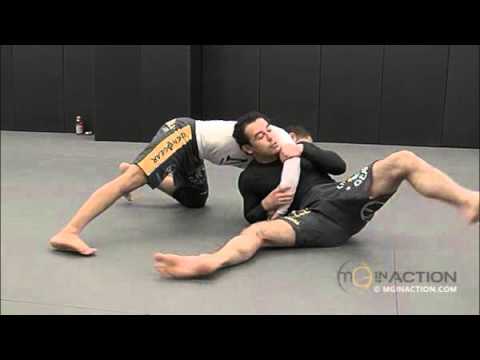
Guillotine/Marcelotine vs front headlock/sprawl
0
Sprawl Front Headlock·JM Modern Jiu Jitsu
For more exclusive content, sign up at http://www.jmmodernjj.com/
Перевод: sprawl front headlock
The Sprawl Front Headlock subfamily covers the front headlock position established after sprawling on an opponent's takedown attempt, where the attacker has driven their hips back and down to stuff the shot and ended up with the opponent's head trapped under the armpit. [1] The sprawl creates a powerful top position where the attacker's weight is distributed forward onto the opponent, and the headlock provides direct head and neck control. [1],[2] From the sprawl headlock, the attacker can transition to go-behinds, snap the opponent to the mat, or set up front headlock submissions. [2],[3]
The sprawl-to-front-headlock transition is a fundamental defensive wrestling sequence that has been taught since the formalisation of competitive wrestling. [1] The sequence became even more critical in MMA where the sprawl headlock serves as the entry point for guillotine and anaconda choke attacks. [2],[3]
The sprawl front headlock combines the defensive sprawl with offensive head control, creating a dominant position for snap-downs and submissions. [1]
Developed in wrestling and adapted into MMA and BJJ for submission attacks. [1]
Изображений для этой техники пока нет.
Войдите, чтобы предложить изображение.
For more exclusive content, sign up at http://www.jmmodernjj.com/
The Sprawl Front Headlock subfamily encompasses submission finishes executed after successfully defending a takedown attempt and establishing control of the opponent's head in a flattened, advantageous position. The unifying principle is positional dominance achieved through sprawl mechanics—spreading the hips backward and extending the legs to prevent the opponent from completing a clinch takedown—which naturally places the defender's upper body in proximity to the opponent's head and neck. Practitioners choose variants based on arm positioning, opponent resistance patterns, and the specific submission target. Just Train emphasizes fundamental control sequencing: isolating both arms from the neck, maintaining a low base with elbows tight, and methodically transitioning from head control into a squeeze position before connecting both hands on the opponent's shoulder. JM Modern Jiu Jitsu introduces a critical technical distinction in finish mechanics, particularly the Marcelotine variation: the placement of the ankle to catch the opponent's elbow—rather than simply stacking the leg on top—creates a mechanically superior finish that prevents roll-out escapes and maintains control regardless of opponent movement. Both instructors address escape considerations: Just Train warns against lingering in the initial position, while JM Modern Jiu Jitsu details alternative finishes (arm triangle variations) when initial grip comfort is compromised, demonstrating that successful practitioners maintain multiple submission threats within the same positional framework.
Сформировано на основе 2 инструкторов
Учебных курсов по этой технике пока нет.
Войдите, чтобы предложить курс.
Риск травмы для человека, к которому применяется техника
Head/neck control positions create cervical strain; Muay Thai plum is primary striking platform
Уровень мастерства, необходимый для надёжного выполнения техники
Разрешена ли техника по основным соревновательным правилам
Freestyle Wrestling: A Complete Guide for Coaches and Wrestlers (Petrov, 1977)
Alias sources — [1] Wrestling Physical Conditioning Encyclopedia (Welker, 2010) [2] Clinch Fighting for MMA (Couture, 2011) [3] NCAA Wrestling Rules and Interpretations (NCAA, 2020)
Effectiveness sources — [1] Wrestling Physical Conditioning Encyclopedia (Petrov, 1977)
Standard katakana transliteration of Western martial arts terminology (外来語) — used in Japanese MMA, boxing, and BJJ communities
Alias sources — [1] Wrestling Physical Conditioning Encyclopedia (Welker, 2010) [2] Clinch Fighting for MMA (Couture, 2011) [3] NCAA Wrestling Rules and Interpretations (NCAA, 2020)
Effectiveness sources — [1] Wrestling Physical Conditioning Encyclopedia (Petrov, 1977)
downward pressure, grip strength, sprawl endurance
strong upper body, heavy chest for top pressure
deltoids, biceps, pectorals, core, hip extensors
Каждое движение в любом боевом искусстве обладает рядом универсальных свойств. Комбинируйте параметры ниже, чтобы найти нужный инструмент или сравнить аналоги из разных стилей.
The sprawl to front headlock is the standard defensive transition after stuffing a takedown. Documented in every wrestling and MMA manual as the first counter-wrestling skill taught. (1943 US Navy H2H Combat manual; Coaching Wrestling Successfully, Gable)
According to JM Modern Jiu Jitsu, catching and controlling the elbow with proper leg placement is the critical detail—it makes the position very difficult to escape, though it requires forethought to set up correctly.
Keep a firm grip on the outside and don't let go, as releasing will allow your opponent to get away; additionally, keep the wrist open and the position deep to make it harder for them to peel off your grip.
According to Just Train, once you establish the front headlock, look for an opening on the opponent's neck—once you see that gap, you can transition to the guillotine by pulling your wrist against their neck.
Just Train emphasizes not staying in the initial front headlock position too long, as you want to transition before your opponent has time to escape.
The Sprawl Front Headlock subfamily covers the front headlock position established after sprawling on an opponent's takedown attempt, where the attacker has driven their hips back and down to stuff the shot and ended up with the opponent's head trapped under the armpit. The sprawl creates a powerful top position where the attacker's weight is distributed forward onto the opponent, and the headlock provides direct head and neck control.
The sprawl-to-front-headlock transition is a fundamental defensive wrestling sequence that has been taught since the formalisation of competitive wrestling. The sequence became even more critical in MMA where the sprawl headlock serves as the entry point for guillotine and anaconda choke attacks.
Unified MMA: разрешён — Legal — clinching is integral to MMA; IJF: разрешён — Legal — kumi-kata (grip fighting) is fundamental to judo; IBJJF: разрешён — Legal — standing grip fighting and clinch work permitted; IFMA: разрешён — Legal — the clinch is a core element of Muay Thai, clinch dominance is highly…; WBC/Boxing: ограничен — Holding is technically a foul — referee breaks clinch, excessive holding resu…; K: ограничен — 1/GLORY — One attack from clinch allowed, then referee breaks; WAKO: ограничен — Clinch generally broken by referee — limited or no clinch fighting in most fo…; UWW: разрешён — Legal — clinch is fundamental to wrestling, the primary position in Greco-Roman
Оценка опасности 5/10. High — head/neck control positions create cervical strain; Muay Thai plum is primary striking platform
Стандартная цепочка подготовки: Close Distance → Establish Primary Grip → Position the Hips → Apply Pressure.
Стандартные контрприёмы: Pummeling — fight for inside position by swimming arms under opponent's grips / Frame and Push — create distance using forearm frames against the chest or neck / Hand Fight — strip grips by peeling fingers or pushing the wrist away / Level Change — change levels to break the collar tie angle and attack the legs.
Распространённые варианты: Standard front headlock (arm wrapped around the head from the front); Front headlock with arm (controlling the head and one arm (head-and-arm position)); Short choke front headlock (tight headlock seeking a guillotine or snap-down).
The sprawl to front headlock is one of the most common defensive transitions in MMA and wrestling, used after defending a takedown to establish a controlling position for snapdowns, guillotines, and anaconda chokes.
Основные ошибки, на которые стоит обратить внимание: Sprawling without immediately securing the head — a sprawl without the headlock gives the opponent a chance to recover / Sprawling onto the opponent's back instead of beside their head — your hips sprawl back, your chest goes on their head / Not controlling the near arm after the sprawl — the opponent can circle out or roll if the arm is free / Standing up from the sprawl instead of maintaining the low, heavy position — stay heavy on the opponent.
Sprawl Front Headlock также известен как Supurōru Furonto Heddo Rokku, Sprawl Headlock, Sprawl Front Chancery, Sprawl Head-And-Arm.