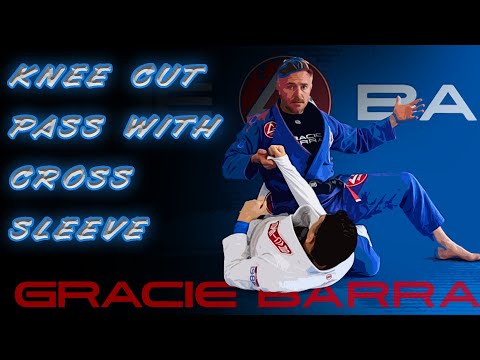
Knee Cut Pass With The Cross Sleeve Grip
0
Cross-Sleeve Grip·Gracie Barra Roundhay Leeds
Hope you enjoy it! If you have any question message us on social: Instagram - https://www.instagram.com/gracie_barr...…
Перевод: cross-sleeve grip
The Cross-Sleeve Grip subfamily covers positions where the attacker reaches across to grip the opponent's far sleeve, controlling the distant arm at an angle that is mechanically disadvantageous for the defender. [1] The cross-sleeve grip isolates the far arm and creates a diagonal pulling line that can be used to off-balance the opponent or set up techniques that exploit the far-side arm control. [1],[2] This grip is commonly combined with a standard collar grip to create an asymmetric control that opens the opponent's body for attacks. [2],[3]
The cross-sleeve grip controls the opponent's far sleeve, restricting their dominant-side attacks. [1]
Cross-sleeve gripping is a tactical variation in judo kumi-kata. [1]
Изображений для этой техники пока нет.
Войдите, чтобы предложить изображение.
Hope you enjoy it! If you have any question message us on social: Instagram - https://www.instagram.com/gracie_barr...…
Учебных курсов по этой технике пока нет.
Войдите, чтобы предложить курс.
Риск травмы для человека, к которому применяется техника
Grip fighting is primarily positional; finger/wrist strain risk
Уровень мастерства, необходимый для надёжного выполнения техники
Разрешена ли техника по основным соревновательным правилам
Freestyle Wrestling: A Complete Guide for Coaches and Wrestlers (Petrov, 1977)
Alias sources — [1] Kodokan Judo (Kano, 1986) [2] Kodokan New Japanese-English Dictionary of Judo (IJF, 2000) [3] Best Judo (Inokuma & Sato, 1979)
Effectiveness sources — [1] Kodokan Judo (Kano, 1986)
Standard katakana transliteration of Western martial arts terminology (外来語) — used in Japanese MMA, boxing, and BJJ communities
Alias sources — [1] Kodokan Judo (Kano, 1986) [2] Kodokan New Japanese-English Dictionary of Judo (IJF, 2000) [3] Best Judo (Inokuma & Sato, 1979)
Effectiveness sources — [1] Kodokan Judo (Kano, 1986)
grip strength, upper body endurance, balance under pressure
strong arms and shoulders, stable base
forearms, deltoids, core, hip muscles
Каждое движение в любом боевом искусстве обладает рядом универсальных свойств. Комбинируйте параметры ниже, чтобы найти нужный инструмент или сравнить аналоги из разных стилей.
Get your hip behind their arm as you execute the knee cut pass—this positioning makes it very hard for them to reclaim the arm even if you lose the initial grip. According to Gracie Barra Roundhay Leeds instruction, once they do reclaim it, you hide your head underneath into side control while using your hip-side hand to dominate the hip position.
Keep your elbows in, not out—Gracie Barra Roundhay Leeds emphasizes that elbows in make you stronger and prevent your opponent from dragging you across and starting to take your arm.
Grab a full fist of gear on the sleeve and keep your grip tight and secure. Gracie Barra Roundhay Leeds stresses not leaning too far forward, as this allows your opponent to cross with you and start working against your grip.
The Cross-Sleeve Grip subfamily covers positions where the attacker reaches across to grip the opponent's far sleeve, controlling the distant arm at an angle that is mechanically disadvantageous for the defender. The cross-sleeve grip isolates the far arm and creates a diagonal pulling line that can be used to off-balance the opponent or set up techniques that exploit the far-side arm control.
Cross-sleeve gripping developed as a tactical variation within judo's kumi-kata system, offering an alternative to standard same-side sleeve control. The grip has become more prevalent in modern competition as athletes seek creative gripping solutions to overcome opponents' defences.
Unified MMA: разрешён — Legal — clinching is integral to MMA; IJF: разрешён — Legal — kumi-kata (grip fighting) is fundamental to judo; IBJJF: разрешён — Legal — standing grip fighting and clinch work permitted; IFMA: разрешён — Legal — the clinch is a core element of Muay Thai, clinch dominance is highly…; WBC/Boxing: ограничен — Holding is technically a foul — referee breaks clinch, excessive holding resu…; K: ограничен — 1/GLORY — One attack from clinch allowed, then referee breaks; WAKO: ограничен — Clinch generally broken by referee — limited or no clinch fighting in most fo…; UWW: разрешён — Legal — clinch is fundamental to wrestling, the primary position in Greco-Roman
Оценка опасности 2/10. Low — grip fighting is primarily positional; finger/wrist strain risk
Стандартная цепочка подготовки: Close Distance → Establish Primary Grip → Position the Hips → Apply Pressure.
Стандартные контрприёмы: Pummeling — fight for inside position by swimming arms under opponent's grips / Frame and Push — create distance using forearm frames against the chest or neck / Grip Break — systematically strip the opponent's controlling grips / Posture Up — straighten the spine and drive the hips forward to break clinch control.
Распространённые варианты: Standard variation (primary clinch configuration from the most common entry); Gi variation (adapted with collar and sleeve grips for gi-based grappling); No-gi / MMA variation (modified for no-gi or cage fighting conditions); Offensive variation (configured to set up strikes, takedowns, or submissions f…).
Cross-sleeve gripping is a key kumi-kata strategy in judo competition, controlling the opponent's attacking arm while creating angular advantages for foot sweeps and sacrifice throws. It is also used in gi BJJ to set up guard pulls and sweeps.
Основные ошибки, на которые стоит обратить внимание: Reaching for the far sleeve without a setup — the opponent easily defends the long-distance reach / Gripping the far sleeve without controlling the near side — you're committed across their body with your near side open / Pulling the sleeve straight toward you instead of across the opponent's body — the cross-body pull is what creates th… / Using a weak grip on the far sleeve — grip the cuff firmly for maximum arm control.
Cross-Sleeve Grip также известен как Kurosu Surību Gurippu, Cross Sleeve Grab, Gyaku-Sode-Kumi, Opposite Sleeve Grip.