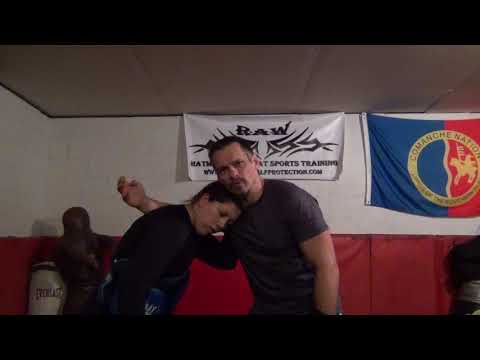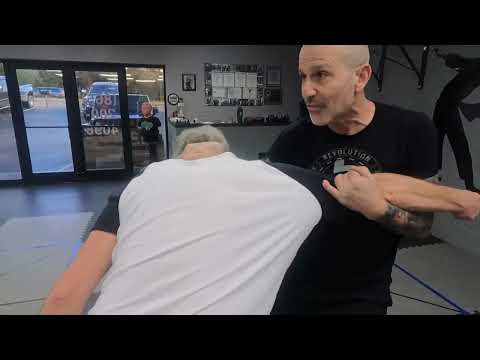
Control Clinch for the street!
0
Clinch Control·Rev Krav Maga
If you have already verbally told someone to stay back with authority and have body language that matches your demeanor.…
Перевод: Clinch control
The Clinch Control family covers techniques for establishing and maintaining dominant control positions in the clinch — the grip configurations, body positions, and pummeling strategies that determine who dictates the action in close-range standing grappling. [1] Clinch control is the 'grip fighting' of standing grappling — the fighter who achieves superior inside position (double underhooks), head positioning, and hip placement controls whether the exchange results in strikes, takedowns, throws, or disengagement. [1],[2] Key clinch control positions include the double underhook (the most dominant clinch position), the Muay Thai plum (double collar tie for knee strikes), the over-under (50/50 neutral position), and the body lock (arms encircling the torso for throws and takedowns). [2],[3] Pummeling — the constant inside-outside arm fighting to gain underhook position — is the fundamental skill that determines clinch control outcomes. [3]
Clinch control techniques have been central to combat sports since ancient wrestling traditions. [1] Greco-Roman wrestling developed the most sophisticated upper-body clinch control system, while Muay Thai refined the plum clinch over centuries of Thai boxing tradition. [1],[2] Judo's kumi kata (grip fighting) represents perhaps the most detailed study of standing grip strategy ever codified. [2],[3]
Clinch control determines the outcome of close-range exchanges — the fighter who wins the clinch dictates where the fight takes place. [1] In Greco-Roman wrestling, clinch control is the entire sport. In Muay Thai, plum clinch specialists like Dieselnoi dominated through clinch control alone. [2],[3]
Изображений для этой техники пока нет.
Войдите, чтобы предложить изображение.
If you have already verbally told someone to stay back with authority and have body language that matches your demeanor.…
Mark Hatmaker discusses Single-Underhook Clinch control. Details and drills on ESP RAW DVD 183 available only on our si…
Учебных курсов по этой технике пока нет.
Войдите, чтобы предложить курс.
Риск травмы для человека, к которому применяется техника
Clinch control positions themselves are relatively safe; the risk comes from the offensive techniques launched from the clinch (throws, knees, elbows, takedowns)
Уровень мастерства, необходимый для надёжного выполнения техники
Разрешена ли техника по основным соревновательным правилам
Wrestling for Fighting (Ben Askren, 2019)
Description sources — [1] Wrestling for Fighting (Askren, 2019) [2] Muay Thai: The Art of Eight Limbs (Kraitus, 1988) [3] Kodokan Judo (Kano, 1986) on kumi kata
Official Kodokan ground technique classification system
Description sources — [1] Wrestling for Fighting (Askren, 2019) [2] Muay Thai: The Art of Eight Limbs (Kraitus, 1988) [3] Kodokan Judo (Kano, 1986) on kumi kata
upper body strength (pummeling), core stability (resisting pushes and pulls), cardio endurance (clinch fighting is exhausting)
shorter stocky build (lower centre of gravity), strong neck (resisting collar ties), long arms (body locks)
shoulders and chest (pummeling), biceps (pulling), forearms (grip), core (rotational stability)
Каждое движение в любом боевом искусстве обладает рядом универсальных свойств. Комбинируйте параметры ниже, чтобы найти нужный инструмент или сравнить аналоги из разных стилей.
According to Mark Hatmaker, position the top of your head (not the hairline or back of the head) directly into your opponent's carotid artery. Keep your head at this height consistently—don't slide it higher over the top or lower into the chest, as this positioning sets up chokes, cranks, and guillotine submissions.
Mark Hatmaker teaches that your free hand should stay up with the palm open to monitor your opponent's movement rather than immediately grabbing their hand. This hand monitors defensively—if your opponent reaches or swings, you can push on their chest and slide down their bicep.
The Clinch Control family covers techniques for establishing and maintaining dominant control positions in the clinch — the grip configurations, body positions, and pummeling strategies that determine who dictates the action in close-range standing grappling. Clinch control is the 'grip fighting' of standing grappling — the fighter who achieves superior inside position (double underhooks), head positioning, and hip placement controls whether the exchange results in strikes, takedowns, throws, or disengagement.
Clinch control techniques have been central to combat sports since ancient wrestling traditions. Greco-Roman wrestling developed the most sophisticated upper-body clinch control system, while Muay Thai refined the plum clinch over centuries of Thai boxing tradition.
Unified MMA: разрешён — Legal — clinching is integral to MMA; IJF: разрешён — Legal — kumi-kata (grip fighting) is fundamental to judo; IBJJF: разрешён — Legal — standing grip fighting and clinch work permitted; IFMA: разрешён — Legal — the clinch is a core element of Muay Thai, clinch dominance is highly…; WBC/Boxing: ограничен — Holding is technically a foul — referee breaks clinch, excessive holding resu…; K: ограничен — 1/GLORY — One attack from clinch allowed, then referee breaks; WAKO: ограничен — Clinch generally broken by referee — limited or no clinch fighting in most fo…; UWW: разрешён — Legal — clinch is fundamental to wrestling, the primary position in Greco-Roman
Оценка опасности 3/10. Low — clinch control positions themselves are relatively safe; the risk comes from the offensive techniques launched from the clinch (throws, knees, elbows, takedowns)
Стандартная цепочка подготовки: Close Distance → Establish Contact → Pummel → Achieve Dominant Clinch → Execute → Disengage or Maintain.
Стандартные контрприёмы: Frame and Circle — forearm frames while circling away to break the clinch / Underhook Counter (Whizzer) — overhook with hip pressure against the underhook / Snap-Down — snapping the head down from collar tie to break posture / Level Change — dropping under the tie-ups for a takedown.
Распространённые варианты: Double underhooks (both arms under the opponent's arms, hands clasped behind…); Single collar tie (one hand on the back of the neck, one arm free for striki…); Muay Thai plum (double collar tie) (both hands clasped behind the head, elbows tight; for kne…); Over-under (50/50) (one underhook, one overhook each; neutral position where …); Body lock (arms locked around the opponent's torso; for lifts, throw…); Russian tie (two-on-one) (controlling one of the opponent's arms with both hands; c…); Wrist control (controlling one or both wrists to prevent grips and creat…).
Clinch control is central to Greco-Roman wrestling (entire bouts in the clinch), Muay Thai (clinch exchanges determine many fights), and MMA (cage clinch is a major strategic component).
Основные ошибки, на которые стоит обратить внимание: Reaching for grips with arms extended — extended arms are weak and easily redirected; enter the clinch with elbows tight / Head on the outside — places your head on the vulnerable side for front headlocks and snap-downs / Standing upright without hip engagement — tall posture loses the leverage battle; bend knees slightly and drive from … / Over-committing to double underhooks — fighting desperately for both often results in being dragged off-balance.
Clinch Control также известен как Kurinchi Kontorōru, Clinch Position Control, Clinch Tie-Up, Standing Control.